atom
Americannoun
-
atoms
plural
-
Physics.
-
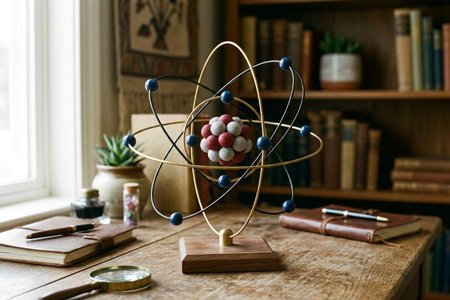
the smallest component of an element having the chemical properties of the element, consisting of a nucleus containing combinations of neutrons and protons and one or more electrons bound to the nucleus by electrical attraction; the number of protons determines the identity of the element.
-
an atom with one of the electrons replaced by some other particle.
muonic atom;
kaonic atom.
-
-
Energy. this component as the source of nuclear energy.
-
a hypothetical particle of matter so minute as to admit of no division.
-
anything extremely small; a minute quantity.
noun
-
-
the smallest quantity of an element that can take part in a chemical reaction
-
this entity as a source of nuclear energy See also atomic structure
the power of the atom
-
-
any entity regarded as the indivisible building block of a theory
-
the hypothetical indivisible particle of matter postulated by certain ancient philosophers as the fundamental constituent of matter See also atomism
-
a very small amount or quantity; minute fragment
to smash something to atoms
there is not an atom of truth in his allegations
-
The smallest unit of an element, consisting of at least one proton and (for all elements except hydrogen) one or more neutrons in a dense central nucleus, surrounded by one or more shells of electrons. In electrically neutral atoms, the number of protons equals the number of electrons. Atoms remain intact in chemical reactions except for the removal, transfer, or exchange of certain electrons.
Discover More
Atoms link together to form molecules.
Other Word Forms
Noun Inflected Forms
Etymology
Origin of atom
First recorded in 1350–1400; Middle English attomos, athomus, from Latin atomus, from Greek átomos, noun use of átomos “undivided,” equivalent to a- a- 6 + tomós “divided,” from témnein “to cut”
Explanation

An atom is the basic unit of an element. When you see the chemical formula for water, H2O, it's telling you that each molecule of water is made up of two atoms of hydrogen and one atom of oxygen. In science class, you've probably come across atoms, the bits that make up molecules. Less scientifically, the word atom can also mean a very small piece of anything at all. The Greek root of atom is atomos, which means "indivisible," since the scientists who first gave the atom its name imagined it couldn't be split or divided into smaller pieces. Even though we know there are smaller things that make up an atom (protons, neutrons and electrons), it's still a good way to think about the word atom.
Vocabulary lists containing atom
Quantum of Vocabulary: the Parlance of Particle Physics
Looking to grow your vocabulary? Check out this interactive, curated word list from our team of English language specialists at Vocabulary.com – one of over 17,000 lists we've built to help learners worldwide!
Word Generation Science - Introductory Chemistry Concepts
Interested in learning more words like this one? Our team at Vocabulary.com has got you covered! You can review flashcards, quiz yourself, practice spelling, and more – and it's all completely free to use!
Matter and Energy 1: Atoms and Molecules
Want to remember this word for good? Start your learning journey today with our library of interactive, themed word lists built by the experts at Vocabulary.com – we'll help you make the most of your study time!
Example Sentences
Examples are provided to illustrate real-world usage of words in context. Any opinions expressed do not reflect the views of Dictionary.com.
See Examples For:
Before testing the first atom bomb, the Los Alamos crew asked Hans Bethe to confirm with math that it wouldn’t start a chain reaction and consume the atmosphere.
From The Wall Street Journal ● Sep. 18, 2026

"The exotic muonium is very well suited to this because it is a neutral atom," explains Soter: "After all, to make something fall, you need something neutral."
From Science Daily ● Sep. 18, 2026

The atoms were manipulated near the surface of a specially designed atom chip.
From Science Daily ● Sep. 8, 2026
To see how the enzyme handles synthetic genetic information, the team combined biochemical experiments with high-resolution cryo-electron microscopy capable of revealing structures at scales smaller than the width of a single atom.
From Science Daily ● Sep. 5, 2026
Elements are defined by the number of protons in their nucleus—all oxygen atoms have eight, and if an atom has six protons, it’s carbon—but the number of neutrons can vary.
From "Meltdown" by Deirdre Langeland

"In this case, 'cold' means that the atoms propagate at similar speeds, almost parallel to one another."
From Science Daily ● Sep. 18, 2026
"Superfluid helium is what is known as a quantum fluid, in which the individual helium atoms lose their identity, and which does not tolerate any impurities within it."
From Science Daily ● Sep. 18, 2026
The issue centers on the inductive effect, a fundamental idea in structural organic chemistry used to describe how atoms influence the distribution of electrons within molecules.
From Science Daily ● Sep. 14, 2026
At the same time, sophisticated computer simulations followed individual atoms and ions as they moved around the DNA.
From Science Daily ● Sep. 10, 2026
That causes it to fission, breaking apart into two smaller atoms.
From "Meltdown" by Deirdre Langeland
Definitions and idiom definitions from Dictionary.com Unabridged, based on the Random House Unabridged Dictionary, © Random House, Inc. 2023
Idioms from The American Heritage® Idioms Dictionary copyright © 2002, 2001, 1995 by Houghton Mifflin Harcourt Publishing Company. Published by Houghton Mifflin Harcourt Publishing Company.
