
desert
1 Americannoun
-
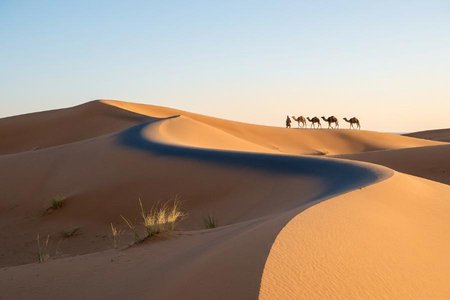
a region so arid because of little rainfall that it supports only sparse and widely spaced vegetation or no vegetation at all.
The Sahara is a vast sandy desert.
-
any area in which few forms of life can exist because of lack of water, permanent frost, or absence of soil.
- Synonyms:
- wasteland
-
an area of the ocean in which it is believed no marine life exists.
-
(formerly) any unsettled area between the Mississippi and the Rocky Mountains thought to be unsuitable for human habitation.
-
any place lacking in something.
The town was a cultural desert.
- Synonyms:
- wasteland
verb (used with object)
-
deserts,
present (3rd person singular)
-
deserted,
past participle, past
-
deserting
present participle
-
to leave (a person, place, etc.) without intending to return, especially in violation of a duty, promise, or the like.
He deserted his wife.
-
(of military personnel) to leave or run away from (service, duty, etc.) with the intention of never returning.
Terrified of the approaching battle, he deserted his post just before dawn.
-
to fail (someone) at a time of need.
None of his friends had deserted him.
verb (used without object)
-
deserts,
present (3rd person singular)
-
deserted,
past participle, past
-
deserting
present participle
noun
-
Usually deserts reward or punishment that is deserved.
Death was his desert.
- Synonyms:
- justice, reward, recompense, payment, due, penalty, retribution, retaliation
-
the state or fact of deserving reward or punishment.
-
the state or condition of being worthy, as in character or behavior.
idioms
noun
-
(often plural) something that is deserved or merited; just reward or punishment
-
the state of deserving a reward or punishment
-
virtue or merit
noun
-
a region that is devoid or almost devoid of vegetation, esp because of low rainfall
-
an uncultivated uninhabited region
-
a place which lacks some desirable feature or quality
a cultural desert
-
(modifier) of, relating to, or like a desert; infertile or desolate
verb
-
(tr) to leave or abandon (a person, place, etc) without intending to return, esp in violation of a duty, promise, or obligation
-
military to abscond from (a post or duty) with no intention of returning
-
(tr) to fail (someone) in time of need
his good humour temporarily deserted him
-
(tr) Scots law to give up or postpone (a case or charge)
Synonym Usage
Desert, waste, wilderness refer to areas that are largely uninhabited. Desert emphasizes lack of water (though not specifically high temperature); it refers to a dry, barren, treeless region, usually sandy: a high-altitude frozen desert. Waste emphasizes lack of inhabitants and of cultivation; it is used of wild, barren land: a desolate waste. Wilderness emphasizes the difficulty of finding one's way, whether because of barrenness or of dense vegetation: a trackless wilderness.
Desert, abandon, forsake mean to leave behind persons, places, or things. Desert implies intentionally violating an oath, formal obligation, or duty: to desert campaign pledges. Abandon suggests giving up wholly and finally, whether of necessity, unwillingly, or through shirking responsibilities: to abandon a hopeless task; abandon a child. Forsake has emotional connotations, since it implies violating obligations of affection or association: to forsake a noble cause.
Desert, merit, worth refer to the quality in a person, action, or thing that entitles recognition, especially favorable recognition. Desert is the quality that entitles one to a just reward: according to her deserts. Merit is usually the excellence that entitles to praise: a person of great merit. Worth is always used in a favorable sense and signifies inherent value or goodness: The worth of your contribution is incalculable.
Closer Look
A desert is defined not by temperature but by the sparse amount of water found in a region. An area with an annual rainfall of fewer than 25 centimeters (9.75 inches) generally qualifies as a desert. In spite of the dryness, however, some animals and plants have adapted to desert life and thrive in these harsh environments. While different animals live in different types of deserts, the dominant animals of warm deserts are reptiles, including snakes and lizards, small mammals, such as ground squirrels and mice, and arthropods, such as scorpions and beetles. These animals are usually nocturnal, spending the day resting in the shade of plants or burrowed in the ground, and emerging in the evenings to hunt or eat. Warm-desert plants are mainly ground-hugging shrubs, small wooded trees, and cacti. Plant and animal life is scarcer in the cool desert, where the precipitation falls mainly as snow. Plants are generally scattered mosses and grasses that are able to survive the cold by remaining low to the ground, avoiding the wind, and animal life can include both large and small mammals, such as deer and jackrabbits, as well as a variety of raptors and other birds.
Pop Culture
— Desert : A novel by Jean-Marie Gustave Le Clézio, winner of the Nobel Prize in Literature in 2008. The book, first published in French in 1980, was translated into English in 2009. — Operation Desert Storm: An air campaign by the U.S. during the 1990–91 Gulf War. — Conflict: Desert Storm: The first in the Conflict series of video games by game developers Pivotal Games. Released in 2002, it is set during the 1990–91 Gulf War.
Other Word Forms
Derived Forms
-
desertednessnoun
-
deserternoun
-
desertedadjective
-
deserticadjective
-
desertlikeadjective
-
desertedlyadverb
Inflected Forms
Participles
Conjugated Forms
Present
-
desertsimple
-
desertssimple
-
have desertedperfect
-
has desertedperfect
-
am desertingprogressive
-
are desertingprogressive
-
is desertingprogressive
-
have been desertingperfect progressive
-
has been desertingperfect progressive
Past
-
desertedsimple
-
had desertedperfect
-
was desertingprogressive
-
were desertingprogressive
-
had been desertingperfect progressive
Future
Etymology
Origin of desert1
First recorded in 1250–1300; Middle English adjective desert, deserd, diserte “barren, unproductive, dried up (lake), deserted (city),” from Anglo-French, Old French des(s)ert “uncultivated; without inhabitants,” from Late Latin dēsertum (neuter), noun use of past participle of Latin dēserere “to abandon, forsake,” equivalent to dē- prefix meaning “from, away from, out of ” + serere “to join together (in a line)”; see origin at de-, series
Origin of desert2
First recorded in 1470–80; from Middle French déserter, from Medieval Latin dēsertāre “to desert; lay waste,” frequentative of Latin dēserere “to part company, leave, forsake,” literally “to undo the links,” equivalent to dē- prefix meaning “from, away from” + serere “to link together, entwine, interlace”; see also desert 1
Origin of desert3
First recorded in 1275–1325; Middle English noun desert, deseert, decert(e), from Old French deserte, noun use of feminine past participle of deservir “to serve devotedly”; see origin at deserve
Explanation

A desert is a very dry area of land where few plants and animals can live. If you find yourself stranded in the middle of the desert, you'll have no company except for the occasional lizard or scorpion. Desert comes from the Latin desertus, for abandoned or lying in waste. This can refer to a vast sandy area without vegetation, or any empty, lifeless expanse. As a verb, it means to leave someone or something. A soldier who runs away from the army is called a deserter. Occasionally you'll hear someone say, "He got his just deserts," which doesn't have anything to do with abandonment; it means he got what he deserved.
Vocabulary lists containing desert
Physical Geography - Introductory
Looking to grow your vocabulary? Check out this interactive, curated word list from our team of English language specialists at Vocabulary.com – one of over 17,000 lists we've built to help learners worldwide!
Commonly Confused Words, List 1
Interested in learning more words like this one? Our team at Vocabulary.com has got you covered! You can review flashcards, quiz yourself, practice spelling, and more – and it's all completely free to use!
The American Civil War
Want to remember this word for good? Start your learning journey today with our library of interactive, themed word lists built by the experts at Vocabulary.com – we'll help you make the most of your study time!
Example Sentences
Examples are provided to illustrate real-world usage of words in context. Any opinions expressed do not reflect the views of Dictionary.com.
See Examples For:
The cafe is a cacophony of color in an expanse of desert brown.
From Los Angeles Times ● Sep. 22, 2026

The search for the source of the medbed conspiracy took me into the world of scammers and crystals and alien invasions and broken families and sci-fi movie sets and the Arizona desert.
From Slate ● Sep. 22, 2026

But one doesn’t have to be near the desert to hear the dissonance.
From Salon ● Sep. 21, 2026

Ron Bath was flying his RF-4 Phantom military jet at nearly 700 miles an hour over the Nevada desert when it smashed into a bird, destroying one of the engines and part of the wing.
From The Wall Street Journal ● Sep. 15, 2026

We had just gained some merchandise and survived the haunted desert.
From "The Many Assassinations of Samir, the Seller of Dreams" by Daniel Nayeri

Julian joins the Air Force out of boredom and deserts for the same reason.
From The Wall Street Journal ● Aug. 28, 2026
The findings come as ministers have pledged to tackle so-called "dental deserts", but dentists say the current deal is not viable.
From BBC ● Aug. 23, 2026

Today, many of the best places to conduct this work are deserts or Arctic landscapes.
From Science Daily ● Aug. 17, 2026

The view changes as the ship’s pilots deftly navigate worlds — or at least try to — like the metropolis of Coruscant and the deserts of Tatooine.
From Los Angeles Times ● Aug. 17, 2026
Those few peoples who remained hunter-gatherers into the 20th century escaped replacement by food producers because they were confined to areas not fit for food production, especially deserts and Arctic regions.
From "Guns, Germs, and Steel: The Fates of Human Societies" by Jared M. Diamond
But this isn’t just a deserted patch of sand.
From MarketWatch ● Sep. 1, 2026

But when he arrived, the business was deserted.
From Los Angeles Times ● Aug. 29, 2026
“The Dog Stars” takes place in a wrecked, deserted 2035, after a viral plague has killed almost everybody on Earth.
From The Wall Street Journal ● Aug. 27, 2026
AFP saw walkways, sun loungers and a restaurant terrace at the hotel deserted.
From Barron's ● Jul. 31, 2026

The roads were deserted as we set out; we passed only two other cars all the way to the rendezvous spot with the car from Haarlem.
From "The Hiding Place" by Corrie ten Boom
In recent years, the number of Kiwis deserting the nation has reached record levels, a large chunk of them moving "across the ditch" to Australia.
From BBC ● Mar. 2, 2026
But a major reason for voters deserting the party in past elections was inflation, an unwelcome phenomenon for households after several decades of stable or falling prices.
From Barron's ● Feb. 9, 2026
But the rate is half the national level for Californians under 35, and they are precisely the group that is deserting the West Coast for “cost of living” reasons.
From Los Angeles Times ● Feb. 18, 2025
But the Syrian army collapsed with surprising ease, with many troops deserting the battlefield, in the face of the HTS rebels’ onslaught.
From Slate ● Dec. 5, 2024
He had gone on by himself, deserting us, deserting me.
From "The Left Hand of Darkness" by Ursula K. Le Guin
Definitions and idiom definitions from Dictionary.com Unabridged, based on the Random House Unabridged Dictionary, © Random House, Inc. 2023
Idioms from The American Heritage® Idioms Dictionary copyright © 2002, 2001, 1995 by Houghton Mifflin Harcourt Publishing Company. Published by Houghton Mifflin Harcourt Publishing Company.
