bandanna
Americannoun
-
a large, printed handkerchief, typically one with white spots or figures on a red or blue background.
-
any large scarf for the neck or head.
noun
Usage
What does bandanna mean?
A bandanna is a type of large handkerchief, usually patterned and brightly colored. While used for many purposes, bandannas are commonly worn on the head, to hold back hair or absorb sweat, or around the neck to protect it from the sun. Today, bandannas are often printed with a distinctive paisley pattern, are square, are made from cotton, and come in a variety of colors. Historically, bandannas were patterned with white spots on a red or blue background. Such a bandanna—red with white spots—is featured in the “We Can Do It!” wartime poster from 1943 created by graphic designer J. Howard Miller for Westinghouse Electric to help boost morale for its workers during World War II. In popular culture, the iconic, bicep-flexing woman wearing the bandanna in the poster has become Rosie the Riveter, though she is not technically that original character.[caption id="attachment_152384" align="alignnone" width="232"]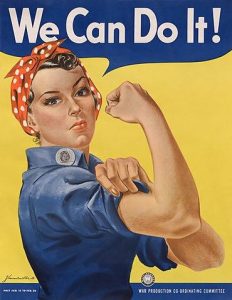 Wikimedia[/caption]Another notable bandanna in U. S. history dates back to the very founding of the country itself. At the request of Martha Washington, the printmaker John Hewson, fashioned a red-and-white bandana featuring George Washington on horseback, his sword drawn and encircled by the words “George Washington, Esq. Foundator and Protector of America's Liberty and Independency.”Indeed, as the Washington bandanna shows, this textile has a long history not just of fashion and function but also to signal various groups, identities, and causes. Different colored bandannas were displayed as sexual code in the 1970s gay culture. Different colored bandanas have also been used to represent various gang affiliations. Still, the bandanna remains a very practical item. During the 2020 coronavirus pandemic, many people used bandannas as makeshift, non-medical face masks to help prevent and protect themselves from the virus, which can spread through droplets expelled by coughing, sneezing, laughing, talking, and breathing.
Other Word Forms
Etymology
Origin of bandanna
1745–55; earlier bandanno (second syllable unstressed) < Hindi bā̃dhnū tie dyeing
Explanation

A bandanna is a square piece of cloth that can be used as a handkerchief or tied around your neck. When kids dress up as cowboys for Halloween, they often wear a bandanna. Most bandannas are brightly colored, with a printed paisley pattern, and they're commonly tied around the head or neck, rolled up or folded in half with one corner pointing down. You can use a bandanna as a headband, a handkerchief, a sweatband, or a napkin — but they're most often just worn as an accessory. The word bandanna, or bandana, comes from the Hindi bandhnu, a tie-dye style of dying fabric.
Vocabulary lists containing bandanna
2015 National Spelling Bee Words
Looking to grow your vocabulary? Check out this interactive, curated word list from our team of English language specialists at Vocabulary.com – one of over 17,000 lists we've built to help learners worldwide!
Texts about Hijab Controversy
Interested in learning more words like this one? Our team at Vocabulary.com has got you covered! You can review flashcards, quiz yourself, practice spelling, and more – and it's all completely free to use!
Example Sentences
Examples are provided to illustrate real-world usage of words in context. Any opinions expressed do not reflect the views of Dictionary.com.
When I spoke to her through Zoom, she was backlit by a shade-drawn window, her face weaving in and out of California shadow, a bandanna covering her dark hair.
From Los Angeles Times ● Sep. 9, 2026

The zippered pocket in the bandanna holds up to 2 pounds of ice that drips out through tiny holes in the neoprene fabric as it melts.
From The Wall Street Journal ● Jul. 21, 2026

At Parc de Bercy, Abdoulaye N. usually showed up on weekends, wearing a bandanna tied like an inverted headband and bringing fresh fruits for everybody, according to friends who trained with him.
From The Wall Street Journal ● Dec. 23, 2025
When Raul spotted me at day’s end, pink bandanna tied around my neck, he laughed.
From Los Angeles Times ● Nov. 30, 2025
“Whew,” he said, collapsing in my chair and mopping his forehead with a red bandanna.
From "The Secret History" by Donna Tartt

Random Word
Spin the wheel and learn a new word!
Get a wordDefinitions and idiom definitions from Dictionary.com Unabridged, based on the Random House Unabridged Dictionary, © Random House, Inc. 2023
Idioms from The American Heritage® Idioms Dictionary copyright © 2002, 2001, 1995 by Houghton Mifflin Harcourt Publishing Company. Published by Houghton Mifflin Harcourt Publishing Company.
