furnace
Americannoun
-
furnaces
plural
-
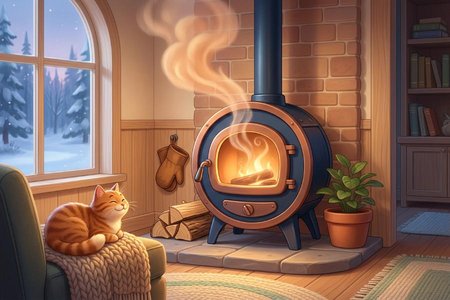
a structure or apparatus in which heat may be generated, as for heating houses, smelting ores, or producing steam.
-
a place characterized by intense heat.
The volcano was a seething furnace.
-
Astronomy. Furnace, the constellation Fornax.
verb (used with object)
noun
-
an enclosed chamber in which heat is produced to generate steam, destroy refuse, smelt or refine ores, etc
-
a very hot or stifling place
Other Word Forms
Derived Forms
Inflected Forms
Nouns
Etymology
Origin of furnace
First recorded in 1175–1225; Middle English furneis, furnais, from Old French fornais, fournais, from Latin fornāc- (stem of fornāx “kiln, oven”), akin to formus “warm”
Explanation

A furnace is an appliance that heats houses and buildings by burning fuel or circulating hot water. Your furnace might rumble in the basement, sending heat up through your house's radiators. Most houses in cold climates have a furnace, to warm their rooms during the chilly months of the year. Furnaces also have industrial uses, like burning trash or extracting ore from metal. If someone says, "It's as hot as a furnace in this classroom!" they mean that it's extremely hot. Furnace comes from the Old French fornaise, "oven," with the Latin root word fornacem, "oven or kiln."
Vocabulary lists containing furnace
Mockingbird
Looking to grow your vocabulary? Check out this interactive, curated word list from our team of English language specialists at Vocabulary.com – one of over 17,000 lists we've built to help learners worldwide!
Unit 4: Powerful Openings
Interested in learning more words like this one? Our team at Vocabulary.com has got you covered! You can review flashcards, quiz yourself, practice spelling, and more – and it's all completely free to use!
Unit 1, Words to Know
Want to remember this word for good? Start your learning journey today with our library of interactive, themed word lists built by the experts at Vocabulary.com – we'll help you make the most of your study time!
Example Sentences
Examples are provided to illustrate real-world usage of words in context. Any opinions expressed do not reflect the views of Dictionary.com.
See Examples For:
Once the writing was finished, Seiler, an affiliate of Berkeley SETI, rolled up the papyrus, sealed it inside a container, placed it in a high-temperature furnace, and burned it until it was thoroughly carbonized.
From Science Daily ● Sep. 26, 2026

In Pressure, Stagg is thrown into a high-stakes furnace of egos.
From BBC ● Sep. 7, 2026

"Every stage is crucial," explains master cymbalsmith Hasan Seker, a burly 56-year-old who co-founded Bosphorus Cymbals in 1996 and is sweating after hauling glowing blanks into and out of the furnace.
From Barron's ● Aug. 6, 2026

“There was this weird vent, a furnace return, and a tiny cabinet with a door above it,” said Pete Lauenstein.
From Los Angeles Times ● Jul. 21, 2026

Dad takes in a heaping forkful of squash and chews it like a furnace.
From "It’s Kind of a Funny Story" by Ned Vizzini

"All the equipment has been almost completely destroyed. There are no windows left, and there are holes in the roofs. The blast furnaces have been almost completely ruined," Maksyshko complains.
From BBC ● Sep. 29, 2026
The company expects to build plants at the site to process the ore for use in electric arc furnaces with scrap steel to make new steel.
From The Wall Street Journal ● Sep. 28, 2026

Italy's government says the country's largest steel works must be converted to electric after a court-ordered shutdown of polluting furnaces but, as Rome seeks a buyer, critics say its plan is woefully unsubstantiated.
From Barron's ● Sep. 17, 2026
At 19, Pierpaolo Seguso created his first glasswork in the furnaces of his family’s glassblowing factory: an elaborate vase he named “Isola.”
From The Wall Street Journal ● Sep. 17, 2026
"Come on back here a minute," he called, his voice cutting sharply through the roar of the furnaces.
From "Invisible Man" by Ralph Ellison
There he lies and sleeps From year to year—in soft Australian nights, And through the furnaced noons, and in the times Of wind and wet!
From The Poems of Henry Kendall With Biographical Note by Bertram Stevens by Henry Kendall

Bake yourselves, kiln-dry yourselves, if you choose, in your furnaced houses at home, but, if you value your health, "reform that altogether" in Italy.
From The Atlantic Monthly, Volume 05, No. 31, May, 1860 by Various
Across a tract of furnaced flints there came a wind of water, From yellow banks with tender hints of Tethys' white-armed daughter.
From The Poems of Henry Kendall With Biographical Note by Bertram Stevens by Henry Kendall
Every word that he speaks has been fierily furnaced In the blast of a life that has struggled in earnest.
From Home Life of Great Authors by Hattie Tyng Griswold
And the winds blew with excessive heat, as if warmed by the breath of sighs furnaced forth by travellers grieved at being separated from their wives.
From Tales of the Sun or Folklore of Southern India by Mrs. Howard Kingscote
Definitions and idiom definitions from Dictionary.com Unabridged, based on the Random House Unabridged Dictionary, © Random House, Inc. 2023
Idioms from The American Heritage® Idioms Dictionary copyright © 2002, 2001, 1995 by Houghton Mifflin Harcourt Publishing Company. Published by Houghton Mifflin Harcourt Publishing Company.
