glacier
Americannoun
-
glaciers
plural
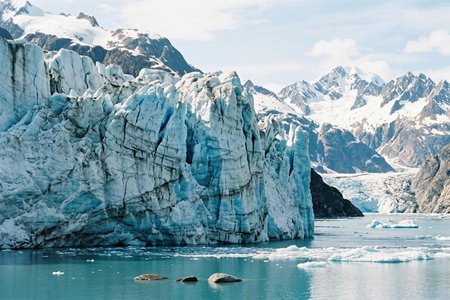
noun
Discover More
A significant percentage of the water of the Earth is locked up in glaciers.
Glaciers exist in high mountains throughout the temperate zones and cover most of Antarctica. Glaciers recede during warm periods and can expand during cold periods, creating ice ages.
Other Word Forms
Derived Forms
Inflected Forms
Nouns
Etymology
Origin of glacier
1735–45; < dialectal French, derivative of Old French glace ice < Late Latin glacia (for Latin glaciēs )
Explanation

A glacier is a very large ice mass, sometimes miles and miles long. Glaciers might not seem all that exciting at first, but people are paying close attention to them because their melting is an indication of climate change. Most glaciers on Earth are found around the North and South poles, but every continent except for Australia has glaciers somewhere in its high mountain ranges. People often want to go see glaciers because they're beautiful, and some you can actually hike across. Luckily, if you get thirsty glaciers are the planet’s largest reservoir of freshwater. You’ll just have to find some way of melting them . . .
Vocabulary lists containing glacier
Physical Geography - Introductory
Looking to grow your vocabulary? Check out this interactive, curated word list from our team of English language specialists at Vocabulary.com – one of over 17,000 lists we've built to help learners worldwide!
Weather and Climate - Introductory
Interested in learning more words like this one? Our team at Vocabulary.com has got you covered! You can review flashcards, quiz yourself, practice spelling, and more – and it's all completely free to use!
Geological Features
Want to remember this word for good? Start your learning journey today with our library of interactive, themed word lists built by the experts at Vocabulary.com – we'll help you make the most of your study time!
Example Sentences
Examples are provided to illustrate real-world usage of words in context. Any opinions expressed do not reflect the views of Dictionary.com.
See Examples For:
But a curious pattern has emerged in recent years: Multiple major landslides have occurred precisely at the terminus of a retreating glacier.
From Science Daily ● Oct. 19, 2026

The device comes in black, silver, burgundy and glacier, and the smaller model provides up to 24 hours of charge, while the larger phone offers up to 30 hours.
From MarketWatch ● Oct. 9, 2026

The explosion has triggered more movement, with another glacier headed toward Alaska.
From Salon ● Oct. 5, 2026

The sea level is rising at a record pace, driven by warming oceans and glacier melt, according to a UN report.
From Barron's ● Oct. 2, 2026

His eyes were blue-white, like core samples from a glacier, and just as cold.
From "The House of Hades" by Rick Riordan

The winter of 2025 to 2026 ranked among Switzerland's ten least snowy winters since records began, leaving glaciers with less snow to protect them from warmer temperatures.
From Science Daily ● Oct. 23, 2026
Landslides are common in the coastal mountains of Alaska where rapid uplift, caused by tectonic forces and long-term ice loss, converges with the erosive forces of precipitation and moving glaciers.
From Science Daily ● Oct. 19, 2026
Experts say the retreat of glaciers can cause glacial lakes to expand, increasing the risk of sudden, potentially devastating floods that can cross borders into countries such as Nepal, India and Bhutan.
From BBC ● Oct. 14, 2026

In 2009, India and China agreed to undertake joint research into the impact of global warming on glaciers in the Himalayas and Tibet.
From BBC ● Oct. 14, 2026
There are no Alpine peaks or grinding glaciers, no great deposits of oil or precious metals, not a hint of a pyroclastic flow.
From "A Short History of Nearly Everything" by Bill Bryson
Random Word
Spin the wheel and learn a new word!
Get a wordDefinitions and idiom definitions from Dictionary.com Unabridged, based on the Random House Unabridged Dictionary, © Random House, Inc. 2023
Idioms from The American Heritage® Idioms Dictionary copyright © 2002, 2001, 1995 by Houghton Mifflin Harcourt Publishing Company. Published by Houghton Mifflin Harcourt Publishing Company.
