
monarchy
Americannoun
-
monarchies
plural
-
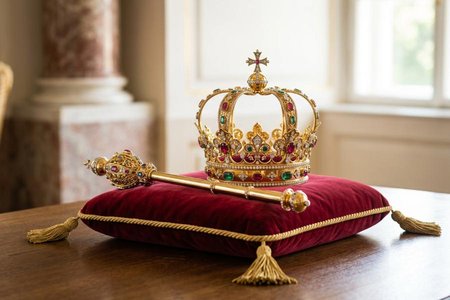
a state or nation in which the supreme power is actually or nominally lodged in a monarch.
-
supreme power or sovereignty held by a single person.
noun
-
a form of government in which supreme authority is vested in a single and usually hereditary figure, such as a king, and whose powers can vary from those of an absolute despot to those of a figurehead
-
a country reigned over by a king, prince, or other monarch
Usage
What is a monarchy? A monarchy is a form of government in which the supreme power is held by one person, either officially or ceremonially. In a monarchy, one person rules the government, and no human is above them in power. The ruler of a monarchy is called a monarch, and their position is nearly always hereditary, meaning that a member of their family will inherit their position when they die or willingly give up their power (known as abdicitation). Throughout history, monarchies have been a relatively common form of government. The ancient Egyptian pharaohs, the Roman and Chinese emperors, and the large number of European kings and queens ruled over monarchies. There are two major types of monarchies:
- In an absolute monarchy, the supreme ruler has total, unlimited power. Nobody can tell them what to do, and they can order their people to do anything they want. This form of monarchy was more common in the past than it is today. Some examples of modern countries with this form of monarchy are Swaziland and Saudi Arabia.
- In a limited monarchy or constitutional monarchy, the supreme ruler has limits on what they are actually able to do. Usually, their power is determined by a written constitution or a governing body that can restrain the actions they want to do. Of the monarchies that still exist today, most of them are limited monarchies, including those found in the United Kingdom and Norway.
Synonym Usage
See kingdom.
Other Word Forms
Derived Forms
Inflected Forms
Nouns
Etymology
Origin of monarchy
First recorded in 1300–50; Middle English monarchie, from Late Latin monarchia, from Greek monarchía. See monarch, -y 3
Compare meaning
How does monarchy compare to similar and commonly confused words? Explore the most common comparisons:
Explanation

A monarchy is a country that is ruled by a monarch, and monarchy is this system or form of government. A monarch, such as a king or queen, rules a kingdom or empire. In a constitutional monarchy, the monarch's power is limited by a constitution. But in an absolute monarchy, the monarch has unlimited power. Monarchy is an old form of government, and the word has been around a long time. It derives from Greek monarkhiā, from monarkhos, "monarch."
Vocabulary lists containing monarchy
Play by the Rules: Arch
Looking to grow your vocabulary? Check out this interactive, curated word list from our team of English language specialists at Vocabulary.com – one of over 17,000 lists we've built to help learners worldwide!
Liberty, Equality, Vocabulary: The French Revolution
Interested in learning more words like this one? Our team at Vocabulary.com has got you covered! You can review flashcards, quiz yourself, practice spelling, and more – and it's all completely free to use!
Ancient Greece - Introductory
Want to remember this word for good? Start your learning journey today with our library of interactive, themed word lists built by the experts at Vocabulary.com – we'll help you make the most of your study time!
Example Sentences
Examples are provided to illustrate real-world usage of words in context. Any opinions expressed do not reflect the views of Dictionary.com.
See Examples For:
This allowance for Mountbatten-Windsor is not from the Sovereign Grant, which is the £138m in public funding for the monarchy.
From BBC ● Oct. 5, 2026

It is no secret that tension existed between Spencer and the monarchy.
From The Wall Street Journal ● Sep. 24, 2026

In an interview with BBC Radio 4's Today programme, Pettigrew - from King's College London - said there were all sorts of connections between the monarchy and slavery, not just this "brutal imprint".
From BBC ● Sep. 14, 2026
Albania gained independence from the Ottoman Empire in 1912 and became a monarchy.
From Slate ● Sep. 8, 2026

A large awning hangs over the entrance, orange, the color of our exiled monarchy.
From "Girl in the Blue Coat" by Monica Hesse

It’s the archaic act of tyrannical monarchies, staged in the shadow of a looming tower or in the town square.
From Los Angeles Times ● Oct. 10, 2026

All but one of the 13 countries that did so are hereditary monarchies.
From Salon ● Jul. 22, 2026

He believes blockchain can be used to bring this world about and that the result would be "corporate monarchies" ruled over by "CEO-kings".
From BBC ● Jul. 10, 2026
The Arab monarchies have long seen Iran as their top security threat, but they also have deep economic and social ties with the country.
From The Wall Street Journal ● May 16, 2026
Their many societies had developed rigid social and economic class structures in which wealth and power were concentrated among monarchies, aristocracies, and the Catholic Church.
From "An Indigenous People’s History of the United States" by Roxanne Dunbar-Ortiz
Random Word
Spin the wheel and learn a new word!
Get a wordDefinitions and idiom definitions from Dictionary.com Unabridged, based on the Random House Unabridged Dictionary, © Random House, Inc. 2023
Idioms from The American Heritage® Idioms Dictionary copyright © 2002, 2001, 1995 by Houghton Mifflin Harcourt Publishing Company. Published by Houghton Mifflin Harcourt Publishing Company.
