Dictionary.com
Thesaurus.com
Jump To:
  • parliament
    parliament
    noun
    the legislature of Great Britain, historically the assembly of the three estates, now composed of Lords Spiritual and Lords Temporal, forming together the House of Lords, and representatives of the counties, cities, boroughs, and universities, forming the House of Commons.
  • Parliament
    Parliament
    noun
    the highest legislative authority in Britain, consisting of the House of Commons, which exercises effective power, the House of Lords, and the sovereign
Synonyms
Trivia Time
Parliament comes from a French word meaning what?

parliament

American  
[pahr-luh-muhnt, pahrl-yuh-] / ˈpɑr lə mənt, ˈpɑrl jə- /
Obsolete, parlement

noun

  • parliaments
    plural
  1. An image of the word parliament as defined by the legislature of Great Britain, historically the assembly of the three estates, now composed of Lords Spiritual and Lords Temporal, forming together the House of Lords, and representatives of the counties, cities, boroughs, and universities, forming the House of Commons.

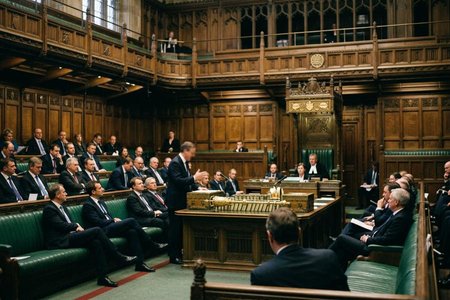
    (usually initial capital letter) the legislature of Great Britain, historically the assembly of the three estates, now composed of Lords Spiritual and Lords Temporal, forming together the House of Lords, and representatives of the counties, cities, boroughs, and universities, forming the House of Commons.

  2. (usually initial capital letter) the legislature of certain British colonies and possessions.

  3. a legislative body in any of various other countries.

  4. French History. any of several high courts of justice in France before 1789.

  5. a meeting or assembly for conference on public or national affairs.

  6. Cards. fan-tan.


parliament 1 British  
/ ˈpɑːləmənt /

noun

  1. an assembly of the representatives of a political nation or people, often the supreme legislative authority

  2. any legislative or deliberative assembly, conference, etc

  3. Also: parlement. (in France before the Revolution) any of several high courts of justice in which royal decrees were registered

"Collins English Dictionary — Complete & Unabridged" 2012 Digital Edition © William Collins Sons & Co. Ltd. 1979, 1986 © HarperCollins Publishers 1998, 2000, 2003, 2005, 2006, 2007, 2009, 2012

Parliament 2 British  
/ ˈpɑːləmənt /

noun

  1. the highest legislative authority in Britain, consisting of the House of Commons, which exercises effective power, the House of Lords, and the sovereign

  2. a similar legislature in another country

  3. the two chambers of a Parliament

  4. the lower chamber of a Parliament

  5. any of the assemblies of such a body created by a general election and royal summons and dissolved before the next election

"Collins English Dictionary — Complete & Unabridged" 2012 Digital Edition © William Collins Sons & Co. Ltd. 1979, 1986 © HarperCollins Publishers 1998, 2000, 2003, 2005, 2006, 2007, 2009, 2012

parliament Cultural  
  1. An assembly of representatives, usually of an entire nation, that makes laws. Parliaments began in the Middle Ages in struggles for power between kings and their people. Today, parliaments differ from other kinds of legislatures in one important way: some of the representatives in the parliament serve as government ministers, in charge of carrying out the laws that the parliament passes. Generally, a parliament is divided by political parties, and the representative who leads the strongest political party in the parliament becomes the nation's head of government. This leader is usually called the prime minister or premier. Typically, a different person — usually a king, queen, or president — is head of state, and this person's duties are usually more ceremonial than governmental.


Discover More

The number of nations governed by parliaments has greatly increased in modern times.

Other Word Forms

Derived Forms

Inflected Forms

Nouns

Etymology

Origin of parliament

First recorded in 1250–1300; Middle English: “discourse, consultation, Parliament,” from Anglo-Latin parliamentum, alteration of Medieval Latin parlāmentum, from Old French parlement “a speaking, conference” ( see parle, -ment); replacing Middle English parlement, from Old French

Explanation

In some countries — Great Britain for example — the group of people who make the laws is called the parliament. It's the equivalent of Congress in the United States. The most common meaning of parliament refers to a country's legislative (law-making) body. England's parliament is very famous. The word comes in part from the French verb parler, which means to speak, which makes sense since this group of people assemble to talk about laws and issues. Another meaning of parliament is the card game known as fan tan or sevens, where you lead with your sevens in a certain sequence and win by using up all your cards.

Keep Reading on Vocabulary.com

Vocabulary lists containing parliament

Example Sentences

Examples are provided to illustrate real-world usage of words in context. Any opinions expressed do not reflect the views of Dictionary.com.

See Examples For:

French Prime Minister Sebastien Lecomu on Thursday was unveiling the country’s draft budget that he will try to push through a fractured parliament.

From MarketWatch ● Oct. 1, 2026

His group and other militias hold top positions in ministries, as well as dozens of seats in Iraq’s parliament where they played a role in Zaidi’s selection in the negotiations that followed last year’s election.

From The Wall Street Journal ● Sep. 30, 2026

With 97 seats, Pam does not have a majority and will need to form a coalition to reach the 198 seats required for an absolute majority in the 395-member parliament.

From BBC ● Sep. 29, 2026

"Tomorrow morning I will hand over my duties to the parliament speaker."

From Barron's ● Sep. 27, 2026

On these occasions, the regent was surrounded by his amapbakathi, a group of councilors of high rank who functioned as the regent’s parliament and judiciary.

From "Long Walk to Freedom" by Nelson Mandela

But when the Sami Parliament requested that the government set up a truth commission, it said it expected that a reconciliation process would follow once the commission's work had been completed.

From Barron's ● Sep. 30, 2026

"I grew up in this area my whole life. It's made me, Camden made me who I am, and to be able to now represent us in Parliament will be such a major thing."

From BBC ● Sep. 24, 2026

However, Parliament voted in 2022 to block juvenile killers from seeking a review if they had been sentenced after they had turned 18.

From BBC ● Sep. 22, 2026

The former Trade Union organiser and Nottingham City councillor was first elected to Parliament in 2017.

From BBC ● Jul. 28, 2026

I could no more choose to live in such beauty than run for Parliament.

From "Long Walk to Freedom" by Nelson Mandela

In 1780, remarkably, Richmond proposed annual parliaments and universal male suffrage, 138 years before the latter would be achieved.

From The Wall Street Journal ● Jun. 12, 2026

Popes rarely address parliaments, trying to avoid overt political interventions.

From Barron's ● Jun. 8, 2026

The idea runs back at least to the influential 18th-century English jurist William Blackstone, who instructed that “Acts of parliament derogatory from the power of subsequent parliaments bind not.”

From Slate ● May 26, 2026

Voters in Scotland and Wales will choose who should run their national parliaments, while seats on dozens of councils and mayors are up for election in England.

From BBC ● May 6, 2026

The Haudenosaunee thus would have the second oldest continuously existing representative parliaments on earth.

From "1491" by Charles C. Mann

Vocabulary.com logo
by dictionary.com

Join 14,000,000 vocabulary learners

Start learning new words today on VocabTrainer.
You'll remember them forever.

Start training





