sword
Americannoun
-
swords
plural
-
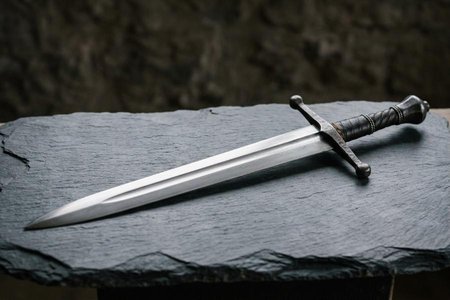
a weapon having various forms but consisting typically of a long, straight or slightly curved blade, sharp-edged on one or both sides, with one end pointed and the other fixed in a hilt or handle.
-
this weapon as the symbol of military power, punitive justice, authority, etc..
The pen is mightier than the sword.
-
a cause of death or destruction.
-
war, combat, slaughter, or violence, especially military force or aggression.
to perish by the sword.
-
Military. Sword. the code name for one of the five D-Day invasion beaches on France's Normandy coast, assaulted by British forces.
noun
-
a thrusting, striking, or cutting weapon with a long blade having one or two cutting edges, a hilt, and usually a crosspiece or guard
-
such a weapon worn on ceremonial occasions as a symbol of authority
-
something resembling a sword, such as the snout of a swordfish
-
to argue or fight
-
-
violence or power, esp military power
-
death; destruction
to put to the sword
-
Other Word Forms
Derived Forms
Inflected Forms
Nouns
Etymology
Origin of sword
First recorded before 900; Middle English; Old English sweord; cognate with Dutch zwaard, German Schwert, Old Norse sverth
Explanation

A sword is a weapon with a long, sharp, metal blade. If you want to dress up as a knight for Halloween, you'll definitely need a sword — and maybe a suit of armor. Swords evolved from daggers, which, like knives, have two sharp edges instead of just one. Some time during the Bronze Age, daggers became longer and longer, eventually being classified as swords. These long, sharp weapons were used by soldiers on battlefields, and for self-defense and dueling. Sword can be traced back to a Proto-Indo-European root meaning "to cut or pierce."
Vocabulary lists containing sword
Example Sentences
Examples are provided to illustrate real-world usage of words in context. Any opinions expressed do not reflect the views of Dictionary.com.
See Examples For:
The company doesn’t make any mention of using Samurai swords or katanas, but its owner, James Jacobs, appears in a picture on the website wielding a long sword.
From Los Angeles Times ● Nov. 20, 2026

Thomas Hobbes in 1651 understood that “covenants, without the sword, are but words.”
From The Wall Street Journal ● Nov. 17, 2026

One guard can be seen swaying before crashing to the ground, falling against a pillar at the Elysee Palace as his ceremonial sword clattered to the ground.
From Barron's ● Nov. 12, 2026

He described social media as a "double-edged sword" when helping people to stay fit.
From BBC ● Oct. 23, 2026

As I study the sword, glowing white inscriptions appear on the obsidian blade.
From "Kwame Crashes the Underworld" by Craig Kofi Farmer

Still, the exhibitions spotlight ships, swords and artifacts of trade and travel, placing them front and center.
From Science Daily ● Sep. 23, 2026

Do you think they are going to fall on their swords?
From MarketWatch ● Sep. 14, 2026

They want swords and plowshares, and that means borrowing.
From The Wall Street Journal ● Aug. 19, 2026
No dragons, of course, but plenty of political conniving, clashing swords and last-minute escapes.
From Los Angeles Times ● Aug. 10, 2026
There are very few such swords as this one left in the world, but remember, it is only a sword, Matthias!
From "Redwall" by Brian Jacques
Random Word
Spin the wheel and learn a new word!
Get a wordDefinitions and idiom definitions from Dictionary.com Unabridged, based on the Random House Unabridged Dictionary, © Random House, Inc. 2023
Idioms from The American Heritage® Idioms Dictionary copyright © 2002, 2001, 1995 by Houghton Mifflin Harcourt Publishing Company. Published by Houghton Mifflin Harcourt Publishing Company.
