tang
noun
a strong taste or flavor.
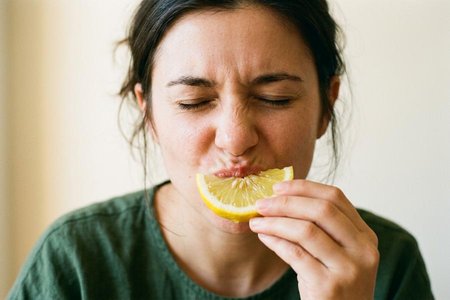
a strong taste or flavor.
the distinctive flavor or quality of a thing.
a pungent or distinctive odor.
a touch or suggestion of something; slight trace.
a long and slender projecting strip, tongue, or prong forming part of an object, as a chisel, file, or knife, and serving as a means of attachment for another part, as a handle or stock.
a surgeonfish.
a strong taste or flavour
the tang of the sea
a pungent or characteristic smell
the tang of peat fires
a trace, touch, or hint of something
a tang of cloves in the apple pie
the pointed end of a tool, such as a chisel, file, knife, etc, which is fitted into a handle, shaft, or stock
First recorded in 1325–75; Middle English tange “tongue of a snake, projection on a tool,” perhaps from Old Norse tangi “projection, headland, tang of a blade”
First recorded in 1660–70; imitative; see ting 1

A tang is a sharp flavor or smell, like the tang of fresh-squeezed lemonade or the tang of the salty ocean breeze. When you eat something sour, you taste a tang, like the tang of blue cheese or vinegar in your salad. Although it's no longer available today, Tang was also the name of a tangy, sugary orange drink that was especially popular in the 1960s and 70s. From a root word meaning "to bite," tang's original meaning was "serpent's tongue."
Looking to grow your vocabulary? Check out this interactive, curated word list from our team of English language specialists at Vocabulary.com – one of over 17,000 lists we've built to help learners worldwide!
Interested in learning more words like this one? Our team at Vocabulary.com has got you covered! You can review flashcards, quiz yourself, practice spelling, and more – and it's all completely free to use!
Want to remember this word for good? Start your learning journey today with our library of interactive, themed word lists built by the experts at Vocabulary.com – we'll help you make the most of your study time!
Examples are provided to illustrate real-world usage of words in context. Any opinions expressed do not reflect the views of Dictionary.com.
Tom Nolan reports that Martin Limón’s crime story delivers “a bracing pace and the aftershave tang of a great 1950s paperback.”
From The Wall Street Journal ● Sep. 30, 2026

It adds tang, salinity, and helps loosen the dip to your ideal consistency.
From Salon ● Jul. 7, 2026

“You won’t miss the statue,” the clerk said, the slightest tang of exasperation in his tone.
From Slate ● Jun. 2, 2026

Stirred into potato salad, it contributes not only seasoning but a subtle lactic tang that would otherwise require additional ingredients to achieve.
From Salon ● Jun. 2, 2026
Nat longed for the tang of a sea breeze off the North Atlantic.
From "Carry On, Mr. Bowditch" by Jean Lee Latham

References to “domino cards” existed as early as the T’ang Dynasty, which lasted from 618-907 AD.
From National Geographic ● Nov. 3, 2023

From the hand-painted cards of T’ang Dynasty China to paper-and-plastic Pokémon trading cards, the history of playing cards spans cultures, epochs, and continents.
From National Geographic ● Nov. 3, 2023
By the time the Pekingese had become a proper breed during the T’ang dynasty, only the Chinese imperial family was allowed to keep them.
From Time ● Feb. 15, 2012
T'ang Fei-Fan and colleagues in Peking described scrupulously conducted experiments in which they grew generations of the virus in fertilized eggs, gave it to monkeys, which got something like trachoma.
From Time Magazine Archive
The T’ang, allied with the Silla kingdom, swept down from the north and pushed their way into Puyo.
From "A Single Shard" by Linda Sue Park
Derek Tang, co-founder of forecasting firm LH Meyer, said the market has a very difficult time understanding when the rate hikes will end.
From MarketWatch ● Oct. 24, 2026

“It is a little bit of a black box,” Tang said.
From MarketWatch ● Oct. 24, 2026
A Tang dynasty empress is believed to have sent two to Japan in the seventh century.
From The Wall Street Journal ● Sep. 25, 2026
Younger workers are particularly susceptible to this, says Tang.
From BBC ● Sep. 15, 2026

Uncle should have gone, for all this moving around was hard on him, but he was needed to help some of the other leaders of the Tang people figure out what to do.
From "Dragonwings" by Laurence Yep
Spin the wheel and learn a new word!
Get a wordDefinitions and idiom definitions from Dictionary.com Unabridged, based on the Random House Unabridged Dictionary, © Random House, Inc. 2023
Idioms from The American Heritage® Idioms Dictionary copyright © 2002, 2001, 1995 by Houghton Mifflin Harcourt Publishing Company. Published by Houghton Mifflin Harcourt Publishing Company.
