shoulda
[shoo duh]
What does shoulda mean?
Shoulda, woulda, coulda. Shoulda is simply a spelling of should have (or should’ve), based on a common, contracted, colloquial pronunciation of this modal verb phrase.
Where does shoulda come from?
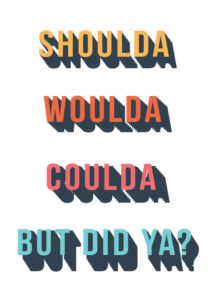
We might spell should have as such, but few of us actually pronounce it that way. The expression typically comes out sounding more like shoulda, hence the spelling. Gonna (“going to”) and wanna (“want to”) are other such examples, with the unstressed to also rendered as an a.
Our bellybuttons shoulda jus been a button u press when u tryna die
— A (@folowmeontwiter) December 6, 2018
Similarly, should have is also frequently (and questionably) rendered as should of.

People have certainly been saying shoulda long before, but record of this colloquial spelling comes in the early 1900s. An early example appears in Collier’s magazine as the author’s way to reflect actual speech.
Examples of shoulda
Today was trash I shoulda stayed in bed
After walking out on stage and saying, “I shoulda left that backstage,” Joe dove into a phenomeonal [sic] set talking about his response to some recent doctor’s advice, being mistaken for the wrong gender, and his favorite part of going to Disney World.
Who uses shoulda?
Shoulda with the same sense as should have but is considered more informal or colloquial in writing.
https://twitter.com/McLellanWyatt/status/1071165453412827136
It’s commonly used to express some obligation, command, or regret, a favorite way of lyricists to begin a line.
https://twitter.com/kidd0OW/status/1130156441162141696
Toni Braxton, for instance, released “Love Shoulda Brought You Home” in 1992, followed shortly thereafter by Toby Keith’s hit song, “Should’ve Been a Cowboy,” popularly rendered with a shoulda.

NOTE
This is not meant to be a formal definition of shoulda like most terms we define on Dictionary.com, but is rather an informal word summary that hopefully touches upon the key aspects of the meaning and usage of shoulda that will help our users expand their word mastery.
