tang
noun
a strong taste or flavor.
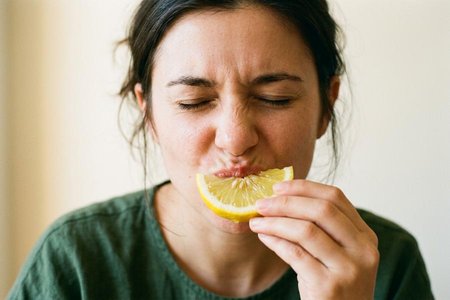
a strong taste or flavor.
the distinctive flavor or quality of a thing.
a pungent or distinctive odor.
a touch or suggestion of something; slight trace.
a long and slender projecting strip, tongue, or prong forming part of an object, as a chisel, file, or knife, and serving as a means of attachment for another part, as a handle or stock.
a surgeonfish.
a strong taste or flavour
the tang of the sea
a pungent or characteristic smell
the tang of peat fires
a trace, touch, or hint of something
a tang of cloves in the apple pie
the pointed end of a tool, such as a chisel, file, knife, etc, which is fitted into a handle, shaft, or stock
First recorded in 1325–75; Middle English tange “tongue of a snake, projection on a tool,” perhaps from Old Norse tangi “projection, headland, tang of a blade”
First recorded in 1660–70; imitative; see ting 1

A tang is a sharp flavor or smell, like the tang of fresh-squeezed lemonade or the tang of the salty ocean breeze. When you eat something sour, you taste a tang, like the tang of blue cheese or vinegar in your salad. Although it's no longer available today, Tang was also the name of a tangy, sugary orange drink that was especially popular in the 1960s and 70s. From a root word meaning "to bite," tang's original meaning was "serpent's tongue."
Looking to grow your vocabulary? Check out this interactive, curated word list from our team of English language specialists at Vocabulary.com – one of over 17,000 lists we've built to help learners worldwide!
Interested in learning more words like this one? Our team at Vocabulary.com has got you covered! You can review flashcards, quiz yourself, practice spelling, and more – and it's all completely free to use!
Want to remember this word for good? Start your learning journey today with our library of interactive, themed word lists built by the experts at Vocabulary.com – we'll help you make the most of your study time!
Examples are provided to illustrate real-world usage of words in context. Any opinions expressed do not reflect the views of Dictionary.com.
“Strip Rules” has a bracing pace and the aftershave tang of a great 1950s paperback.
From The Wall Street Journal ● Sep. 9, 2026

The buttery, milder fish compliments the tang of the tomatoes and the bright balsamic dressing that finishes the salad.
From The Wall Street Journal ● Jul. 7, 2026
In a hearty lentil-and-vegetable soup, lemon juice contrasts those earthy, spicy flavors with tang and a hint of sweetness.
From Salon ● Jun. 13, 2026

“You won’t miss the statue,” the clerk said, the slightest tang of exasperation in his tone.
From Slate ● Jun. 2, 2026

She bit into it and the sweetness startled her; it was like liquid sugar with a tart, lingering tang.
From "Huntress" by Malinda Lo

From the hand-painted cards of T’ang Dynasty China to paper-and-plastic Pokémon trading cards, the history of playing cards spans cultures, epochs, and continents.
From National Geographic ● Nov. 3, 2023

References to “domino cards” existed as early as the T’ang Dynasty, which lasted from 618-907 AD.
From National Geographic ● Nov. 3, 2023
By the time the Pekingese had become a proper breed during the T’ang dynasty, only the Chinese imperial family was allowed to keep them.
From Time ● Feb. 15, 2012
A color may be baked on: T'ang red, clair de lune blue, Ming green, rose du Barry, orchid de Vincennes, etc., etc.
From Time Magazine Archive
Probably looking at the moon and reciting some poem from the T’ang Dynasty.”
From "The Secret History" by Donna Tartt
Younger workers are particularly susceptible to this, says Tang.
From BBC ● Sep. 15, 2026

Calling the endeavor “Touch High Project,” Tang said Z.AI would invest in building AI systems that can improve themselves.
From The Wall Street Journal ● Sep. 14, 2026
Other CMU authors included doctoral students Shahul Alam and Shike Wang and postdoctoral research associate Junjie Tang.
From Science Daily ● Sep. 13, 2026
“Those are a few things I think people should pay more attention to,” Tang said.
From MarketWatch ● Sep. 11, 2026

Later that evening we would hang up a new picture of the Stove King that we had bought in the Tang people’s town.
From "Dragonwings" by Laurence Yep
Definitions and idiom definitions from Dictionary.com Unabridged, based on the Random House Unabridged Dictionary, © Random House, Inc. 2023
Idioms from The American Heritage® Idioms Dictionary copyright © 2002, 2001, 1995 by Houghton Mifflin Harcourt Publishing Company. Published by Houghton Mifflin Harcourt Publishing Company.
