amphibian
Americannoun
-
amphibians
plural
-
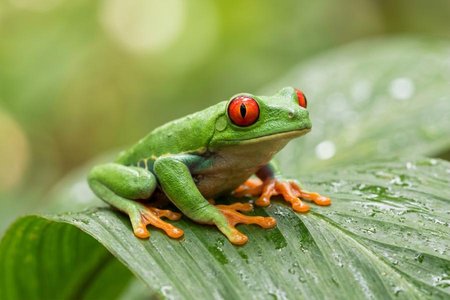
any cold-blooded vertebrate of the class Amphibia, comprising frogs and toads, newts and salamanders, and caecilians, the larvae being typically aquatic, breathing by gills, and the adults being typically semiterrestrial, breathing by lungs and through the moist, glandular skin.
-
an amphibious plant.
-
an airplane designed for taking off from and landing on both land and water.
-
Also called amtrac. a flat-bottomed, armed, military vehicle, equipped with both tracks and a rudder, that can travel either on land or in water, used chiefly for landing assault troops.
adjective
-
belonging or pertaining to the Amphibia.
noun
-
any cold-blooded vertebrate of the class Amphibia, typically living on land but breeding in water. Their aquatic larvae (tadpoles) undergo metamorphosis into the adult form. The class includes the newts and salamanders, frogs and toads, and caecilians
-
a type of aircraft able to land and take off from both water and land
-
any vehicle able to travel on both water and land
adjective
-
another word for amphibious
-
of, relating to, or belonging to the class Amphibia
Word History
Amphibians, not quite fish and not quite reptiles, were the first vertebrates to live on land. These cold-blooded animals spend their larval stage in water, breathing through their gills. In adulthood they usually live on land, using their lungs to breath air. This double life is also at the root of their name, amphibian, which, like many scientific words, derives from Greek. The Greek prefix amphi– means “both,” or “double,” and the Greek word bios means “life.” Both these elements are widely used in English scientific terminology: bios, for example, is seen in such words as biology, antibiotic, and symbiotic.
Other Word Forms
Derived Forms
Inflected Forms
Nouns
Etymology
Origin of amphibian
1630–40; < Latin amphibi ( a ), neuter plural of amphibius (adj.) ( see amphibious) + -an
Explanation

An amphibian is a cold-blooded vertebrate animal that is born in water and breathes with gills. As the larva grows into its adult form, the animal's lungs develop the ability to breathe air, and the animal can live on land. Frogs, toads, and salamanders are all amphibians. The word amphibian comes from the Greek word amphibios, which means "to live a double life." The noun amphibian has its roots in the words amphi, meaning "of both kinds," and bios, meaning "life." The word is used for the class of animals that spend part of their lives in water and part on land. The word can also be used as an adjective to describe the animals that live this way. You might be interested to know that the largest amphibian weighs about 140 pounds and the smallest weighs only a few grams.
Vocabulary lists containing amphibian
Words to Live By: Bio
Looking to grow your vocabulary? Check out this interactive, curated word list from our team of English language specialists at Vocabulary.com – one of over 17,000 lists we've built to help learners worldwide!
Animal Adjectives
Interested in learning more words like this one? Our team at Vocabulary.com has got you covered! You can review flashcards, quiz yourself, practice spelling, and more – and it's all completely free to use!
Life Science: Organisms and Taxonomy
Want to remember this word for good? Start your learning journey today with our library of interactive, themed word lists built by the experts at Vocabulary.com – we'll help you make the most of your study time!
Example Sentences
Examples are provided to illustrate real-world usage of words in context. Any opinions expressed do not reflect the views of Dictionary.com.
See Examples For:
This sharp increase suggests that the pathogen arrived and spread through the local amphibian community around the same time that frog populations were collapsing.
From Science Daily ● Nov. 3, 2026

Nevertheless, the surveys indicate that most amphibian species at Boracéia have recovered since the severe declines of the early 1980s.
From Science Daily ● Nov. 3, 2026
"Many teeth from Saurichthys were once mistaken for those of an amphibian, and that misunderstanding continued well into the 20th Century," said Museum Wales curator Cindy Howells.
From BBC ● Sep. 28, 2026

In a rescue mission on Wednesday, amphibian and reptile experts found dead wildlife, but also some survivors which were collected and relocated.
From BBC ● Aug. 21, 2026
I make a drawing of the inside of the frog, with all its curlicues and bulbs, its tiny lungs, its cold-blooded amphibian heart.
From "Cat's Eye" by Margaret Atwood

Although fish lack this pathway, scientists have identified it in amphibians, reptiles, birds, and mammals.
From Science Daily ● Nov. 4, 2026
The Smithsonian's National Museum of Natural History houses specimens collected by William Ronald Heyer, a former curator of amphibians and reptiles.
From Science Daily ● Nov. 3, 2026
Working with the Zoological Society of London, WWF tracks nearly 36,000 populations of almost 6,000 species of mammals, birds, fish, reptiles and amphibians.
From BBC ● Oct. 8, 2026
A panel of wildlife experts drew up a shortlist of 18 mammals, birds, amphibians insects and fish which were put forward to public nominations.
From BBC ● Oct. 7, 2026
From amphibians and reptiles to birds and mammals, no biological class is immune.
From "Camp Panda" by Catherine Thimmesh
Random Word
Spin the wheel and learn a new word!
Get a wordDefinitions and idiom definitions from Dictionary.com Unabridged, based on the Random House Unabridged Dictionary, © Random House, Inc. 2023
Idioms from The American Heritage® Idioms Dictionary copyright © 2002, 2001, 1995 by Houghton Mifflin Harcourt Publishing Company. Published by Houghton Mifflin Harcourt Publishing Company.
