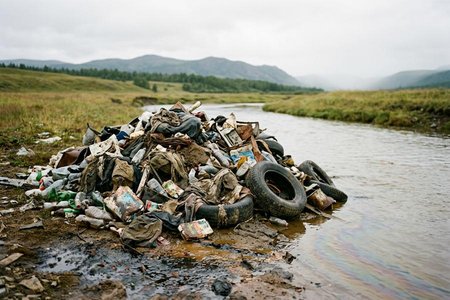
noun
-
the act of polluting or the state of being polluted
-
harmful or poisonous substances introduced into an environment
-
The contamination of air, water, or soil by substances that are harmful to living organisms. Pollution can occur naturally, for example through volcanic eruptions, or as the result of human activities, such as the spilling of oil or disposal of industrial waste.
-
◆ Light from cities and towns at night that interferes with astronomical observations is known as light pollution. It can also disturb natural rhythms of growth in plants and other organisms.
-
◆ Continuous noise that is loud enough to be annoying or physically harmful is known as noise pollution.
-
◆ Heat from hot water that is discharged from a factory into a river or lake, where it can kill or endanger aquatic life, is known as thermal pollution.
Other Word Forms
Derived Forms
Inflected Forms
Nouns
Etymology
Origin of pollution
First recorded in 1350–1400; Middle English pollucioun, from Old French, from Late Latin pollūtiōn-, stem of pollūtiō “defilement”; equivalent to pollute + -ion
Explanation

Pollution is unwanted, harmful stuff contaminating an environment. The race to develop clean energy is motivated by high levels of pollution that people fear are permanently damaging the earth's environment. When you hear about pollution, you’re most likely hearing about chemical emissions into air or water that come from industrial processing. But pollution isn’t just environmental. Anything we think of as pure can be contaminated by pollution polluted, whether that's a lake or an idea. If your mother finds you reading trashy magazines instead of doing your homework, she might worry about the pollution of your mind.
Vocabulary lists containing pollution
Africa - Introductory
Looking to grow your vocabulary? Check out this interactive, curated word list from our team of English language specialists at Vocabulary.com – one of over 17,000 lists we've built to help learners worldwide!
Eastern Europe - Introductory
Interested in learning more words like this one? Our team at Vocabulary.com has got you covered! You can review flashcards, quiz yourself, practice spelling, and more – and it's all completely free to use!
East Asia - Middle School
Want to remember this word for good? Start your learning journey today with our library of interactive, themed word lists built by the experts at Vocabulary.com – we'll help you make the most of your study time!
Example Sentences
Examples are provided to illustrate real-world usage of words in context. Any opinions expressed do not reflect the views of Dictionary.com.
Locals aren’t looking forward to increased traffic congestion, noise and air pollution, and disruptions to operations at the ports of Los Angeles and Long Beach.
From Los Angeles Times ● Oct. 16, 2026

Indonesian wildfire haze has caused a regional pollution crisis and prompted growing frustration in neighbours, including Malaysia.
From Barron's ● Oct. 16, 2026

Colman said there is "very little light pollution on Exmoor", adding it "enables the dark to be really dark with none of the pollution impacting".
From BBC ● Oct. 16, 2026

For most of Earth's history, plastic pollution did not exist.
From Science Daily ● Oct. 16, 2026

But the waste from CAFOs is a huge source of very toxic pollution.
From "The Omnivore's Dilemma" by Michael Pollan

Random Word
Spin the wheel and learn a new word!
Get a wordDefinitions and idiom definitions from Dictionary.com Unabridged, based on the Random House Unabridged Dictionary, © Random House, Inc. 2023
Idioms from The American Heritage® Idioms Dictionary copyright © 2002, 2001, 1995 by Houghton Mifflin Harcourt Publishing Company. Published by Houghton Mifflin Harcourt Publishing Company.
