
duplicity
Americannoun
-
duplicities
plural
-
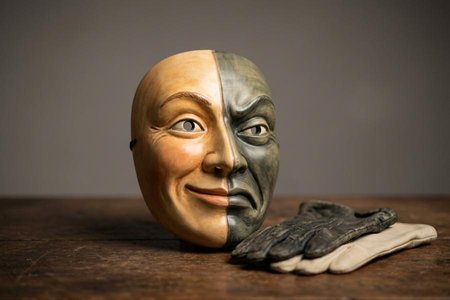
deceitfulness in speech or conduct, as by speaking or acting in two different ways to different people concerning the same matter; double-dealing.
- Antonyms:
- straightforwardness, honesty, directness, candidness
-
an act or instance of such deceitfulness.
-
Law. the act or fact of including two or more offenses in one count, or charge, as part of an indictment, thus violating the requirement that each count contain only a single offense.
-
the state or quality of having two elements or parts; being twofold or double.
noun
Usage
What does duplicity mean? Duplicity is the practice of intentionally misleading people, especially by saying different things to different people or acting in different ways at different times. Close synonyms are deceit and deception. A more informal synonym is double-dealing (which can also be used as an adjective). Duplicity can also refer to the quality of someone or something that misleads in this way or to an instance of deception. People who are liars engage in duplicity. The word is based on the idea of presenting two or more different versions of oneself or of a situation. Fittingly, people who use duplicity are often accused of being two-faced or of “speaking out of both sides of their mouth.” This typically means that they say different things to different people (in other words, they lie) in order to serve their agenda. In a legal context, duplicity is used in a more specific way to refer to the inclusion of two offenses in one charge, which in many places is a violation of the legal process (in which each offense should be counted separately). Less commonly, duplicity can refer to the state or quality of having two elements or parts. This sense of duplicity does not have the same negative implication as the primary sense of the word. The adjective form of duplicity is duplicitous. Example: There is clearly no shame in his duplicity—he says one thing and then turns around and says the complete opposite, barely trying to conceal the lie.
Synonym Usage
Duplicity, deceit, guile, hypocrisy, fraud, trickery refer either to practices designed to mislead or to the qualities that produce those practices. Duplicity is the form of deceitfulness that leads one to give two impressions, either or both of which may be false: the duplicity of a spy working for two governments. Deceit is the quality that prompts intentional concealment or perversion of truth for the purpose of misleading: honest and without deceit. The quality of guile leads to craftiness in the use of deceit: using guile and trickery to attain one's ends. Hypocrisy is the pretense of possessing qualities of sincerity, goodness, devotion, etc.: It was sheer hypocrisy for him to go to church. Fraud refers usually to the practice of subtle deceit or duplicity by which one may derive benefit at another's expense: an advertiser convicted of fraud. Trickery is the quality that leads to the use of tricks and habitual deception: notorious for his trickery in business deals.
Pop Culture
—“The Duplicity of Hargraves”: A short story by O. Henry, first published in 1902. — Duplicity: A 2009 spy flick starring Julia Roberts and Clive Owen.
Other Word Forms
Derived Forms
Inflected Forms
Nouns
Etymology
Origin of duplicity
First recorded in 1400–50; late Middle English duplicite, from Middle French duplicitė́, from Late Latin duplicitāt-, stem of duplicitās “doubleness”; see origin at duplex, -ity
Explanation

Though he said he didn't know anything about the footprints in the new sidewalk, his duplicity, or deceitfulness, was obvious from the cement caking his shoes. His mouth said one thing, his feet said another. Many words with "du" have meanings with "two" or "duo." Duplicity is from a Latin word meaning "twofold, having two parts." Someone who shows duplicity is two-faced — maybe showing one side in public and another in private — or is just a liar, saying something known to be untrue or misleading. A fraud uses duplicity to gain something with false promises, and someone described as "fake" might use duplicity just to fit in or be accepted.
Vocabulary lists containing duplicity
300 Most Difficult "SAT" Words
Looking to grow your vocabulary? Check out this interactive, curated word list from our team of English language specialists at Vocabulary.com – one of over 17,000 lists we've built to help learners worldwide!
A Web of Lies
Interested in learning more words like this one? Our team at Vocabulary.com has got you covered! You can review flashcards, quiz yourself, practice spelling, and more – and it's all completely free to use!
Grade 11, List 3
Want to remember this word for good? Start your learning journey today with our library of interactive, themed word lists built by the experts at Vocabulary.com – we'll help you make the most of your study time!
Example Sentences
Examples are provided to illustrate real-world usage of words in context. Any opinions expressed do not reflect the views of Dictionary.com.
See Examples For:
On Friday, Eritrea's information minister called the accusations levelled against Asmara as "duplicity in their most extreme forms".
From BBC ● Oct. 9, 2026

She has spoken of her interest in lying and duplicity, and has consistently, fruitfully, positioned her work on the border of fiction and nonfiction.
From Los Angeles Times ● Aug. 25, 2026

Earlier this week, Ross wrote on X that he "did not enjoy the duplicity" as the game progressed.
From BBC ● Oct. 18, 2025
The truth hovers tantalizingly out of focus, and the characters’ duplicity becomes its adversary.
From The Wall Street Journal ● Oct. 17, 2025

Through some complex combination of duplicity and disposition, Jefferson had come to embody the will to believe.
From "Founding Brothers: The Revolutionary Generation" by Joseph J. Ellis

Through their eyes, this thoughtful and deeply humane novel exposes some of the contradictions and quiet duplicities of ordinary life.
From The Wall Street Journal ● Jan. 30, 2026
He led us through the hallways of our insane asylums, the passions and duplicities our courtrooms, and into the blur of flying hair, free love, tie-dye and peace signs that marked our 1960s antiwar protests.
From Los Angeles Times ● Apr. 16, 2018
Nguyen leaves us with a harrowing vision of the sprawling tragedies of wartime, and of the moral duplicities of which we are capable.
From The New Yorker ● Feb. 5, 2017

You could guess le Carré believes that the betrayals and duplicities throughout his 23 books are an integral part of human nature and likely to remain so.
From Washington Post ● Sep. 8, 2016
The Man of Iron needed this sort of character as a cover and a buckler to his own duplicities.
From The Goose Girl by Harold MacGrath

Random Word
Spin the wheel and learn a new word!
Get a wordDefinitions and idiom definitions from Dictionary.com Unabridged, based on the Random House Unabridged Dictionary, © Random House, Inc. 2023
Idioms from The American Heritage® Idioms Dictionary copyright © 2002, 2001, 1995 by Houghton Mifflin Harcourt Publishing Company. Published by Houghton Mifflin Harcourt Publishing Company.
