asteroid
Americannoun
-
asteroids
plural
-
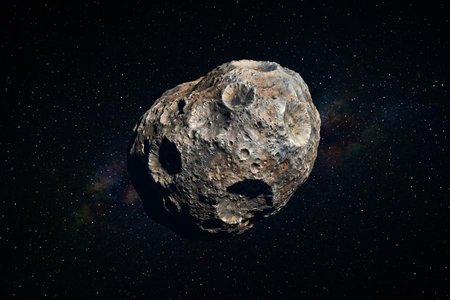
Astronomy. any of millions of small celestial objects revolving around the sun, often irregularly shaped and having a great range in size, from as small as 6 feet (2 meters) across to about 620 miles (998 kilometers) across: the vast majority of known asteroids exist within the asteroid belt.
-
Zoology. a starfish; an asteroidean.
adjective
noun
-
Also called: minor planet, planetoid. any of numerous small celestial bodies that move around the sun mainly between the orbits of Mars and Jupiter. Their diameters range from 930 kilometres (Ceres) to less than one kilometre
-
Also called: asteroidean. any echinoderm of the class Asteroidea; a starfish
adjective
-
of, relating to, or belonging to the class Asteroidea
-
shaped like a star
-
Any of numerous small solar system bodies that orbit the Sun primarily in the asteroid belt, a region between the orbits of Mars and Jupiter. Asteroids are intermediate in size between planets and meteoroids with diameters that measure between approximately one hundred and several hundred kilometers. While more than 1,800 asteroids have been cataloged, and as many as a million or more smaller ones may exist, their total mass has been estimated to be less than three percent of the Moon's. Asteroids are thought to be left over from the early formation of the solar system, when planetesimals in a protoplanetary disk were scattered after coming under Jupiter's gravitational influence. The continuing collision of planetesimals that remained between Jupiter and Mars caused many of them to fragment, creating the asteroids that exist today.
-
Also called minor planet planetoid
Other Word Forms
Derived Forms
Inflected Forms
Nouns
Etymology
Origin of asteroid
First recorded in 1795–1805; from Greek asteroeidḗs “starry, starlike”; see star, -oid
Explanation

An asteroid is a large, irregularly shaped object in space that orbits our Sun. If one of these giant rocks ends up on a collision course with Earth, we are in for big trouble. An asteroid is like a comet. However, while comets are mostly made of ice, asteroids are made up of rock or even metal. This makes them dangerous because they can cause a lot of damage if they collide with a planet. The craters on the Moon were formed by asteroids and some think it was an asteroid that wiped out the dinosaurs. Around a million asteroids are located between Mars and Jupiter in an area called the “asteroid belt.”
Vocabulary lists containing asteroid
Over The Moon: Planetary Vocabulary
Looking to grow your vocabulary? Check out this interactive, curated word list from our team of English language specialists at Vocabulary.com – one of over 17,000 lists we've built to help learners worldwide!
Oh, My Stars! A Solstice Sampler
Interested in learning more words like this one? Our team at Vocabulary.com has got you covered! You can review flashcards, quiz yourself, practice spelling, and more – and it's all completely free to use!
Elements of the Universe: Aster, Astro ("Star")
Want to remember this word for good? Start your learning journey today with our library of interactive, themed word lists built by the experts at Vocabulary.com – we'll help you make the most of your study time!
Example Sentences
Examples are provided to illustrate real-world usage of words in context. Any opinions expressed do not reflect the views of Dictionary.com.
See Examples For:
He says some of the projections by the stay side are all "doom and gloom", joking that the only possible negative they failed to include is "a large asteroid hitting Canada".
From BBC ● Oct. 7, 2026

But Catlos said the teeth were probably already millions of years old by the time the asteroid struck.
From Science Daily ● Oct. 4, 2026

Those measurements bolstered the idea that the asteroid impact intensified volcanic activity, creating a one-two punch that contributed to the extinction of all non-avian dinosaurs.
From Science Daily ● Sep. 30, 2026
It formed near the Moon's eastern edge sometime between April 11 and May 22, 2024, when an asteroid or comet roughly the size of a three- to six-story building struck the surface.
From Science Daily ● Sep. 18, 2026
But what if the flashes were instead caused by the impact of a small asteroid or a piece of a comet?
From "Cosmos" by Carl Sagan

The "capture" hypothesis meanwhile postulates that the moons are asteroids from the outer Solar System that were captured by Mars' gravity.
From Barron's ● Aug. 16, 2026

This occurs when the Earth passes through trials of debris from asteroids or comets.
From BBC ● Aug. 12, 2026
Meteor showers happen when the Earth passes through trails of debris from asteroids or comets - a snowball of frozen rock and gas orbiting the Sun.
From BBC ● Aug. 11, 2026
Some asteroids are carbonaceous, meaning they contain carbon and water ice.
From Science Daily ● Aug. 7, 2026
The arresting analogy that is always made is that the number of people in the world who are actively searching for asteroids is fewer than the staff of a typical McDonald’s restaurant.
From "A Short History of Nearly Everything" by Bill Bryson
Definitions and idiom definitions from Dictionary.com Unabridged, based on the Random House Unabridged Dictionary, © Random House, Inc. 2023
Idioms from The American Heritage® Idioms Dictionary copyright © 2002, 2001, 1995 by Houghton Mifflin Harcourt Publishing Company. Published by Houghton Mifflin Harcourt Publishing Company.
