burrow
Americannoun
-
burrows
plural
-
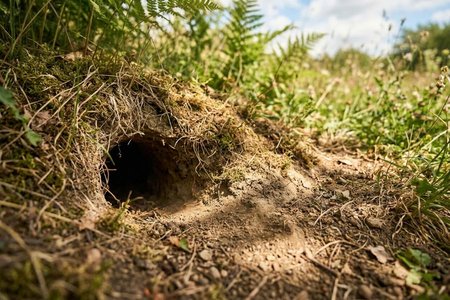
a hole or tunnel in the ground made by a rabbit, fox, or similar animal to live or hide in.
Even in winter, chipmunks are active in their burrows and emerge on sunny days.
-
a place of retreat; shelter or refuge.
His study is his burrow—we have to coax him out for every meal.
verb (used without object)
-
burrows,
present (3rd person singular)
-
burrowed,
past participle, past
-
burrowing
present participle
-
to make a hole or passage in, into, or under something.
This small bird can survive cold Arctic nights by burrowing into the snow.
-
to lodge in an underground hole or tunnel.
Many rodents burrow over the winter.
-
to hide.
My cat likes to burrow under the rug and surprise me by jumping out as I walk past.
Fleeing fame, he burrowed in a small town to focus on his family for a decade or so.
-
to proceed by or as if by digging.
Buried under sediment, the clams can burrow up to the surface from a depth of 16 inches.
Stray dogs burrowed through the piles of trash looking for scraps.
-
to penetrate deeply into something so as to investigate, exploit, or influence it, etc..
In her book on the brain, the writer burrows into the workings of an organ once deemed unknowable.
These nasty computer viruses are adept at burrowing into your system.
verb (used with object)
-
burrows,
present (3rd person singular)
-
burrowed,
past participle, past
-
burrowing
present participle
-
to dig holes or passages into (a hill, mountainside, etc.).
When earthworms burrow the soil, they aerate it and help plant roots to penetrate deeper.
-
to hide or shelter in a safe, snug space.
The abandoned pup had burrowed itself in the straw of the barn out of pure fear.
She burrowed the runt piglet in her coat till she had completed her chores in the barn.
-
to make by or as if by digging.
We burrowed our way through the crowd.
verb phrase
noun
-
a hole or tunnel dug in the ground by a rabbit, fox, or other small animal, for habitation or shelter
-
a small snug place affording shelter or retreat
verb
-
to dig (a burrow) in, through, or under (ground)
-
to move through by or as by digging
to burrow through the forest
-
(intr) to hide or live in a burrow
-
(intr) to delve deeply
he burrowed into his pockets
-
to hide (oneself)
Other Word Forms
Derived Forms
Inflected Forms
Nouns
Participles
Conjugated Forms
Present
-
burrowsimple
-
burrowssimple
-
have burrowedperfect
-
has burrowedperfect
-
am burrowingprogressive
-
are burrowingprogressive
-
is burrowingprogressive
-
have been burrowingperfect progressive
-
has been burrowingperfect progressive
Past
-
burrowedsimple
-
had burrowedperfect
-
was burrowingprogressive
-
were burrowingprogressive
-
had been burrowingperfect progressive
Future
Etymology
Origin of burrow
First recorded in 1325–75; Middle English borow, earlier burh, of uncertain origin; perhaps from Old English gebeorg “refuge,” noun derivative of beorgan “to hide, protect, preserve” (compare late Middle English beri “burrow,” variant of earlier berg “refuge”); akin to Old English burgen “grave” (in the sense “place of protection for a body”); cf. bury
Explanation

Rabbits live in a burrow or a set of tunnels under the earth. They make these tunnels by burrowing, or digging holes with their bodies. Just one letter separates burrow from borrow. To remember the difference, think of the 'u' in burrow as the 'u' for under. Burrows are always underground, and when you burrow under something, you are always going beneath it. Worms can burrow into apples, and on a cold day, you might decide that you'd rather stay in and burrow underneath your blankets.
Vocabulary lists containing burrow
"There Will Come Soft Rains" by Ray Bradbury (1950)
Looking to grow your vocabulary? Check out this interactive, curated word list from our team of English language specialists at Vocabulary.com – one of over 17,000 lists we've built to help learners worldwide!
50 Great Words from The Curious Incident of the Dog in the Night-Time, by Mark Haddon
Interested in learning more words like this one? Our team at Vocabulary.com has got you covered! You can review flashcards, quiz yourself, practice spelling, and more – and it's all completely free to use!
James and the Giant Peach
Want to remember this word for good? Start your learning journey today with our library of interactive, themed word lists built by the experts at Vocabulary.com – we'll help you make the most of your study time!
Example Sentences
Examples are provided to illustrate real-world usage of words in context. Any opinions expressed do not reflect the views of Dictionary.com.
See Examples For:
After hatching, the larvae burrow into the tissue and begin feeding.
From Science Daily ● Sep. 15, 2026

This is an "active burrow", the conservationist said, explaining that the water voles have been "mushing" their droppings.
From BBC ● Aug. 14, 2026

In one, a female marmot known as “1” chases away a curious male named “G” as he pokes around her burrow, screeching as they go.
From Los Angeles Times ● Aug. 3, 2026

Diggers are already clearing parts of the OPP complex, shaking the ruins even as volunteers and families continue to burrow for the bodies of loved ones.
From Barron's ● Jul. 6, 2026

I tried to burrow a little deeper into my coat.
From "Made You Up" by Francesca Zappia

It burrows deep into the legal past in search of an artifact that will indisputably resolve a difficult issue—even though 21st-century English speakers can read our Constitution without difficulty.
From The Wall Street Journal ● Oct. 2, 2026

Some animals make short daily trips back to nests or burrows after searching for food, while others navigate across vast distances over weeks or months.
From Science Daily ● Sep. 14, 2026
Trail parking lots there sit next to a boulder-strewn meadow where marmot mothers nurse their young in burrows, making nearby cars irresistible targets, said park spokeswoman Holly Streit.
From The Wall Street Journal ● Aug. 27, 2026
But wildlife experts are very familiar with the little penguins' burrows at Phillip Island and St Kilda, he said.
From Barron's ● Aug. 20, 2026
The skunks had burrows and plugged themselves in at dawn with bunches of leaves.
From "My Side of the Mountain" by Jean Craighead George
A punk-vicious “Subdivisions” — “Be cool or be cast out,” go the lyrics — benefited from added grit, while 1984’s “Distant Early Warning” burrowed into nuclear anxiety with unstoppable momentum.
From Los Angeles Times ● Jun. 8, 2026
The two-year-old male, named Neukgu, burrowed under a fence at Daejeon O-World zoo and theme park in the central city of Daejeon on Wednesday, officials said.
From BBC ● Apr. 10, 2026
Suddenly, the Irish tails were up and replacement prop Michael Milne burrowed over.
From Barron's ● Feb. 5, 2026
During Thanksgiving week, from the soft neutral cocoon of my parents’ guest room, I burrowed into an impulsive rewatch of the BBC “Sherlock” — yes, the Benedict Cumberbatch era, all sculptural cheekbones and good outerwear.
From Salon ● Dec. 2, 2025

Finn burrowed his face harder against Mom’s side.
From "The Strangers" by Margaret Peterson Haddix
Scabies is caused by microscopic mites burrowing under the skin and it spreads through close skin contact.
From BBC ● Sep. 30, 2026
Granted, the bar for Netflix movies has long since descended past Hell’s ninth circle, burrowing so low that it’s carved out a 10th reserved for the streamer’s original titles.
From Salon ● Sep. 2, 2026
Construction appears ongoing at the site, which includes tunnels burrowing into the granite mountain from the east and west.
From The Wall Street Journal ● Jul. 17, 2026
Just civilian volunteers burrowing through the jagged piles.
From Los Angeles Times ● Jun. 30, 2026
Cora marched past them, bent as if burrowing her body into a gale.
From "The Underground Railroad: A Novel" by Colson Whitehead
Definitions and idiom definitions from Dictionary.com Unabridged, based on the Random House Unabridged Dictionary, © Random House, Inc. 2023
Idioms from The American Heritage® Idioms Dictionary copyright © 2002, 2001, 1995 by Houghton Mifflin Harcourt Publishing Company. Published by Houghton Mifflin Harcourt Publishing Company.
