asteroid
Americannoun
-
asteroids
plural
-
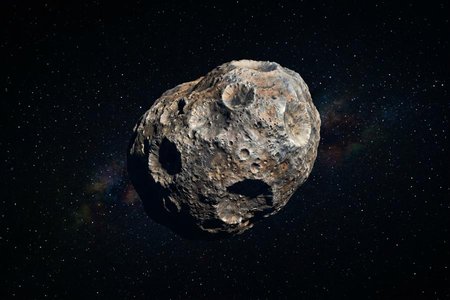
Astronomy. any of millions of small celestial objects revolving around the sun, often irregularly shaped and having a great range in size, from as small as 6 feet (2 meters) across to about 620 miles (998 kilometers) across: the vast majority of known asteroids exist within the asteroid belt.
-
Zoology. a starfish; an asteroidean.
adjective
noun
-
Also called: minor planet, planetoid. any of numerous small celestial bodies that move around the sun mainly between the orbits of Mars and Jupiter. Their diameters range from 930 kilometres (Ceres) to less than one kilometre
-
Also called: asteroidean. any echinoderm of the class Asteroidea; a starfish
adjective
-
of, relating to, or belonging to the class Asteroidea
-
shaped like a star
-
Any of numerous small solar system bodies that orbit the Sun primarily in the asteroid belt, a region between the orbits of Mars and Jupiter. Asteroids are intermediate in size between planets and meteoroids with diameters that measure between approximately one hundred and several hundred kilometers. While more than 1,800 asteroids have been cataloged, and as many as a million or more smaller ones may exist, their total mass has been estimated to be less than three percent of the Moon's. Asteroids are thought to be left over from the early formation of the solar system, when planetesimals in a protoplanetary disk were scattered after coming under Jupiter's gravitational influence. The continuing collision of planetesimals that remained between Jupiter and Mars caused many of them to fragment, creating the asteroids that exist today.
-
Also called minor planet planetoid
Other Word Forms
Derived Forms
Inflected Forms
Nouns
Etymology
Origin of asteroid
First recorded in 1795–1805; from Greek asteroeidḗs “starry, starlike”; see star, -oid
Explanation

An asteroid is a large, irregularly shaped object in space that orbits our Sun. If one of these giant rocks ends up on a collision course with Earth, we are in for big trouble. An asteroid is like a comet. However, while comets are mostly made of ice, asteroids are made up of rock or even metal. This makes them dangerous because they can cause a lot of damage if they collide with a planet. The craters on the Moon were formed by asteroids and some think it was an asteroid that wiped out the dinosaurs. Around a million asteroids are located between Mars and Jupiter in an area called the “asteroid belt.”
Vocabulary lists containing asteroid
Over The Moon: Planetary Vocabulary
Looking to grow your vocabulary? Check out this interactive, curated word list from our team of English language specialists at Vocabulary.com – one of over 17,000 lists we've built to help learners worldwide!
Oh, My Stars! A Solstice Sampler
Interested in learning more words like this one? Our team at Vocabulary.com has got you covered! You can review flashcards, quiz yourself, practice spelling, and more – and it's all completely free to use!
Elements of the Universe: Aster, Astro ("Star")
Want to remember this word for good? Start your learning journey today with our library of interactive, themed word lists built by the experts at Vocabulary.com – we'll help you make the most of your study time!
Example Sentences
Examples are provided to illustrate real-world usage of words in context. Any opinions expressed do not reflect the views of Dictionary.com.
See Examples For:
Hera's observations will help answer some of the biggest questions left unanswered by NASA's first asteroid deflection experiment.
From Science Daily ● Nov. 17, 2026

"Previous predictions by our impact models suggested many different ways the asteroid body might react, but Hera will reveal which forecast was the correct one - if any!"
From Science Daily ● Nov. 17, 2026
Did the collision excavate a large crater, or did it significantly reshape the entire asteroid?
From Science Daily ● Nov. 17, 2026
Such a capability could prove critical if an asteroid were ever discovered on a collision course with Earth.
From Science Daily ● Nov. 16, 2026
A makeweightflying to the void Supplemental asteroid Or compensatory spark Shoots across the neutral dark.
From "Seabiscuit: An American Legend" by Laura Hillenbrand

Instead, it is made up of sharp, irregular fragments produced by billions of years of impacts from asteroids, micrometeorites, and other debris striking the Moon.
From Science Daily ● Nov. 20, 2026
Navigating around asteroids presents challenges that are very different from those encountered by spacecraft exploring planets.
From Science Daily ● Nov. 17, 2026
If a planned thruster firing fails, Hera will naturally drift farther from the asteroids instead of moving toward a potentially dangerous collision.
From Science Daily ● Nov. 17, 2026
At alternating intervals of three and four days, the spacecraft fires its thrusters while moving away from the asteroids, changing direction by 90 degrees.
From Science Daily ● Nov. 17, 2026
I know from years of planetarium visits that craters on the moon were caused by asteroids and meteoroids crashing into the lunar surface, especially when the moon was very, very young.
From "Shine!" by J.J. and Chris Grabenstein
Random Word
Spin the wheel and learn a new word!
Get a wordDefinitions and idiom definitions from Dictionary.com Unabridged, based on the Random House Unabridged Dictionary, © Random House, Inc. 2023
Idioms from The American Heritage® Idioms Dictionary copyright © 2002, 2001, 1995 by Houghton Mifflin Harcourt Publishing Company. Published by Houghton Mifflin Harcourt Publishing Company.
