magnet
noun
a body, as a piece of iron or steel, that possesses the property of attracting certain substances, as iron.
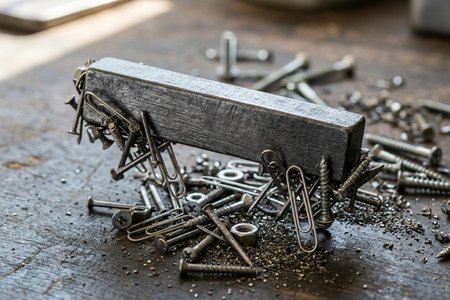
a body, as a piece of iron or steel, that possesses the property of attracting certain substances, as iron.
a lodestone.
a thing or person that attracts.
The park was a magnet for pickpockets and muggers.
a body that can attract certain substances, such as iron or steel, as a result of a magnetic field; a piece of ferromagnetic substance See also electromagnet
a person or thing that exerts a great attraction
A material or object that produces a magnetic field. Lodestones are natural magnets, though many materials, especially metals, can be made into magnets by exposing them to a magnetic field.
See also electromagnet ferromagnetism magnetic pole See Note at magnetism
1400–50; late Middle English magnete < Latin magnēta < Greek mágnēta, accusative of mágnēs, short for ( hē ) Mágnēs ( líthos ) (the stone) of Magnesia

A magnet is a piece of metal with a strong attraction to another metal object. The attraction a magnet produces is called a "magnetic field." You might cover the front of your refrigerator with magnets, which stick to its metal surface. Other kinds of magnets are even more powerful, strong enough to pick up entire cars, for example. Most magnets are made of iron or an iron alloy, and magnets are at the heart of many common items like cassette tapes, credit cards, toys, and compasses.
Looking to grow your vocabulary? Check out this interactive, curated word list from our team of English language specialists at Vocabulary.com – one of over 17,000 lists we've built to help learners worldwide!
Interested in learning more words like this one? Our team at Vocabulary.com has got you covered! You can review flashcards, quiz yourself, practice spelling, and more – and it's all completely free to use!
Want to remember this word for good? Start your learning journey today with our library of interactive, themed word lists built by the experts at Vocabulary.com – we'll help you make the most of your study time!
Examples are provided to illustrate real-world usage of words in context. Any opinions expressed do not reflect the views of Dictionary.com.
On one side are some parents, police union leaders and students who participate in the district’s police academy magnet programs.
From Los Angeles Times ● Oct. 7, 2026

In Chengdu, a second-tier city in China’s southwest that was once a magnet for young professionals, secondary-market property prices have fallen at least 15% since their peak in 2023, Srinivasan said.
From The Wall Street Journal ● Oct. 6, 2026

"You've taken us for fools long enough," read a banner beneath a display depicting BFV officials using a magnet to pull a compass needle towards them.
From BBC ● Oct. 2, 2026

In that simple contest, the electromagnetic force produced by the magnet easily overcomes gravity.
From Science Daily ● Sep. 20, 2026

Her elementary school is a magnet school, so even though we moved across town, she can still keep going there.
From "A Soft Place to Land" by Janae Marks

This is the first record of magnet- ism.
From Science and Health, with Key to the Scriptures by Mary Baker Eddy

It is the only non-Chinese commercial producer of so-called heavy rare earths, such as dysprosium and terbium, which are added to magnets to help them run more efficiently at higher temperatures.
From The Wall Street Journal ● Oct. 1, 2026
Four points down at the break, Dave Rennie's side had hopes of taking home half of a specially-designed series trophy, which, held together by magnets, can be shared between the two sides.
From BBC ● Sep. 12, 2026
Even powerful lab magnets can only cover a relatively small region.
From Science Daily ● Sep. 6, 2026
That requires frequent adjustments to systems such as the tokamak's heating equipment, magnets and gas injectors.
From Science Daily ● Sep. 6, 2026
She is different from my biological mom, with whom I have those powerful memories that always acted like magnets connecting me to her no matter how much time passed or what circumstances intervened.
From "Three Little Words: A Memoir" by Ashley Rhodes-Courter
Definitions and idiom definitions from Dictionary.com Unabridged, based on the Random House Unabridged Dictionary, © Random House, Inc. 2023
Idioms from The American Heritage® Idioms Dictionary copyright © 2002, 2001, 1995 by Houghton Mifflin Harcourt Publishing Company. Published by Houghton Mifflin Harcourt Publishing Company.
