meteor
meteor
1 American
[mee-tee-er, -awr]
/ ˈmi ti ər, -ˌɔr /
noun
-
meteors
plural
-
Astronomy.
-
any person or object that moves, progresses, becomes famous, etc., with spectacular speed.
-
(formerly) any atmospheric phenomenon, as hail or a typhoon.
-
Military. Meteor, Britain's first operational jet fighter, a twin-engine aircraft that entered service in 1944.
meteor.
2
American
abbreviation
-
meteorological.
-
meteorology.
meteor
British
/ ˈmiːtɪə /
noun
-
a very small meteoroid that has entered the earth's atmosphere. Such objects have speeds approaching 70 kilometres per second
-
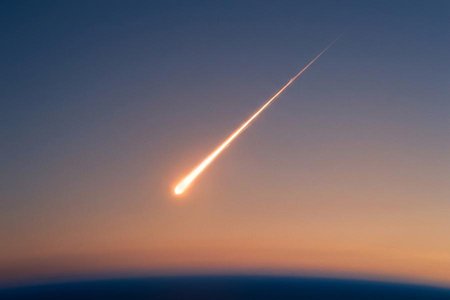
Also called: shooting star, falling star. the bright streak of light appearing in the sky due to the incandescence of such a body heated by friction at its surface
meteor
Scientific
/ mē′tē-ər /
-
A bright trail or streak of light that appears in the night sky when a meteoroid enters the Earth's atmosphere. The friction with the air causes the rock to glow with heat.
-
Also called shooting star
-
A rocky body that produces such light. Most meteors burn up before reaching the Earth's surface.
-
See Note at solar system
meteor
Cultural
Usage
What is a meteor? A meteor is space matter that has entered Earth’s atmosphere, as in I was able to see a meteor enter our atmosphere last night through my telescope. A meteor is also the bright, fiery streak that is visible in the sky when a meteor burns up. Meteors are often referred to as shooting stars or falling stars. Simply put, a meteor is a meteoroid that has entered Earth’s atmosphere. A meteoroid is a small body of matter usually composed of dust or rock that travels through outer space. A meteor that reaches Earth’s surface is called a meteorite. Meteor is sometimes used figuratively to mean something that moves or advances at high speed, as in The new rock band was a meteor that shot up the charts. The adjective meteoric describes something involved with or related to a meteor. Meteoric is also used to describe something that resembles a meteor in terms of brightness or speed, as in We were amazed by her meteoric rise to stardom in Hollywood. A large number of meteors traveling through Earth’s surface at one time is called a meteor shower. Example: She took great pictures of last night’s meteor as it zoomed across the sky.
Discover More
Meteor showers occur at regular times during the year.
Other Word Forms
Derived Forms
Inflected Forms
Nouns
Etymology
Origin of meteor
First recorded in 1570–80; from New Latin meteōrum, from Greek metéōron “meteor, a thing in the air,” noun use of neuter of metéōros “raised in the air,” equivalent to met- met- + eōr- (variant stem of aeírein “to raise”) + -os adjective suffix
Explanation

A meteor is a space rock that hits Earth's atmosphere. It's also another word for a shooting star — which is not a star at all, but a streak of light visible in the sky when a meteor burns up in the atmosphere. There are a lot of large objects in space: stars, planets, and moons. There are smaller bodies, too, such as meteoroids — small chunks of rock or metal orbiting the sun. When a meteoroid enters Earth's atmosphere, it becomes a meteor. This word is also used for the streak of light caused when this happens, commonly called a shooting star. Sometimes there are meteor showers, when Earth passes through a trail of space objects that then burn up due to friction with Earth's atmosphere.
Vocabulary lists containing meteor
Over The Moon: Planetary Vocabulary
Looking to grow your vocabulary? Check out this interactive, curated word list from our team of English language specialists at Vocabulary.com – one of over 17,000 lists we've built to help learners worldwide!
List 1
Interested in learning more words like this one? Our team at Vocabulary.com has got you covered! You can review flashcards, quiz yourself, practice spelling, and more – and it's all completely free to use!
Space Science (Astronomy) - Introductory
Want to remember this word for good? Start your learning journey today with our library of interactive, themed word lists built by the experts at Vocabulary.com – we'll help you make the most of your study time!
Example Sentences
Examples are provided to illustrate real-world usage of words in context. Any opinions expressed do not reflect the views of Dictionary.com.
See Examples For:
One key question is whether extinction events were triggered primarily by forces from space, such as meteor impacts, or by processes within Earth, including episodes of massive volcanic activity.
From Science Daily ● Oct. 4, 2026

"This lets us more precisely infer causality between events in the geologic record, for example a meteor impact structure and a mass extinction," Renne said.
From Science Daily ● Sep. 30, 2026
Her daughter would arrive 13 days late, she wrote, “in the face of a solar eclipse and meteor shower,” which places the child’s birth date around Aug. 12.
From Los Angeles Times ● Sep. 16, 2026

Another meteor shower arrives later in November, with the Leonids expected to peak around 17 November.
From BBC ● Sep. 12, 2026

“But it’s still happening, right? Like, there is still a meteor shower. We just can’t see it.”
From "Turtles All the Way Down" by John Green

“In the case of climate, we are not the dinosaurs — we are the meteor. We are not only in danger — we are the danger. But we are also the solution.”
From Los Angeles Times ● Jun. 6, 2024
A bolide is the only noisy type of meteor.*
From Time Magazine Archive
This consequence is so dependant, that Fromondus De meteor. l.
From The Discovery of a World in the Moone Or, A Discovrse Tending To Prove That 'Tis Probable There May Be Another Habitable World In That Planet by John Wilkins

Another proof of Athene's connection with storm is the miracle she works when she sets a flame to fly from the head of Diomede or of Achilles,*** or fleets from the sky like a meteor.****
From Myth, Ritual And Religion, Vol. 2 (of 2) by Andrew Lang
The best time to spot the meteors will be between midnight and dawn, when the sky is at its darkest.
From BBC ● Sep. 30, 2026
They get their name from the constellation Leo, from which the meteors appear to radiate.
From BBC ● Sep. 12, 2026
These meteors are visible all around the world and named because they appear to originate from the constellation Perseus.
From BBC ● Aug. 11, 2026
Light pollution will hide the fainter meteors, leaving only the brightest ones visible.
From BBC ● Aug. 11, 2026
On some nights you can see a shower of meteors, always on the same few days of every year—a natural fireworks display, an entertainment in the heavens.
From "Cosmos" by Carl Sagan
Definitions and idiom definitions from Dictionary.com Unabridged, based on the Random House Unabridged Dictionary, © Random House, Inc. 2023
Idioms from The American Heritage® Idioms Dictionary copyright © 2002, 2001, 1995 by Houghton Mifflin Harcourt Publishing Company. Published by Houghton Mifflin Harcourt Publishing Company.
