visit
Americanverb (used with object)
-
visits,
present (3rd person singular)
-
visited,
past participle, past
-
visiting
present participle
-
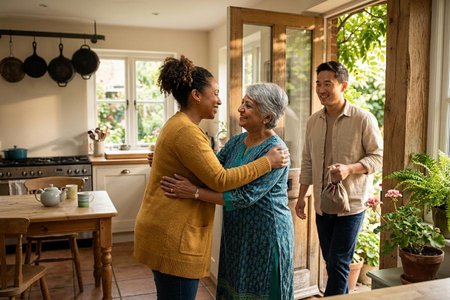
to go to and stay with (a person or family) or at (a place) for a short time for reasons of sociability, politeness, business, curiosity, etc..
to visit a friend; to visit clients; to visit Paris.
-
to stay with as a guest.
-
to come or go to.
to visit a church for prayer.
-
to go to for the purpose of official inspection or examination.
a general visiting his troops.
-
to come to in order to comfort or aid.
to visit the sick.
-
to come upon; assail; afflict.
The plague visited London in 1665.
-
to cause trouble, suffering, etc., to come to.
to visit him with sorrows.
-
to access, as a website.
-
to inflict, as punishment, vengeance, etc. (often followed by on orupon ).
verb (used without object)
-
visits,
present (3rd person singular)
-
visited,
past participle, past
-
visiting
present participle
-
to make a visit.
-
to talk or chat casually.
to visit on the phone with a friend.
-
to inflict punishment.
noun
-
visits
plural
-
the act of or an instance of visiting.
a nice, long visit.
-
a chat or talk.
We had a good visit on the way back from the grocery store.
-
a call paid to a person, family, etc.
-
a stay or sojourn as a guest.
-
an official inspection or examination.
-
the act of an officer of a belligerent nation in boarding a vessel in order to ascertain the nature of its cargo, its nationality, etc..
the right of visit and search.
verb
-
to go or come to see (a person, place, etc)
-
to stay with (someone) as a guest
-
to go or come to (an institution, place, etc) for the purpose of inspecting or examining
-
(tr) (of a disease, disaster, etc) to assail; afflict
-
(tr; foll by upon or on) to inflict (punishment, etc)
the judge visited his full anger upon the defendant
-
archaic to afflict or plague (with punishment, etc)
-
informal (often foll by with) to chat or converse (with someone)
noun
-
the act or an instance of visiting
-
a stay as a guest
-
a professional or official call
-
a formal call for the purpose of inspection or examination
-
international law the right of an officer of a belligerent state to stop and search neutral ships in war to verify their nationality and ascertain whether they carry contraband
the right of visit and search
-
informal a friendly talk or chat
Other Word Forms
Derived Forms
-
previsitnoun
-
revisitverb
-
intervisitverb (used without object)
-
nonvisitingadjective
-
unvisitedadjective
-
unvisitingadjective
-
visitableadjective
Inflected Forms
Nouns
Participles
Conjugated Forms
Present
-
visitsimple
-
visitssimple
-
have visitedperfect
-
has visitedperfect
-
am visitingprogressive
-
are visitingprogressive
-
is visitingprogressive
-
have been visitingperfect progressive
-
has been visitingperfect progressive
Past
-
visitedsimple
-
had visitedperfect
-
was visitingprogressive
-
were visitingprogressive
-
had been visitingperfect progressive
Future
Etymology
Origin of visit
First recorded in 1175–1225; Middle English visiten (verb), from Old French visiter, from Latin vīsitāre “to see repeatedly,” from vīsere “to go to see,” from vidēre “to see”; noun derivative of the verb
Explanation

When you travel to another place, or spend some time at a friend's house, it's a visit. You should visit your grandmother! It's been a while since she's had a visit from you. Whenever you spend a temporary amount of time with another person or in another place, that's a visit — whether it's your visit to San Francisco or your visit to the doctor for a checkup. In some parts of the U.S., visit is also a name for a chat: "I had a nice visit with your Aunt Sylvia yesterday." And if you pay a visit to someone, you go see them for a while.
Vocabulary lists containing visit
Example Sentences
Examples are provided to illustrate real-world usage of words in context. Any opinions expressed do not reflect the views of Dictionary.com.
See Examples For:
Skip the hay bale photo op and the overextended visit to the pumpkin patch.
From The Wall Street Journal ● Oct. 21, 2026

An interview with Prince Harry with GQ was released as the state visit was getting under way.
From BBC ● Oct. 20, 2026

And with the help of a former hacker turned cybersecurity expert, she tracks the man behind the mask to his home in West Africa and pays him a visit.
From Los Angeles Times ● Oct. 20, 2026

US Secretary of State Marco Rubio arrived in India on Tuesday, his second official visit to the country this year, as he pursues an Asian tour blending diplomacy and trade.
From Barron's ● Oct. 20, 2026

It is too late for an autopsy, and California is too far for a research visit.
From "Phineas Gage" by John Fleischman

State visits are a mix of pageantry and politics, with the carefully choreographed hospitality providing an opportunity for talks about important strategic alliances and to promote military and business links.
From BBC ● Oct. 20, 2026
Disney offered creators a wide variety of future opportunities, including set visits, press junkets and red carpet interviews with talent.
From Los Angeles Times ● Oct. 19, 2026
Instead he will focus on investment and energy during visits to financial hub Mumbai and India's oil hub of Jamnagar, which is home to billionaire Mukesh Ambani's refining complex, the world's largest.
From Barron's ● Oct. 18, 2026
Soni and his wife invested more than $30,000 gut-renovating and furnishing their home’s ground-floor apartment for their parents’ monthslong visits from India.
From The Wall Street Journal ● Oct. 17, 2026
During his visits, reporters kept tabs on him, printing stories about his cowboy adventures in the newspaper, which kept him in the public eye.
From "Death on the River of Doubt" by Samantha Seiple
Alongside Iran, the soaring cost of living was a recurring theme for the households visited by Banks and Starr.
From Barron's ● Oct. 21, 2026
In August Mr. Putin visited the islands, which Russia captured in 1945 and whose legitimate control is disputed by Japan.
From The Wall Street Journal ● Oct. 20, 2026
For one assignment, he visited malls and photographed people riding escalators.
From Los Angeles Times ● Oct. 20, 2026
In September, Fleming visited some counties and also spoke of his affection for the domestic game in England.
From BBC ● Oct. 19, 2026
Some days he visited three times a day.
From "American Spirits" by Barb Rosenstock
"This has now been recognised and is becoming a major issue across Europe," he said in a statement broadcast live while visiting the education ministry.
From Barron's ● Oct. 20, 2026
They lost their father and the house they grew up visiting at the same time.
From MarketWatch ● Oct. 20, 2026

Deep cuts: A group of partiers visiting a cabin near Crystal Lake join forces with a brother who is searching for his missing sister.
From Los Angeles Times ● Oct. 19, 2026
State media and Russian outlets have published images of small groups of Russian tourists visiting the Wonsan Kalma resort, which opened in July 2025.
From BBC ● Oct. 17, 2026
As far as is known, she stayed away from the séance table even when visiting friends, family, and believers.
From "American Spirits" by Barb Rosenstock
Random Word
Spin the wheel and learn a new word!
Get a wordDefinitions and idiom definitions from Dictionary.com Unabridged, based on the Random House Unabridged Dictionary, © Random House, Inc. 2023
Idioms from The American Heritage® Idioms Dictionary copyright © 2002, 2001, 1995 by Houghton Mifflin Harcourt Publishing Company. Published by Houghton Mifflin Harcourt Publishing Company.
