volcano
Americannoun
-
volcanoes,
plural
-
volcanos
plural
-
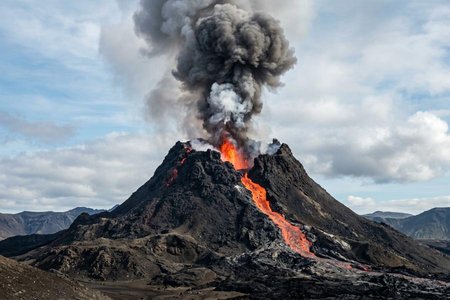
a vent in the earth's crust through which lava, steam, ashes, etc., are expelled, either continuously or at irregular intervals.
-
a mountain or hill, usually having a cuplike crater at the summit, formed around such a vent from the ash and lava expelled through it.
noun
-
an opening in the earth's crust from which molten lava, rock fragments, ashes, dust, and gases are ejected from below the earth's surface
-
a mountain formed from volcanic material ejected from a vent in a central crater
-
An opening in the Earth's crust from which lava, ash, and hot gases flow or are ejected during an eruption.
-
A usually cone-shaped mountain formed by the materials issuing from such an opening. Volcanoes are usually associated with plate boundaries but can also occur within the interior areas of a tectonic plate. Their shape is directly related to the type of magma that flows from them—the more viscous the magma, the steeper the sides of the volcano.
-
◆ A volcano composed of gently sloping sheets of basaltic lava from successive volcanic eruptions is called a shield volcano. The lava flows associated with shield volcanos, such as Mauna Loa, on Hawaii, are very fluid.
-
◆ A volcano composed of steep, alternating layers of lava and pyroclastic materials, including ash, is called a stratovolcano. Stratovolcanos are associated with relatively viscous lava and with explosive eruptions. They are the most common form of large continental volcanos. Mount Vesuvius, Mount Fuji, and Mount St. Helens are stratovolcanos.
-
Also called composite volcano
-
See more at hot spot island arc tectonic boundary volcanic arc
Discover More
Volcanoes tend to occur along the edges of tectonic plates.
Eruptions and lava flows associated with them can be very destructive. (See Mount Saint Helens and Mount Vesuvius.)
Other Word Forms
Noun Inflected Forms
Etymology
Origin of volcano
1605–15; < Italian < Latin Volcānus, variant of Vulcānus Vulcan
Explanation

When the earth's crust cracks open and spews hot lava and gases, you've got a volcano on your hands. You better run. The noun volcano comes from the name of the Roman god of fire, Vulcan. The Romans believed Vulcan had a forge in Mt. Etna, a volcano in Italy. The term can be applied to a vent in a planet's surface or crust. Lava, ash, and gas escape through the vent. The term volcano can also apply to a mountain created by such a vent.
Vocabulary lists containing volcano
Physical Geography - Introductory
Looking to grow your vocabulary? Check out this interactive, curated word list from our team of English language specialists at Vocabulary.com – one of over 17,000 lists we've built to help learners worldwide!
Physical Geography - Middle School
Interested in learning more words like this one? Our team at Vocabulary.com has got you covered! You can review flashcards, quiz yourself, practice spelling, and more – and it's all completely free to use!
The United States
Want to remember this word for good? Start your learning journey today with our library of interactive, themed word lists built by the experts at Vocabulary.com – we'll help you make the most of your study time!
Example Sentences
Examples are provided to illustrate real-world usage of words in context. Any opinions expressed do not reflect the views of Dictionary.com.
See Examples For:
He had started leaning on Google’s AI-assisted search for other classes, like when he needed to label the parts of a volcano or write an essay about Edgar Allan Poe’s “The Raven.”
From The Wall Street Journal ● Oct. 1, 2026

It is the second time in recent months that Catania International Airport, on the island of Sicily, has stopped flights due to emissions from Etna, which is Europe's tallest active volcano and erupts frequently.
From BBC ● Sep. 15, 2026

Because the volcano erupted beneath the ocean, it blasted enormous quantities of salty seawater upward along with volcanic ash.
From Science Daily ● Sep. 15, 2026

On Monday, a speedboat carrying eight people, including five journalists working for local and international news agencies went missing near a volcano, Mount Anak Krakatau, in Banten province and a search is ongoing.
From Barron's ● Sep. 13, 2026

The towns nearest the volcano began selling souvenirs, like bumper stickers that read “Lava or Leave It,” and T-shirts that said “Mt. St. Helens, we lava you!”
From "Mountain of Fire" by Rebecca E. F. Barone

Across the surrounding countryside, seepages resemble miniature volcanoes overflowing with crude and leaving hardened black trails.
From Barron's ● Sep. 26, 2026
Hiding vegetables is a technique we tend to leave behind somewhere around the age of dino nuggets and mashed-potato volcanoes.
From Salon ● Sep. 15, 2026

His research focuses on how volcanoes work, particularly what causes some eruptions to become explosive and which processes control their behavior.
From Science Daily ● Sep. 14, 2026
The Pacific Ring of Fire refers to a string of volcanoes, earthquake sites and tectonic plates around the Pacific.
From BBC ● Sep. 7, 2026
Now they had firsthand accounts that volcanoes could—and did—erupt with violent lateral blasts as well as vertical blasts.
From "Mountain of Fire" by Rebecca E. F. Barone
It is not just storms threatening the region, but earthquakes and volcanos too, points out Peter Levy, boss of Jamaican insurance company BCIC.
From BBC ● Oct. 1, 2025
One of the most active volcanos on Earth, Kilauea erupts every 2 to 3 years on average.
From Science Magazine ● May 27, 2024
In addition to lava, volcanos eject large amounts of pumice, ashes and gases as a fast-moving flow, known as "pyroclastic flow," and its sediments are a valuable data source on past eruptions.
From Science Daily ● Feb. 22, 2024
It seemed like an eruption might be imminent … but volcanos are fickle.
From Slate ● Dec. 20, 2023

The hot cakes rose like little hassocks, and small volcanos formed and erupted on them until they were ready to be turned.
From "East of Eden" by John Steinbeck
Definitions and idiom definitions from Dictionary.com Unabridged, based on the Random House Unabridged Dictionary, © Random House, Inc. 2023
Idioms from The American Heritage® Idioms Dictionary copyright © 2002, 2001, 1995 by Houghton Mifflin Harcourt Publishing Company. Published by Houghton Mifflin Harcourt Publishing Company.
