How did this new species of monkey get its name, and what does it mean?
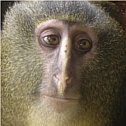 You may have read the news about the discovery of a new species of monkey in Africa, known as the Lesula, or Cercopithecus lomamiensis. The announcement of any new species is thrilling, and Lesula is only the second new primate species to be identified in the past 28 years. When something as rare and significant as this occurs, we immediately turn to where nature meets the dictionary: its name.
When an animal is verified by the scientific community as a new species, who decides its name? And what does the name mean?
You may recall from biology class that scientists use taxonomy, or a classification into categories, to organize all creatures big and small. The eight major tiered groupings are: life, domain, kingdom, phylum, class, order, family, genus, and species.
Species is the level that concerns us, so back to our monkey. When a biologist finds a creature that seems novel, he or she uses the eight categories above to start giving it an identity. Once the genus of an animal is settled, the tricky work of distinguishing one species from another begins. In the case of the Lesula, it is quite similar to a known primate, Cercopithecus Hamlyni, that lives in the neighboring region of the Congo. Cercopithecus is the genus for this subset of primates, and the naming of genera are governed by a set of rules called the Nomenclature Code. In this case, “cerco-“ is a Greek root meaning tailed, and “-pithecus” is Greek for monkey, thus the Ceropithecus is a tailed monkey.
The formal name of an undocumented species follows the rules of Binomial Nomenclature: you may recall from math class that binomial means two. The first part of a name is the genus, as we explained above. The second part is usually the privilege of the team of scientists who discovered the species. Can they name it anything? As long as the name can be treated like a Greek word, the rules are fairly open. Some people have named species after Bob Marley, Stephen Colbert, and many others. Usually, biologists try to have the name make sense. The “lomamiensis” in our new monkey’s name refers to the Lomami River, which flows through the Congo region where the species dwells. In the case of its relative, Cercopithecus Hamlyni, “Hamlyni” derives from the name of an animal trapper who introduced that primate to the scientific community.
You have noted that this entire time we’ve been referring to Cercopithecus lomamiensis as the “Lesula.” This is the name that local people call it. If that’s the case, why can’t the scientific name simply be “Lesula?” The answer is that science requires standardized rules and categories in order to make sense of the millions of species on our planet.
