Three Authors Who Changed the English Language
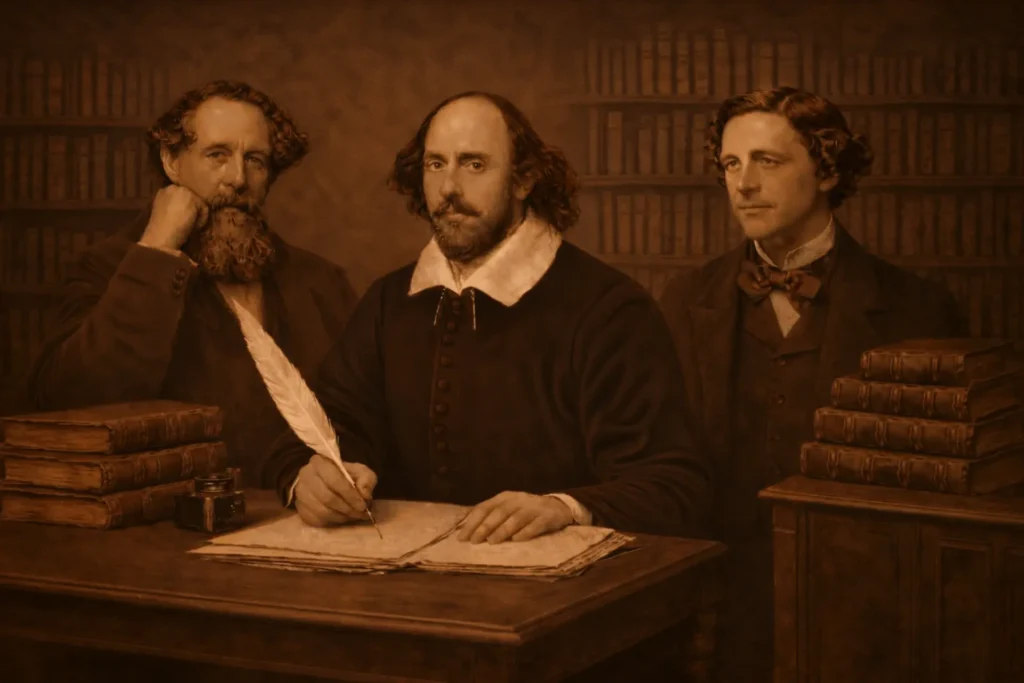
Many authors tell great stories, but some make an impression on language that lasts far beyond the last page. When a writer’s linguistic creativity resonates with readers, their words can take on a life of their own and eventually find a permanent home in the dictionary.
You might not always realize when you’re using a writer’s invention, because sometimes a word feels so natural that it seems like it must have always existed. But if you start looking for these linguistic innovations, patterns emerge. Certain names come up again and again when English takes a leap forward, carried along by imagination rather than rules.
William Shakespeare: Words We Can Feel
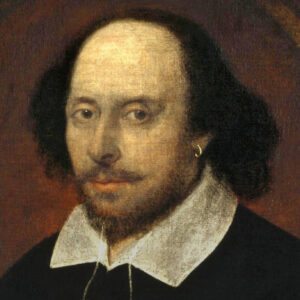
William Shakespeare wrote during the Early Modern English period, an era when the English language was rapidly adding new words, and strict rules of grammar weren’t yet settled. English during this period was wildly flexible, and Shakespeare took advantage of that freedom to freely modify nouns, invent verbs, and coin phrases when he couldn’t find the nuance he was looking for. He bent English to his needs to describe characters and scenes more vividly to capture an audience’s attention and imagination.
Here are just a few of the many new words and phrases that Shakespeare added to the English language:
swagger
verb: to walk or strut with a defiant or insolent air
First appearance (1590s):
“What hempen home-spuns have we swaggering here,
So near the cradle of the fairy queen?”
— A Midsummer Night’s Dream, Act 3, Scene 1
Shakespeare transformed the earlier noun swag into a verb that conveys both movement and attitude. Because Shakespeare wrote for the stage, physicality was a central aspect of his characterization. The word swagger describes a way of walking, but it symbolically captures a way of being. Its sound, rhythm, and energy help make the word memorable, and today it’s part of modern pop culture, symbolizing stylish confidence.
lonely
adjective: affected with, characterized by, or causing a depressing feeling of being alone
First appearance (1616):
“I go alone
Like to a lonely dragon…”
— Coriolanus, Act 4, Scene 1
Shakespeare’s tragedies dealt with internal conflict and psychological strain. The word lonely captured a feeling of emotional isolation that was emerging as a theme in 16th- and 17th-century English literature. Simple yet complex, it remains one of the most resonant emotional words in the English language.
green-eyed monster
noun: jealousy
First appearance (1603–1604):
“O, beware, my lord, of jealousy;
It is the green-eyed monster which doth mock
The meat it feeds on”
— Othello, Act 3, Scene 3
Shakespeare personifies jealousy as a creature — hungry, mocking, and cruel. Though jealousy had long been associated with the color green, this phrase was Shakespeare’s invention. In Othello, jealousy isn’t just a feeling; it’s a destructive force of nature. Shakespeare wanted a metaphor capable of embodying the psychological horror that drives the play, and he created one of the most vivid and memorable metaphors in literature.
Lewis Carroll: Letting Words Play
You might assume you know nothing about 19th-century mathematician Charles Lutwidge Dodgson, but he’s the man behind the pseudonym “Lewis Carroll,” author of Alice in Wonderland and other fantastical novels and poems. Some might say his evocative language combines playful imagination with mathematical precision. His nonsense words feel intuitive because they are logical blends, often created by combining familiar sounds to make new, expressive forms. Many appeared in his famous poem “Jabberwocky,” which remains one of the great feats of linguistic creativity.
Here are three Carroll inventions that galumphed from his imagination into standard English:
chortle
verb: to chuckle gleefully
First appearance (1871):
“He chortled in his joy.”
— “Jabberwocky,” Through the Looking-Glass
The word chortle blends the essence of chuckle and snort to evoke a joyful, bubbling laugh. The word’s staying power comes from the pronunciation itself — the word practically performs its meaning aloud when it’s spoken. Because readers can instantly “get it,” the word was able to leap from nonsense verse into natural speech.
snark
noun: rude or sarcastic criticism
First appearance (1876):
“For the Snark’s a peculiar creature, that won’t
Be caught in a commonplace way.”
— The Hunting of the Snark
The word snark originates from the name of a mysterious, elusive creature in Carroll’s The Hunting of the Snark. He wanted a term with a sharpness and strangeness that was short, punchy, and suggestive of slyness or mischief. Later writers adapted the sound-symbolism to describe sharp wit. From there, the word snarky quickly followed and became essential in describing modern-day sarcasm, especially in the world of digital communication.
portmanteau
noun: a word that combines the form and meaning of two or more other words
First appearance (1871):
“Well, ‘slithy’ means ‘lithe and slimy’… You see it’s like a portmanteau — there are two meanings packed up into one word.”
— Through the Looking-Glass
The word portmanteau, meaning “a case or bag to carry clothing in while traveling,” has been around since the 16th century, but Carroll came up with the metaphor that led to its modern linguistic meaning. In a bit of meta-linguistic commentary, a character in Through the Looking Glass uses the word to describe other words that Carroll was inventing in the very same book. Portmanteau so neatly captured the concept of a single word carrying two or more whole meanings that it made its way into academic texts describing the phenomenon.
Charles Dickens: Naming Human Nature
Charles Dickens had a remarkable gift for creating characters so distinctive that their names entered standard English. The names of his immensely popular characters became convenient reference points for both familiar human behaviors and quirky idiosyncrasies. And in a twist, the eponym Dickensian itself became shorthand for other real or imagined individuals akin to the hardscrabble Victorian-era characters he popularized.
Here are three Dickens-born words that endure in dictionaries and culture today:
gamp
noun: an umbrella
First appearance (1843):
“Mrs. Gamp…carried a large umbrella, which she referred to as her trusty companion.”
— Martin Chuzzlewit
The word gamp owes its quirky charm to Sarah Gamp, a wonderfully unruly nurse in Dickens’s Martin Chuzzlewit. Remembered for her slovenly habits and the gigantic umbrella she toted everywhere, Mrs. Gamp became the very picture of the bumbling Victorian nurse. Her trusty, oversized brolly was so unforgettable that her name slipped into English as a playful term for any big, unwieldy umbrella.
podsnappery
noun: a smug attitude characterized by denying or dismissing unwelcome facts and opinions
First appearance (1865):
“Mr. Podsnap had even acquired a peculiar flourish…Hence the expression: Podsnappery.”
— Our Mutual Friend
Podsnappery springs from Mr. Podsnap, a Dickens character so puffed up with smug self-satisfaction that he practically waltzes through life with moral blinders on. In his trademark skewering of social hypocrisy, Dickens turned Podsnap’s name into an ism, neatly packaging a whole attitude into one memorable word. Ever since, podsnappery has described that brand of willful ignorance and cheerful refusal to face uncomfortable truths.
scrooge
noun: a mean or miserly person
First appearance (1843):
“Oh! But he was a tight-fisted hand at the grindstone, Scrooge!”
— A Christmas Carol
The word scrooge traces its frosty roots to Ebenezer Scrooge, the famously tight-fisted curmudgeon from A Christmas Carol. Dickens loved crafting names that echoed a character’s essence, and “Scrooge,” with its pinched, scraping sound, captures Ebenezer’s miserly spirit perfectly. By the 20th century, scrooge could be flung at any stingy killjoy, whether complaining about loud Christmas carolers or giving the delivery driver a one-dollar tip.
Summary
From Shakespeare’s metaphorical monsters to Carroll’s joyful portmanteaus and Dickens’s unforgettable names, these authors remind us that language is not static but living and evolving. They expanded English not through committees or formal decrees, but through creativity and imagination. Today, we still reach for their inventions to describe our feelings, our frustrations, our humor, and even our holidays. These authors didn’t just write stories; they reshaped the very words we use to tell our own.
