transform
Americanverb (used with object)
-
transforms,
present (3rd person singular)
-
transformed,
past participle, past
-
transforming
present participle
-
to change in form, appearance, or structure; metamorphose.
- Synonyms:
- transfigure
-
to change in condition, nature, or character; convert.
-
to change into another substance; transmute.
-
Electricity.
-
to increase or decrease (the voltage and current characteristics of an alternating-current circuit), as by means of a transformer.
-
to decrease (the voltage and current characteristics of a direct-current circuit), as by means of a transformer.
-
-
Mathematics. to change the form of (a figure, expression, etc.) without in general changing the value.
-
Physics. to change into another form of energy.
verb (used without object)
-
transforms,
present (3rd person singular)
-
transformed,
past participle, past
-
transforming
present participle
noun
-
Mathematics.
-
a mathematical quantity obtained from a given quantity by an algebraic, geometric, or functional transformation.
-
the transformation itself.
-
-
the result of a transformation.
-
a transformation.
-
Logic. transformation.
-
Linguistics. a structure derived by a transformation.
verb
-
to alter or be altered radically in form, function, etc
-
(tr) to convert (one form of energy) to another form
-
(tr) maths to change the form of (an equation, expression, etc) by a mathematical transformation
-
(tr) to increase or decrease (an alternating current or voltage) using a transformer
noun
Synonym Usage
Transform , convert mean to change one thing into another. Transform suggests changing from one form, appearance, structure, or type to another: to transform soybeans into oil and meal by pressure. Convert suggests so changing the characteristics as to change the use or purpose: to convert a barn into a house.
Other Word Forms
Derived Forms
-
retransformverb (used with object)
-
intertransformableadjective
-
nontransformingadjective
-
self-transformedadjective
-
transformableadjective
-
transformativeadjective
-
untransformableadjective
-
untransformedadjective
-
untransformingadjective
Inflected Forms
Participles
Conjugated Forms
Present
-
transformsimple
-
transformssimple
-
have transformedperfect
-
has transformedperfect
-
am transformingprogressive
-
are transformingprogressive
-
is transformingprogressive
-
have been transformingperfect progressive
-
has been transformingperfect progressive
Past
-
transformedsimple
-
had transformedperfect
-
was transformingprogressive
-
were transformingprogressive
-
had been transformingperfect progressive
Future
Etymology
Origin of transform
First recorded in 1300–50; Middle English transformen, from Latin trānsfōrmāre “to change in shape”; see trans-, form
Explanation

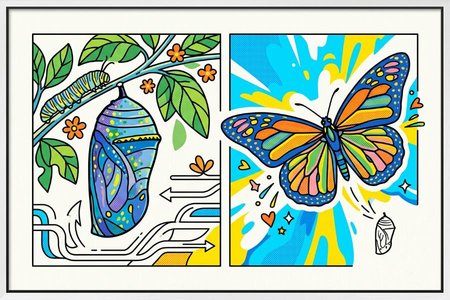
When you transform you change from one thing or state to another. Picture a transformer that changes from a robot to a car. Simple, right? Caterpillars transform into butterflies, a forest is transformed by a snowfall, and a city can be transformed by a new government or a changing economy. Transform means a big change in appearance or in essence. The Internet has transformed how we live our day-to-day lives, but you wouldn't say that moving a throw pillow has transformed your living room.
Vocabulary lists containing transform
Shape Up: Form
Looking to grow your vocabulary? Check out this interactive, curated word list from our team of English language specialists at Vocabulary.com – one of over 17,000 lists we've built to help learners worldwide!
Starting Your New Life: Inspiring Words from Commencement Speeches
Interested in learning more words like this one? Our team at Vocabulary.com has got you covered! You can review flashcards, quiz yourself, practice spelling, and more – and it's all completely free to use!
Brown Girl Dreaming
Want to remember this word for good? Start your learning journey today with our library of interactive, themed word lists built by the experts at Vocabulary.com – we'll help you make the most of your study time!
Example Sentences
Examples are provided to illustrate real-world usage of words in context. Any opinions expressed do not reflect the views of Dictionary.com.
See Examples For:
The genius of “The Glass Castle” lies in Ms. Walls’s ability to transform horrific moments of parental malfeasance into scenes of humor, vitality and resilience.
From The Wall Street Journal ● Oct. 15, 2026

During his time with the theater group, his collaboration with co-founders Jules Irving and Herbert Blau helped transform the workshop into one of the first regional theater companies in the U.S.
From Los Angeles Times ● Oct. 15, 2026

This is not the first such protest in Batam, whose shrinking reservoirs find themselves under more pressure as the island tries to transform itself into a digital hub.
From BBC ● Oct. 12, 2026

AI may transform the data-center market, but that does not mean this is the project that will help do it.
From MarketWatch ● Oct. 12, 2026

I was the only one who still lived in the Dimwood, yearning for the day it would transform into the Goldengrove.”
From "How to Disappear Completely" by Ali Standish

Automation enables "inquiries that were not previously possible; it transforms the conditions of research."
From Barron's ● Oct. 16, 2026

Mona transforms before our eyes from a diffident mother of two in an unhappy marriage into the star she always could be, though not without a few bumps in the road.
From Salon ● Oct. 12, 2026

Altogether, the combination of the main residence, guest accommodations and extensive outdoor amenities transforms the property into a private resort-like compound tucked into one of Los Angeles’ most exclusive residential areas.
From MarketWatch ● Oct. 12, 2026
Plus, Volkswagen fights its own board in a battle to survive, and wartime “coffin money” transforms Russia’s poorest regions.
From The Wall Street Journal ● Sep. 2, 2026
So I go to bed and, sure enough, within a few hours I awake from a nightmare where that old woman from District 4 transforms into a large rodent and gnaws on my face.
From "Catching Fire" by Suzanne Collins
The moves have removed risk from the balance sheet “and transformed EchoStar into an investment company with meaningful further opportunities to unlock value,” he wrote in a note to clients on Friday while relaunching J.P.
From MarketWatch ● Oct. 16, 2026
Experts say years of deforestation and the drying out of naturally water-logged peatlands for cultivation has also transformed formerly fire-resistant landscapes.
From Barron's ● Oct. 15, 2026
Taiwan was transformed into a global manufacturing hub in the 1970s, well before it became known as the source of the world’s semiconductors.
From The Wall Street Journal ● Oct. 13, 2026
GLP-1 receptor agonist drugs have transformed obesity treatment by helping patients lose substantial amounts of weight.
From Science Daily ● Oct. 11, 2026

Over the years, the work and experience had noticeably transformed Roosevelt’s physical appearance.
From "Death on the River of Doubt" by Samantha Seiple
Rob Reiner’s career began on television, and after leaving “All in the Family” he continued to perform, transforming tonally into a sort of gentle Jewish Buddha onscreen.
From Los Angeles Times ● Oct. 15, 2026
The findings, published in Nature Communications, could help scientists develop more effective catalysts for transforming CO2 into useful products such as methanol.
From Science Daily ● Oct. 14, 2026
Executives generally believe AI is transforming work faster than their employees do.
From The Wall Street Journal ● Oct. 13, 2026
With frequent power cuts transforming Havana into a ghost town, young Cubans are struggling to get their kicks, many resorting to games of dominoes with strangers to pass the time.
From Barron's ● Oct. 13, 2026
Joy to the Heart looked even more perplexed, his smile transforming into a frown.
From "When the Sea Turned to Silver" by Grace Lin
Random Word
Spin the wheel and learn a new word!
Get a wordDefinitions and idiom definitions from Dictionary.com Unabridged, based on the Random House Unabridged Dictionary, © Random House, Inc. 2023
Idioms from The American Heritage® Idioms Dictionary copyright © 2002, 2001, 1995 by Houghton Mifflin Harcourt Publishing Company. Published by Houghton Mifflin Harcourt Publishing Company.
