- plural of alga.
algae
Americanplural noun
-
alga
singular
plural noun
Discover More
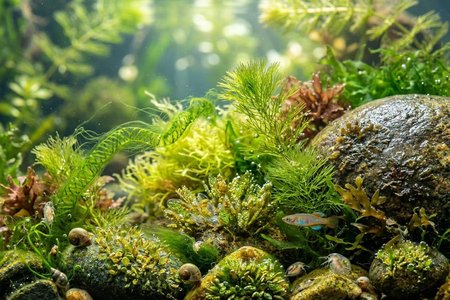
Algae supply a considerable part of the world's oxygen.
The most familiar algae are the greenish scum that collects in still water.
Other Word Forms
Etymology
Origin of algae
First recorded in 1790–1800; from New Latin, plural of Latin alga “seaweed”
Compare meaning
How does algae compare to similar and commonly confused words? Explore the most common comparisons:
Explanation

Ever walk in the ocean and feel your feet slipping and sliding along the rocks? That slimy green stuff under your feet is algae, a nonflowering plant that grows in the water and has no stems, roots, or leaves. Algae is actually the plural form of the word alga, which in Latin means, you guessed it: "seaweed." Algae isn't just something gross looking floating on the water. It's actually important in aquatic ecology because the tiny organisms that live suspended in algae are the food base for most marine food chains.
Vocabulary lists containing algae
Something's Fishy: A Fresh Catch of Aquatic Words
Looking to grow your vocabulary? Check out this interactive, curated word list from our team of English language specialists at Vocabulary.com – one of over 17,000 lists we've built to help learners worldwide!
Ecology - Middle School
Interested in learning more words like this one? Our team at Vocabulary.com has got you covered! You can review flashcards, quiz yourself, practice spelling, and more – and it's all completely free to use!
Ecology - High School
Want to remember this word for good? Start your learning journey today with our library of interactive, themed word lists built by the experts at Vocabulary.com – we'll help you make the most of your study time!
Example Sentences
Examples are provided to illustrate real-world usage of words in context. Any opinions expressed do not reflect the views of Dictionary.com.
See Examples For:
The broad category also includes organisms such as kelp, slime molds, and red algae, some of which grow into large, complex structures.
From Science Daily ● Oct. 8, 2026

The National Park Service at that time had been working to remove algae that had covered the pool bottom shortly after the renovation work was finished.
From The Wall Street Journal ● Oct. 1, 2026

The lake's extreme briny environment sustains algae blooms that attract flamboyances of pink flamingos that thrive in the area.
From BBC ● Sep. 12, 2026

Shortly after reopening, the water turned green with algae.
From Salon ● Sep. 12, 2026

I tried everything but the worms, including the algae.
From "Life of Pi" by Yann Martel

You may never have heard of this single-celled alga, but sailors and fishermen know its effect very well: the P. lunula algae are the organisms that occasionally make the see glow blue.
From Science Daily ● Nov. 18, 2024
Blue-green algae is not actually an alga but rather a type of bacteria called cyanobacteria.
From BBC ● Jul. 10, 2023
The alga could be providing a place for younger isopods to hide from predators, as Idotea is often the same color as the plant.
From Science Magazine ● Jul. 27, 2022
Giant kelp is the common name for Macrocystis pyrifera, a species of alga that grows into lush underwater forests along the coast of the northeastern Pacific Ocean, from Baja California north to southeastern Alaska.
From Scientific American ● Jul. 21, 2022
She is curious; she wants to know the difference between an alga and a lichen, a Diplodon char- ruanus and a Diplodon delodontus.
From "All the Light We Cannot See" by Anthony Doerr
Definitions and idiom definitions from Dictionary.com Unabridged, based on the Random House Unabridged Dictionary, © Random House, Inc. 2023
Idioms from The American Heritage® Idioms Dictionary copyright © 2002, 2001, 1995 by Houghton Mifflin Harcourt Publishing Company. Published by Houghton Mifflin Harcourt Publishing Company.
