biosphere
Americannoun
-
biospheres
plural
-
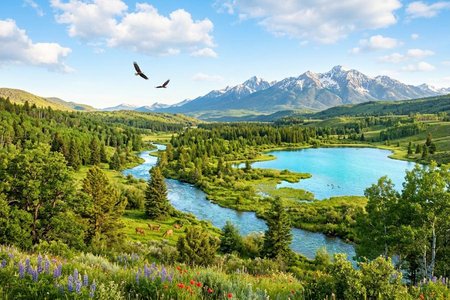
the part of the earth's crust, waters, and atmosphere that supports life.
-
the ecosystem comprising the entire earth and the living organisms that inhabit it.
noun
-
The parts of the land, sea, and atmosphere in which organisms are able to live. The biosphere is an irregularly shaped, relatively thin zone in which life is concentrated on or near the Earth's surface and throughout its waters.
-
All the Earth's ecosystems considered as a single, self-sustaining unit.
Synonym Usage
See ecosystem ( def. ).
Other Word Forms
Derived Forms
Inflected Forms
Nouns
Etymology
Origin of biosphere
First recorded in 1895–1900; from German Biosphäre; see bio-, -sphere
Explanation

A biosphere is a place where organisms live. You wouldn't want to travel beyond the earth's biosphere, unless of course you are an astronaut. From the Greek bios, "life," and sphaira, "sphere," biosphere came into English use in the 19th century. It means the life that occurs within a certain sphere or region around a planet. If you're reading this from Mars you probably have a biosphere all your own. You and other living things on Earth need oxygen and other substances to survive, and the biosphere fulfills those needs.
Vocabulary lists containing biosphere
Words to Live By: Bio
Looking to grow your vocabulary? Check out this interactive, curated word list from our team of English language specialists at Vocabulary.com – one of over 17,000 lists we've built to help learners worldwide!
Weather and Climate - Introductory
Interested in learning more words like this one? Our team at Vocabulary.com has got you covered! You can review flashcards, quiz yourself, practice spelling, and more – and it's all completely free to use!
Physical Geography - Middle School
Want to remember this word for good? Start your learning journey today with our library of interactive, themed word lists built by the experts at Vocabulary.com – we'll help you make the most of your study time!
Example Sentences
Examples are provided to illustrate real-world usage of words in context. Any opinions expressed do not reflect the views of Dictionary.com.
See Examples For:
"By comparing ecological ways of life for extinct and modern species, we can understand how patterns of adaptive evolution have changed through time and what factors shaped the modern biosphere."
From Science Daily ● Aug. 21, 2026

The island was designated a Unesco biosphere reserve in 2019, which recognises the sustainable ways in which local people work with their natural environment.
From BBC ● Apr. 8, 2026

Various forms of evidence suggest that the biosphere was more productive during the Miocene compared to now, and that at higher latitudes, this effect was more pronounced.
From Salon ● Feb. 17, 2025

In contrast, land habitats make up less than 1 percent of the planet’s biosphere because the band of life is so narrow, making its volume quite small.
From New York Times ● May 30, 2024
It might turn out that the same tendency underlies the joining of organisms into communities, communities into ecosystems, and ecosystems into the biosphere.
From "The Lives of a Cell" by Lewis Thomas

"By understanding the limits that apply to all living systems, we can better predict how cells, ecosystems, and even entire biospheres respond to changing environments."
From Science Daily ● Nov. 11, 2025
Maine’s messy dilemma reflects how climate change is transforming biospheres the world over by expanding the northward range of parasites.
From Reuters ● Oct. 28, 2022
We are doing what bacteria do, heating the climate system with our waste, while also driving mass extinction by destroying local biospheres and filling the liquid parts of our planet with plastics.
From Scientific American ● Dec. 19, 2019
Even if plants do succeed in adapting to climate change by changing their location or schedule, they’re not alone in their biospheres.
From Slate ● Dec. 13, 2019

The habitable zone concept focuses on this requirement for surface liquid water—even though we know that subsurface habitable conditions could prevail at more distant orbits—exactly because these worlds would have biospheres detectable at a distance.
From Textbooks ● Oct. 13, 2016

Definitions and idiom definitions from Dictionary.com Unabridged, based on the Random House Unabridged Dictionary, © Random House, Inc. 2023
Idioms from The American Heritage® Idioms Dictionary copyright © 2002, 2001, 1995 by Houghton Mifflin Harcourt Publishing Company. Published by Houghton Mifflin Harcourt Publishing Company.
