
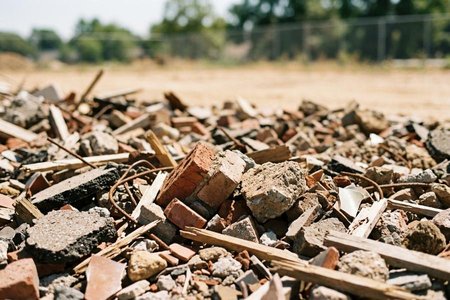
noun
-
fragments or remnants of something destroyed or broken; rubble
-
a collection of loose material derived from rocks, or an accumulation of animal or vegetable matter
Etymology
Origin of debris
First recorded in 1700–10; from French débris, Middle French debris, derivative of debriser “to break up (into pieces),” Old French debrisier, from de- de- + brisier “to break” ( see bruise)
Explanation

Debris is trash scattered around after a disaster, like shattered glass on the road after a car accident. Debris comes from French for "waste, rubbish." Although debris usually refers to the trash leftover after some kind of explosion or crash, it can also be what's on your floor after hosting a kid's make-your-own pizza party, or what you shouldn't leave at the park after a picnic. Sometimes Mother Nature leaves debris, such as a pile of rocks, or that car on your lawn after the flood recedes. Don't pronounce the "s": debris rhymes with "be free."
Vocabulary lists containing debris
100 Words Every Middle Schooler Should Know
Looking to grow your vocabulary? Check out this interactive, curated word list from our team of English language specialists at Vocabulary.com – one of over 17,000 lists we've built to help learners worldwide!
"Of Mice and Men"
Interested in learning more words like this one? Our team at Vocabulary.com has got you covered! You can review flashcards, quiz yourself, practice spelling, and more – and it's all completely free to use!
Essential Academic Vocabulary for Middle School Students, List 8
Want to remember this word for good? Start your learning journey today with our library of interactive, themed word lists built by the experts at Vocabulary.com – we'll help you make the most of your study time!
Example Sentences
Examples are provided to illustrate real-world usage of words in context. Any opinions expressed do not reflect the views of Dictionary.com.
Yellow caution tape fluttered in the wind as water poured into a room strewn with wooden debris, an upturned refrigerator and a television.
From Los Angeles Times ● Oct. 11, 2026

The kingdom's civil defence agency also said "interception debris" had damaged a kindergarten and a medical complex in Riyadh.
From Barron's ● Oct. 9, 2026

Rain rates are probably going to be a quarter of inch per hour or less, making debris flow and landslides unlikely.
From Los Angeles Times ● Oct. 8, 2026
Their dust grains are smaller than those found in protoplanetary or more typical debris disks, they contain unusually high concentrations of warm dust, and their brightness changes irregularly over time.
From Science Daily ● Oct. 7, 2026

When the first wave pulled back, the debris around him loosened and sank, and he was able to climb onto a nearby roof.
From "Meltdown" by Deirdre Langeland

Definitions and idiom definitions from Dictionary.com Unabridged, based on the Random House Unabridged Dictionary, © Random House, Inc. 2023
Idioms from The American Heritage® Idioms Dictionary copyright © 2002, 2001, 1995 by Houghton Mifflin Harcourt Publishing Company. Published by Houghton Mifflin Harcourt Publishing Company.
