fossil
Americannoun
-
fossils
plural
-
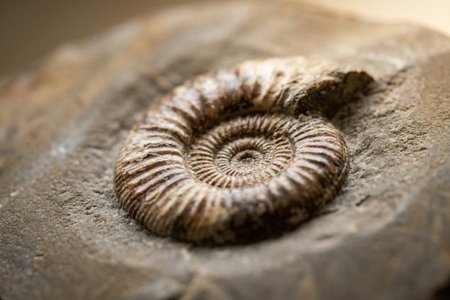
any remains, impression, or trace of a living thing of a former geologic age, as a skeleton, footprint, etc.
-
a markedly outdated or old-fashioned person or thing.
-
a linguistic form that is archaic except in certain restricted contexts, as nonce in for the nonce, or that follows a rule or pattern that is no longer productive, as the sentence So be it.
adjective
-
of the nature of a fossil.
fossil insects.
-
belonging to a past epoch or discarded system; antiquated.
a fossil approach to economics.
noun
-
-
a relic, remnant, or representation of an organism that existed in a past geological age, or of the activity of such an organism, occurring in the form of mineralized bones, shells, etc, as casts, impressions, and moulds, and as frozen perfectly preserved organisms
-
( as modifier )
fossil insects
-
-
informal
-
a person, idea, thing, etc, that is outdated or incapable of change
-
( as modifier )
fossil politicians
-
-
linguistics a form once current but now appearing only in one or two special contexts, as for example stead , which is found now only in instead ( of ) and in phrases like in his stead
-
obsolete any rock or mineral dug out of the earth
-
The remains or imprint of an organism from a previous geologic time. A fossil can consist of the preserved tissues of an organism, as when encased in amber, ice, or pitch, or more commonly of the hardened relic of such tissues, as when organic matter is replaced by dissolved minerals. Hardened fossils are often found in layers of sedimentary rock and along the beds of rivers that flow through them.
-
See also index fossil microfossil trace fossil
Discover More
The term is used figuratively to refer to a person with very old-fashioned or outmoded viewpoints: “That old fossil thinks that men should wear suits at the theater!”
Other Word Forms
Derived Forms
Inflected Forms
Nouns
Etymology
Origin of fossil
First recorded in 1555–65; from Latin fossilis “dug up,” from foss(us) “dug” (past participle of fodere “to dig”) + -ilis -ile ( def. ); replacing earlier fossile, from French
Explanation

Fossils are the really, really old remains of a plant or animal — so old they've turned to stone. Fossil is also an insult for an old or old-fashioned person. Fossils are very important to scientists who study animals: they're one of the ways we learn about the beasts and critters of the past. A fossil is an imprint of the bones of that animal in rock or stone. If you see a reconstruction of a dinosaur in a museum, scientists used fossils to figure out how it should look. Also, calling someone a fossil is like calling them a geezer or old fogey. It's not a compliment.
Vocabulary lists containing fossil
Tyrannosaurus Lex(icon)
Looking to grow your vocabulary? Check out this interactive, curated word list from our team of English language specialists at Vocabulary.com – one of over 17,000 lists we've built to help learners worldwide!
Africa - Introductory
Interested in learning more words like this one? Our team at Vocabulary.com has got you covered! You can review flashcards, quiz yourself, practice spelling, and more – and it's all completely free to use!
Africa - Middle School
Want to remember this word for good? Start your learning journey today with our library of interactive, themed word lists built by the experts at Vocabulary.com – we'll help you make the most of your study time!
Example Sentences
Examples are provided to illustrate real-world usage of words in context. Any opinions expressed do not reflect the views of Dictionary.com.
See Examples For:
The use of fossil fuels to power the centre prompted criticism from environmental campaign group Friends of the Earth Cymru.
From BBC ● Oct. 16, 2026

According to estimates by the think tank Carbon Majors cited in the lawsuit, Shell holds responsibility for 2.02 percent of global carbon dioxide emissions from fossil fuel and cement-making.
From Barron's ● Oct. 15, 2026

But while AI could boost the efficiency and use of renewables, the technology has long been used by oil and gas companies to sift through geological data, identify underground reservoirs and streamline fossil fuel production.
From Barron's ● Oct. 15, 2026
The team went beyond examining the fossil itself, using mathematical models to reconstruct how megaraptorans spread and evolved over millions of years.
From Science Daily ● Oct. 14, 2026

“And that means, we are most likely to find a fossil in a place that once had water.”
From "A Rover's Story" by Jasmine Warga

The research team also used mathematical modelling to investigate how the spread of megaraptors around the world might have changed over time, based on fossils discovered so far, dinosaurs' evolutionary trees, geography and climate.
From BBC ● Oct. 14, 2026
The team then compared its anatomy with fossils from several other groups of meat-eating dinosaurs, including tyrannosaurs, spinosaurs, raptors, and other predators that walked on two legs.
From Science Daily ● Oct. 14, 2026
Megaraptors are regarded as the most mysterious of the large, meat-eating dinosaurs, as few megaraptor fossils have been found.
From BBC ● Oct. 14, 2026
The second part of the name refers to India, where the fossils were discovered.
From Science Daily ● Oct. 14, 2026
“Speaking of fossils, that’s what Dad and I have in mind for you today. When’s the last time you went on a dig?”
From "Linked" by Gordon Korman
Random Word
Spin the wheel and learn a new word!
Get a wordDefinitions and idiom definitions from Dictionary.com Unabridged, based on the Random House Unabridged Dictionary, © Random House, Inc. 2023
Idioms from The American Heritage® Idioms Dictionary copyright © 2002, 2001, 1995 by Houghton Mifflin Harcourt Publishing Company. Published by Houghton Mifflin Harcourt Publishing Company.
