galleon
Americannoun
-
galleons
plural
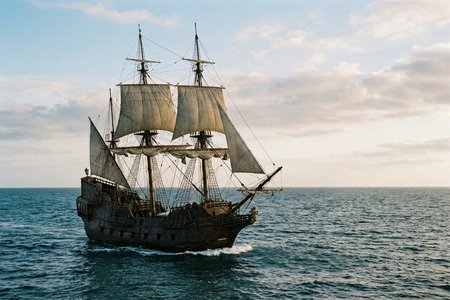
noun
Other Word Forms
Noun Inflected Forms
Etymology
Origin of galleon
1520–30; < Spanish galeón, augmentative of galea galley
Explanation

Though a galleon was a large ship with multiple decks, it was no cruise liner and probably didn’t offer round-the-clock buffets. A galleon refers to a type of sailboat used in the 15th to 18th centuries mostly for battles and carrying consumer goods. Galleons had big square sails rigged onto several masts. They were built and sailed by many Europeans, but they are most commonly associated with the Spanish. In fact, this word is derived from the Spanish word galeón, which means “armed merchant ship.”
Vocabulary lists containing galleon
The Cay
Looking to grow your vocabulary? Check out this interactive, curated word list from our team of English language specialists at Vocabulary.com – one of over 17,000 lists we've built to help learners worldwide!
"The Highwayman"
Interested in learning more words like this one? Our team at Vocabulary.com has got you covered! You can review flashcards, quiz yourself, practice spelling, and more – and it's all completely free to use!
A Long Way from Chicago
Want to remember this word for good? Start your learning journey today with our library of interactive, themed word lists built by the experts at Vocabulary.com – we'll help you make the most of your study time!
Example Sentences
Examples are provided to illustrate real-world usage of words in context. Any opinions expressed do not reflect the views of Dictionary.com.
See Examples For:
She was checking people in on the pier for a separate boat tour to Sazan on a replica galleon that advertises the opportunity to “be a pirate for a day.”
From Slate ● Sep. 8, 2026

The Museo del Galeon, which focuses on the hulking Espiritu Santo, aims to tell the story of Spain's 250-year-long Pacific galleon trade from the perspective of the Filipinos who built and crewed the towering vessels.
From Barron's ● Apr. 28, 2026

Sunk in 1708, the galleon San José attained legendary status.
From The Wall Street Journal ● Jan. 30, 2026

In 1708 the San José, a treasure-laden Spanish galleon, sunk off the coast of Colombia.
From Los Angeles Times ● Dec. 31, 2025

Men in wet suits will find the galleon three years from now.
From "Dreaming in Cuban" by Cristina García

The Spanish, who had at first just flitted along the coast in their galleons, had begun marching inland and overland from Mexico with crosses and soldiers and soldiers’ families.
From Los Angeles Times ● Jul. 2, 2026
Early in the process, Quezon, a historian and grandson of a former Philippine president, learned to his dismay that the local hardwood and water-resistant species used to build the galleons had long been wiped out.
From Barron's ● Apr. 28, 2026
“The ideas just cascade down about the romance of Spanish galleons and pirate ships,” Mr. Meide said.
From New York Times ● Dec. 9, 2022

It is not like corporations deploy an armada of 17th century galleons to sail shipments of gold across the ocean.
From Slate ● Nov. 15, 2021
Spanish treasure galleons were soon sailing home loaded with riches from mines in Mexico and Peru.
From "In the Shadow of Liberty" by Kenneth C. Davis
Definitions and idiom definitions from Dictionary.com Unabridged, based on the Random House Unabridged Dictionary, © Random House, Inc. 2023
Idioms from The American Heritage® Idioms Dictionary copyright © 2002, 2001, 1995 by Houghton Mifflin Harcourt Publishing Company. Published by Houghton Mifflin Harcourt Publishing Company.
