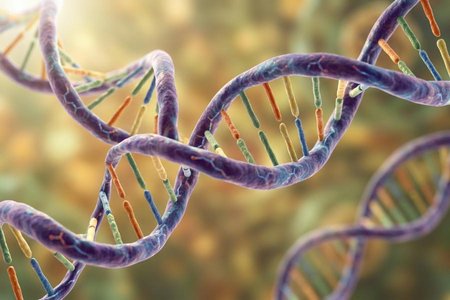
the basic physical unit of heredity; a linear sequence of nucleotides along a segment of DNA that provides the coded instructions for synthesis of RNA, which, when translated into protein, leads to the expression of hereditary character.
the basic physical unit of heredity; a linear sequence of nucleotides along a segment of DNA that provides the coded instructions for synthesis of RNA, which, when translated into protein, leads to the expression of hereditary character.
a unit of heredity composed of DNA occupying a fixed position on a chromosome (some viral genes are composed of RNA). A gene may determine a characteristic of an individual by specifying a polypeptide chain that forms a protein or part of a protein ( structural gene ); or encode an RNA molecule; or regulate the operation of other genes or repress such operation See also operon
A segment of DNA, occupying a specific place on a chromosome, that is the basic unit of heredity. Genes act by directing the production of RNA, which determines the synthesis of proteins that make up living matter and are the catalysts of all cellular processes. The proteins that are determined by genetic DNA result in specific physical traits, such as the shape of a plant leaf, the coloration of an animal's coat, or the texture of a person's hair. Different forms of genes, called alleles, determine how these traits are expressed in a given individual. Humans are thought to have 20,000 to 25,000 genes; bacteria have between 500 and 6,000.
A portion of a DNAmolecule that serves as the basic unit of heredity. Genes control the characteristics that an offspring will have by transmitting information in the sequence of nucleotides on short sections of DNA.
Usage
What is a gene?
A gene is a sequence of nucleotides along a strand of DNA that a cell nucleus uses to produce proteins. Genes determine the specific traits of an organism. DNA (deoxyribonucleic acid) is a large molecule that is shaped like a double helix sometimes described as a twisty ladder. The rungs of the ladder are made of molecules called nucleotides. These rungs, or bases, are arranged in a specific order that creates a set of instructions, which is known as a gene. When the body needs to do something or build something, it often requires a protein. Genes are the instructions that the cells read for how to build proteins. Proteins have very specific jobs, so scientists name genes based on what job their linked proteins are designed to do. For example, hair proteins come from hair genes, while eye proteins come from eye genes. Every living organism has genes. Animals, plants, fungi, bacteria, and even the humble amoeba all have genes. The more closely related two organisms are, the more similar their genes will be. For example a dog and a wolf, which are from the same genus, will have similar genes, while a dog and a human, which are not part of the same genus, will have much different genes from each other.
First recorded in 1911; from German Gen (1909), apparently abstracted from -gen-gen ( def. ); introduced by Danish geneticist Wilhelm L. Johannsen (1857–1927)
Explanation
Microscopic, yet powerful, a gene is segment of DNA, the molecule that stores the code for building living bodies. A gene is a single unit of genetic information, stored on twisting strands in every cell of every living being. In sexual reproduction, the parents' genes mix together to make the child. Although people would like to think that genes code for discrete traits, like friendliness or mathematical genius, that's not the case. Genes control the color of your eyes and the shape of your toes, not your weird personality.
A gene is more than a set of protein-building instructions, but Beadle and Tatum’s experiments provided a mechanistic basis for a gene’s function.
From
"The Gene" by Siddhartha Mukherjee
The Roadster demo “was an engineering flex with no commercial value beyond embarrassing traditional car makers,” Gene Munster, managing partner at Deepwater Asset Management, wrote on X.
Rod Roddenberry, founder of the Roddenberry Foundation and son of “Star Trek” creator Gene Roddenberry and actor Majel Barrett Roddenberry, is an executive producer on current “Star Trek” television shows.
Gene activity also revealed improvements in several biological features associated with aging, including reduced inflammation and less decline in the body's ability to repair and regenerate tissue.
A screening service operates in Northern Ireland to provide testing for family members of people who have FH to detect as many carriers of the genes as possible.