lever
noun
a rigid bar that pivots about one point and that is used to move an object at a second point by a force applied at a third.
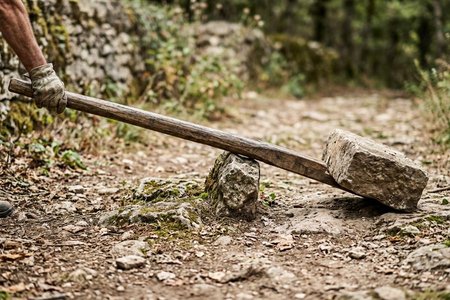
Mechanics. a rigid bar that pivots about one point and that is used to move an object at a second point by a force applied at a third.
a tool, as a pry or a crowbar, for raising, moving, or opening something by leverage.
There's a small lever in my toolbox that'll be perfect for prying off these narrow moldings.
a handle or bar that is manipulated to operate, control, or adjust a machine, mechanism, etc..
Pushing down the lever on the left will automatically open the door.
a means or agency of persuading or of achieving an end.
Saying that the chairman of the board likes the plan is just a lever to get us to support it.
Horology. the pallet of an escapement.
a rigid bar pivoted about a fulcrum, used to transfer a force to a load and usually to provide a mechanical advantage
any of a number of mechanical devices employing this principle
a means of exerting pressure in order to accomplish something; strategic aid
A simple machine consisting of a bar that pivots on a fixed support, or fulcrum, and is used to transmit torque. A force applied by pushing down on one end of the lever results in a force pushing up at the other end. If the fulcrum is not positioned in the middle of the lever, then the force applied to one end will not yield the same force on the other, since the torque must be the same on either side of the fulcrum. Levers, like gears, can thus be used to increase the force available from a mechanical power source.
See more at fulcrum See also mechanical advantage
1250–1300; Middle English levere, levour for *lever < Anglo-French; Old French levier, equivalent to lev ( er ) to lift (< Latin levāre to lighten, lift, verbal derivative of levis light) + -ier -ier 2

A lever is a handle, sticking out at an angle, that allows you to operate a machine or close a door. When you pull the lever of a voting booth, you both cast your ballot and open the curtain. All kinds of things — particularly machines — have levers. The word is also used to describe anything that you are able to use to move or influence someone else: think leverage. A headline in The New York Times said the government would use its contracts with private companies as a "wage lever," meaning the government would try to improve wages by giving work and money to companies that paid well and provided generous benefits. Levers get things done.
Looking to grow your vocabulary? Check out this interactive, curated word list from our team of English language specialists at Vocabulary.com – one of over 17,000 lists we've built to help learners worldwide!
Interested in learning more words like this one? Our team at Vocabulary.com has got you covered! You can review flashcards, quiz yourself, practice spelling, and more – and it's all completely free to use!
Want to remember this word for good? Start your learning journey today with our library of interactive, themed word lists built by the experts at Vocabulary.com – we'll help you make the most of your study time!
Examples are provided to illustrate real-world usage of words in context. Any opinions expressed do not reflect the views of Dictionary.com.
“Memory is a lever for better AI performance. AI models generate better results with more memory, run faster with more memory,” he wrote.
From MarketWatch ● Oct. 7, 2026

Pulling the force majeure lever buys Oracle some time but doesn’t reduce its financial exposure to the data center.
From The Wall Street Journal ● Sep. 25, 2026

He said he recalled having pulled the lever to release the car's parachute before trying to steer it away from disaster, "but disaster was, it seemed, my fate".
From BBC ● Sep. 20, 2026

Just like war itself, polygraphs should be a lever of last resort.
From Salon ● Sep. 14, 2026

He tapped some keys and pulled the lever on it and then inspected the resulting paper strip.
From "October Sky" by Homer Hickam

Kalshi has a ban on those practices and has banned markets tied directly to death and war, Lever said.
From Los Angeles Times ● Jun. 16, 2026

A sale would mark the biggest portfolio shake-up for Unilever since it was created nearly a century ago through the merger of Dutch group Margarine Unie and British soap maker Lever Bros.
From The Wall Street Journal ● Mar. 20, 2026
Raymond Illingworth's triumphant visitors to Australia in 1970-71 had Bob Willis, Peter Lever and John Snow, and the England team that won in 1954-55 included Brian Statham and Frank 'Typhoon' Tyson.
From BBC ● Nov. 19, 2025
Lever Architecture, a firm with offices in Portland, Ore., and L.A., has helped pioneer the use of mass timber in the U.S.
From Los Angeles Times ● Aug. 10, 2025
He smells like a perfect combination of Lever soap and Old Spice.
From "The Hate U Give" by Angie Thomas
Richard Hasen, professor of law at UCLA, outlines five levers the president could pull and how states, courts, and the people could respond.
From Slate ● Oct. 8, 2026

Macron would also soon convene a video meeting of G7 leaders "to make progress on the various levers that can be used to address the rising fuel prices... including coordination on releasing reserves."
From Barron's ● Oct. 1, 2026

There are Oompa-Loompas of various sizes, including Rusty Goffe, from the 1971 film, who perform Oompa-Loompa dances and sing Oompa-Loompa songs and are seen offstage pushing buttons and pulling levers.
From Los Angeles Times ● Sep. 23, 2026
"Diet is one of the most powerful, modifiable levers we have in medicine, and this study gives us a molecular framework to start using it more precisely."
From Science Daily ● Sep. 13, 2026

On top of the tank were two levers; the first was next to pictures of a rabbit and a turtle.
From "Lawn Boy" by Gary Paulsen
He also said that an important difference between the companies is that Dave and Buster’s is “a much more levered entity.”
From MarketWatch ● Oct. 12, 2026
That includes more than 400 levered single-stock ETFs.
From MarketWatch ● Jul. 9, 2026
“You’ve got people with a lottery mentality using margin to buy options on levered ETFs. That’s three or four layers.”
From The Wall Street Journal ● Jun. 29, 2026
One popular technique is levered long-short tax-loss harvesting, a strategy that uses margin and leverage to significantly boost the volume of harvestable tax losses.
From Barron's ● Jun. 13, 2026
With a swift movement he levered the fourth step an inch forward, exposing a long dark gap.
From "Redwall" by Brian Jacques
In that case, says Whitelaw, “maybe we should be telling young investors that they should actually be levering up, and that this is the tool to do it.”
From The Wall Street Journal ● Sep. 4, 2026
Gerstner expressed concerns that investors are “layering up” right now, noting that “there are 14 exchange-traded funds launching on the day of the SpaceX IPO,” some of which are aimed at levering returns.
From MarketWatch ● Jun. 8, 2026
If it is to play a game-changing role in levering in private investment, its £8.3bn funding over five years will have a lot of heavy lifting to do.
From BBC ● Jul. 25, 2024
By employing bioinformatics analyses and levering diverse public datasets, the team validated the robustness of HK-CREs across 50 randomly selected healthy cell types, confirming the location of HK-CREs within the genome.
From Science Daily ● Jan. 5, 2024
Pearl wielded the tools with expert hands, levering the side panels into place against the headboard, propping them up on one ankle while she bolted them into place.
From "Little Fires Everywhere" by Celeste Ng
Definitions and idiom definitions from Dictionary.com Unabridged, based on the Random House Unabridged Dictionary, © Random House, Inc. 2023
Idioms from The American Heritage® Idioms Dictionary copyright © 2002, 2001, 1995 by Houghton Mifflin Harcourt Publishing Company. Published by Houghton Mifflin Harcourt Publishing Company.
