myopia
Americannoun
-
myopias
plural
-
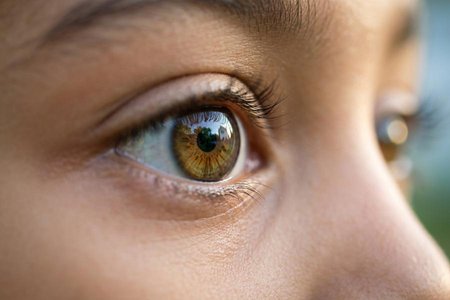
Ophthalmology. a condition of the eye in which parallel rays are focused in front of the retina, objects being seen distinctly only when near to the eye; nearsightedness (opposed to hyperopia).
-
lack of foresight or discernment; obtuseness.
-
narrow-mindedness; intolerance.
noun
-
A defect of the eye that causes light to focus in front of the retina instead of directly on it, resulting in an inability to see distant objects clearly. Myopia is often caused by an elongated eyeball or a misshapen lens.
-
Also called nearsightedness
-
Compare hyperopia
Discover More
The term is often used to indicate an inability to see into the future: “The new policy is incredibly myopic, and puts future generations at a great disadvantage for the sake of a few short-term gains.”
Other Word Forms
Derived Forms
Inflected Forms
Nouns
Etymology
Origin of myopia
First recorded in 1685–95; from New Latin, from Greek myōpía, from myōp- (stem of mýōps, “nearsighted,” literally, “blinking,” from mý(ein) “to shut” + ṓps “eye, face”) + -ia -ia; see also eye ( def. )
Compare meaning
How does myopia compare to similar and commonly confused words? Explore the most common comparisons:
Explanation

Myopia is nearsightedness, which means you see things more clearly that are closer to your eye. You probably suffer from myopia if you walk into the living room and notice the chair in front of you but not the chair ten feet away. If you have myopia, things farther away look out of focus. Also, this can mean narrow-mindedness and intolerance. Due to the first kind of myopia, someone might always hold the menu two centimeters from their eyeballs at restaurants. Due to the second kind, someone might avoid people with different opinions from their own.
Vocabulary lists containing myopia
Lord of the Flies
Looking to grow your vocabulary? Check out this interactive, curated word list from our team of English language specialists at Vocabulary.com – one of over 17,000 lists we've built to help learners worldwide!
Common Senses: Op, Ops, Opt ("Sight")
Interested in learning more words like this one? Our team at Vocabulary.com has got you covered! You can review flashcards, quiz yourself, practice spelling, and more – and it's all completely free to use!
Pelé
Want to remember this word for good? Start your learning journey today with our library of interactive, themed word lists built by the experts at Vocabulary.com – we'll help you make the most of your study time!
Example Sentences
Examples are provided to illustrate real-world usage of words in context. Any opinions expressed do not reflect the views of Dictionary.com.
See Examples For:
Praying for a rain delay, I found myself innings deep into “Team Moms: Baseball” before realizing that, like Bryce Harper looking at a ghost fork, I’d fallen victim to my own myopia.
From The Wall Street Journal ● Sep. 24, 2026

Children who spend more time indoors looking at screens and less time outside are more likely to develop myopia, also known as nearsightedness.
From Science Daily ● Aug. 26, 2026

But lighting products designed with the particular characteristics that might help prevent myopia are not yet widely available.
From Science Daily ● Aug. 26, 2026
"If future clinical studies confirm the findings, indigo-enriched lighting could become a safe, passive and scalable way to help reduce childhood myopia risk."
From Science Daily ● Aug. 26, 2026
Grey, feathery ashes scurried hither and thither at his breath but no spark shone among them The twins watched anxiously and Piggy sat expressionless behind the luminous wall of his myopia.
From "Lord of the Flies" by William Golding

Like all TV shows, but especially ones that capture the zeitgeist, it’s a product of its time, reflecting the myopias of the era and of its creative team.
From Washington Post ● Dec. 9, 2021
But alongside generational myopias there is wisdom, too.
From New York Times ● Sep. 19, 2020
Ultimately, however, as the disorientation expands, we realise that there are not just misogynies at work here: there are cultural myopias, competing models of freedom, competing versions of Islam.
From The Guardian ● Feb. 22, 2020
But it’s also a symbol for certain insistent myopias of masculinity.
From The New Yorker ● Nov. 4, 2019
Definitions and idiom definitions from Dictionary.com Unabridged, based on the Random House Unabridged Dictionary, © Random House, Inc. 2023
Idioms from The American Heritage® Idioms Dictionary copyright © 2002, 2001, 1995 by Houghton Mifflin Harcourt Publishing Company. Published by Houghton Mifflin Harcourt Publishing Company.
