patent
Americannoun
-
patents
plural
-
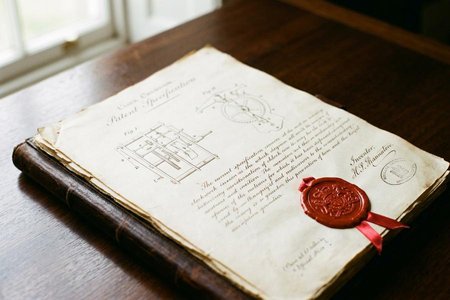
the exclusive right granted by a government to an inventor to manufacture, use, or sell an invention for a certain number of years.
-
an invention or process protected by an exclusive right to manufacture, use, or sell it.
-
an official document conferring on the inventor the exclusive right to manufacture, use, or sell an invention; letters patent.
-
Law. the instrument by which the government of the United States conveys the legal fee-simple title to public land.
adjective
-
protected by an exclusive right given to an inventor to manufacture, use, or sell an invention; patented.
a patent cooling device.
-
relating to, concerned with, or dealing with the granting of exclusive rights to sell or manufacture something, especially inventions.
a patent attorney;
patent law.
-
(of a right, privilege, etc.) conferred by a patent.
-
holding an exclusive right to manufacture, use, or sell an invention.
-
readily open to notice or observation; evident; obvious.
She turned her nose up at me in a patent breach of good manners.
- Synonyms:
- unconcealed, conspicuous, palpable, clear
-
made of patent leather.
patent shoes.
-
(of a medication) sold without a prescription and usually protected by an exclusive legal right to manufacture.
patent remedies;
patent drugs.
-
lying open; not enclosed or shut in.
a patent field.
-
(of a doorway, passage, or the like) open.
-
Chiefly Botany. expanded or spreading.
-
Medicine/Medical. (of a duct or passage in the body) open or unobstructed.
-
Phonetics. open, in various degrees, to the passage of the breath stream.
verb (used with object)
-
patents,
present (3rd person singular)
-
patented,
past participle, past
-
patenting
present participle
-
to take out a patent on; obtain the exclusive rights to (an invention, process, etc.) by a patent.
-
to originate and establish as one's own.
-
Metallurgy. to heat and quench (wire) so as to prepare for cold-drawing.
-
Law. to grant (public land) by a patent.
noun
-
-
a government grant to an inventor assuring him the sole right to make, use, and sell his invention for a limited period
-
a document conveying such a grant
-
-
an invention, privilege, etc, protected by a patent
-
-
an official document granting a right
-
any right granted by such a document
-
-
-
a grant by the government of title to public lands
-
the instrument by which such title is granted
-
the land so granted
-
-
a sign that one possesses a certain quality
adjective
-
open or available for inspection (esp in the phrases letters patent, patent writ )
-
obvious
their scorn was patent to everyone
-
concerning protection, appointment, etc, of or by a patent or patents
-
proprietary
-
(esp of a bodily passage or duct) being open or unobstructed
-
biology spreading out widely
patent branches
-
(of plate glass) ground and polished on both sides
verb
-
to obtain a patent for
-
(in the US) to grant (public land or mineral rights) by a patent
-
metallurgy to heat (a metal) above a transformation temperature and cool it at a rate that allows cold working
Usage
The pronunciation ˈpætənt is heard in letters patent and Patent Office and is the usual US pronunciation for all senses. In Britain ˈpætənt is sometimes heard for senses 1, 2 and 3, but ˈpeɪtənt is commoner and is regularly used in collocations like patent leather
Synonym Usage
See apparent.
Other Word Forms
Derived Forms
-
nonpatentabilitynoun
-
patentabilitynoun
-
prepatentnoun
-
unpatentabilitynoun
-
nonpatentableadjective
-
nonpatentedadjective
-
patentableadjective
-
unpatentadjective
-
unpatentableadjective
-
unpatentedadjective
-
nonpatentlyadverb
-
patentablyadverb
-
patentlyadverb
Inflected Forms
Nouns
Participles
Conjugated Forms
Present
-
patentsimple
-
patentssimple
-
have patentedperfect
-
has patentedperfect
-
am patentingprogressive
-
are patentingprogressive
-
is patentingprogressive
-
have been patentingperfect progressive
-
has been patentingperfect progressive
Past
-
patentedsimple
-
had patentedperfect
-
was patentingprogressive
-
were patentingprogressive
-
had been patentingperfect progressive
Future
Etymology
Origin of patent
First recorded in 1250–1300; (adjective) Middle English, from Latin patent-, stem of patēns “open, standing open,” present participle of patēre “to stand open, lie open”; (noun) Middle English, short for letters patent, translation of Medieval Latin litterae patentēs “open letters”
Explanation

A patent is a government document that proves that an invention is yours and yours alone. In the U.S., as of 2009, over 7,000,000 patents were issued by the Patent and Trademark Office. Patent also refers to leather that has a very shiny finish. The process for making leather look like this was once patented, but since patents do not last forever, the process is now available for anyone to use. As with patent leather, the word is often used as part of a sales pitch, explaining why something is special: "We use patented technology..." or "Our patented method..."
Vocabulary lists containing patent
"The Gift of the Magi" by O. Henry
Looking to grow your vocabulary? Check out this interactive, curated word list from our team of English language specialists at Vocabulary.com – one of over 17,000 lists we've built to help learners worldwide!
The Ingenious Lexicon of Invention
Interested in learning more words like this one? Our team at Vocabulary.com has got you covered! You can review flashcards, quiz yourself, practice spelling, and more – and it's all completely free to use!
"Of Plymouth Plantation," Vocabulary from the historical account
Want to remember this word for good? Start your learning journey today with our library of interactive, themed word lists built by the experts at Vocabulary.com – we'll help you make the most of your study time!
Example Sentences
Examples are provided to illustrate real-world usage of words in context. Any opinions expressed do not reflect the views of Dictionary.com.
See Examples For:
The research team is now working to patent the technology behind the brain electrode.
From Science Daily ● Sep. 21, 2026

The researchers have applied for a patent for the technology, and the findings were published in the Journal of the American Chemical Society.
From Science Daily ● Sep. 21, 2026
In 1767, Bowen received a British patent for his method of producing soy sauce, a fermented condiment resembling the soy sauce already imported from Asia.
From Salon ● Sep. 13, 2026

The failures of cardiovascular and neuromuscular drugs pelacarsen and del-desiran raise the bar for Novartis’s pipeline, given that these were two important candidates to offset sales lost to upcoming patent expirations, they add.
From The Wall Street Journal ● Sep. 10, 2026

The nurse hummed busily as she opened one drawer after another, stuffing the new underclothes and blouses and skirts and pajamas my mother had bought me into the black patent leather overnight case.
From "The Bell Jar" by Sylvia Plath

When a country has a relative scarcity of younger workers, that country’s technology sector rises to the occasion, resulting in “more labor-saving patents and growing high-tech activity.”
From MarketWatch ● Sep. 11, 2026

The Zume patents could help Miso Robotics expand Flippy's capabilities, suggests Hull, though he does not cite any specific example.
From BBC ● Aug. 27, 2026

Grytz and Lang report that they are inventors named on pending patents covering lighting devices related to the research.
From Science Daily ● Aug. 26, 2026
It already holds more than 30 patents related to its findings.
From The Wall Street Journal ● Aug. 3, 2026
No one he talked to there even knew that the patents on all but one class of the second-line antibiotics had expired years ago.
From "Mountains Beyond Mountains" by Tracy Kidder and Michael French
Stafford and Adams also had one of their patented over-the-shoulder touchdown connections in the corner of the end zone, which made it 21-3 in the third quarter.
From Los Angeles Times ● Sep. 22, 2026

“Everyone flattens ideas into a tiny text box for AI, and Olive’s patented model training retains the prosody and turn-taking in a voice exchange to reveal uncompressed intent that a frontier model needs,” he said.
From The Wall Street Journal ● Sep. 4, 2026
"So this retains the biodegradability," she added, declining to reveal further details of the patented process.
From Barron's ● Aug. 23, 2026

If a patented drug is listed by the U.S. government as in short supply, compounders can legally produce it.
From MarketWatch ● Aug. 5, 2026
Scott de Martinville had patented his machine, the phonautograph, in 1857.
From "The Story of Music" by Howard Goodall
At Fudan, Lu has continued to research infectious diseases, recently patenting technology for an improved Covid-19 antiviral, which was licensed by an American company.
From The Wall Street Journal ● May 14, 2026
In his spare time, he enjoys inventing and patenting original ideas.
From New York Times ● Apr. 15, 2024
With the help of hid dad, he setup Arcane Footwear in 2021 after patenting a magnetic spring cushion which can be used in trainers.
From BBC ● Jan. 25, 2024
"My father absolutely just did not have any interest personally in patenting and in the vaccine being patented."
From Salon ● Nov. 1, 2023
Chakrabarty’s victory opened up the possibility of patenting other living things, including genetically modified animals and cell lines, which didn’t occur naturally outside the body.
From "The Immortal Life of Henrietta Lacks" by Rebecca Skloot
Definitions and idiom definitions from Dictionary.com Unabridged, based on the Random House Unabridged Dictionary, © Random House, Inc. 2023
Idioms from The American Heritage® Idioms Dictionary copyright © 2002, 2001, 1995 by Houghton Mifflin Harcourt Publishing Company. Published by Houghton Mifflin Harcourt Publishing Company.
