pathogen
Americannoun
-
pathogens
plural
noun
-
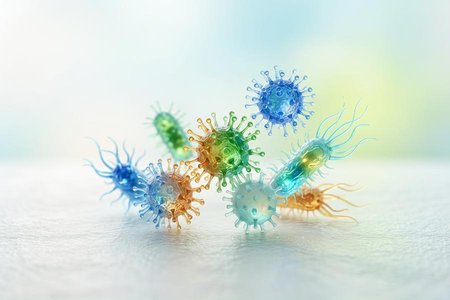
An agent that causes infection or disease, especially a microorganism, such as a bacterium or protozoan, or a virus.
-
See Note at germ
Other Word Forms
Derived Forms
Inflected Forms
Nouns
Etymology
Origin of pathogen
Explanation

A pathogen is a tiny living organism, such as a bacterium or virus, that makes people sick. Washing your hands frequently helps you avoid the pathogens that can make you sick. Pathos is the Greek word for disease and -genes means "born of." So, a pathogen is something that causes disease, like a virus like the rhinovirus, which causes the common cold. At summer picnics, people are cautious about keeping certain foods like potato salad in coolers with ice — the eggs in such dishes spoil quickly out in the heat, introducing pathogens that can make people sick.
Vocabulary lists containing pathogen
Common Senses: Path ("Feeling")
Looking to grow your vocabulary? Check out this interactive, curated word list from our team of English language specialists at Vocabulary.com – one of over 17,000 lists we've built to help learners worldwide!
Fast Food Nation
Interested in learning more words like this one? Our team at Vocabulary.com has got you covered! You can review flashcards, quiz yourself, practice spelling, and more – and it's all completely free to use!
The Martian
Want to remember this word for good? Start your learning journey today with our library of interactive, themed word lists built by the experts at Vocabulary.com – we'll help you make the most of your study time!
Example Sentences
Examples are provided to illustrate real-world usage of words in context. Any opinions expressed do not reflect the views of Dictionary.com.
See Examples For:
Because several bacterial species may contribute to the same disease, methods designed to target a single pathogen may not be sufficient.
From Science Daily ● Oct. 11, 2026

Plague is a disease caused by the Yersinia pestis bacterium, the same pathogen that killed millions of people in Europe during the Middle Ages.
From Barron's ● Oct. 7, 2026

“You cannot be able to put a wall between Uganda and D.R. Congo, between Kenya and Uganda, to prevent the entry of a pathogen, so we continue to maintain a heightened state of alert.”
From The Wall Street Journal ● Oct. 6, 2026

Asked if the pathogen might have been studied for potential use as a bio-weapon, the scientist agreed it was possible.
From BBC ● Oct. 5, 2026

Most human groups are a scattershot mix of HLA profiles, which means that almost always some people in the group will not get sick when exposed to a particular pathogen.
From "1491" by Charles C. Mann

Samples tested found norovirus, campylobacter, shigella and "other pathogens that cause stomach cramps and diarrhoea", officials said.
From BBC ● Oct. 20, 2026
We still use decades-old technology to detect the presence of dangerous pathogens.
From The Wall Street Journal ● Oct. 14, 2026
They help destroy pathogens and trigger the early inflammatory response.
From Science Daily ● Oct. 10, 2026
Rospotrebnadzor said Wednesday that the situation in the Irkutsk region remained "stable", and that nearly 5,000 tests had been conducted, none of which revealed dangerous pathogens.
From Barron's ● Oct. 7, 2026
The insect pathogens are so specific that they infect only a small group of insects — sometimes a single species.
From "Silent Spring" by Rachel Carson
Random Word
Spin the wheel and learn a new word!
Get a wordDefinitions and idiom definitions from Dictionary.com Unabridged, based on the Random House Unabridged Dictionary, © Random House, Inc. 2023
Idioms from The American Heritage® Idioms Dictionary copyright © 2002, 2001, 1995 by Houghton Mifflin Harcourt Publishing Company. Published by Houghton Mifflin Harcourt Publishing Company.
