
tariff
Americannoun
-
tariffs
plural
-
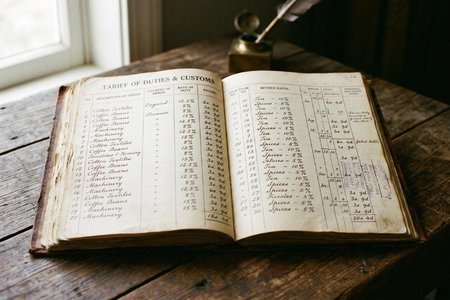
an official list or table showing the duties or customs imposed by a government on imports or exports.
-
the schedule or system of duties so imposed.
-
any duty or rate of duty in such a list or schedule.
-
any table of charges, as of a railroad, bus line, etc.
-
bill; cost; charge.
verb (used with object)
-
tariffs,
present (3rd person singular)
-
tariffed,
past participle, past
-
tariffing
present participle
-
to subject to a tariff.
-
to put a valuation on according to a tariff.
noun
-
-
a tax levied by a government on imports or occasionally exports for purposes of protection, support of the balance of payments, or the raising of revenue
-
a system or list of such taxes
-
-
any schedule of prices, fees, fares, etc
-
-
a method of charging for the supply of services, esp public services, such as gas and electricity
block tariff
-
a schedule of such charges
-
-
a bill of fare with prices listed; menu
-
the level of punishment imposed for a criminal offence
verb
-
to set a tariff on
-
to set a price on according to a schedule of tariffs
Usage
What does tariff mean? A tariff is a tax or duty on products that come into a country (imports) or leave it (exports), imposed by the country’s government. A tariff is also the list of taxes a government imposes on imports and exports. To tariff can mean to subject to a tariff. Example: There is a high tariff on foreign music CDs, so I just stream it instead.
Other Word Forms
Derived Forms
Inflected Forms
Nouns
Participles
Conjugated Forms
Present
-
tariffsimple
-
tariffssimple
-
have tariffedperfect
-
has tariffedperfect
-
am tariffingprogressive
-
are tariffingprogressive
-
is tariffingprogressive
-
have been tariffingperfect progressive
-
has been tariffingperfect progressive
Past
-
tariffedsimple
-
had tariffedperfect
-
was tariffingprogressive
-
were tariffingprogressive
-
had been tariffingperfect progressive
Future
Etymology
Origin of tariff
First recorded in 1585–95; earlier tariffa, from Italian, from Arabic taʿrīfah, derivative of ʿarrafa “to make known,” akin to ʿarafa “to know”
Explanation

A tariff is a kind of tax on goods a country imports or exports. If you want to buy a European-made car in the U.S., the price will include tariffs the government adds to the price of imported vehicles. Usually a government imposes a tariff to encourage its own industries and to discourage buying cheaper imports from other countries. If a government wants to protect its own clothing industry, it may add a tariff to imported clothing, to make sure that the imported clothes aren't cheaper than the locally manufactured items. You can control exports, too, by imposing tariffs. As a verb, you can say "the government tariffs certain imports and exports."
Vocabulary lists containing tariff
American History I
Looking to grow your vocabulary? Check out this interactive, curated word list from our team of English language specialists at Vocabulary.com – one of over 17,000 lists we've built to help learners worldwide!
The American Revolution - Introductory
Interested in learning more words like this one? Our team at Vocabulary.com has got you covered! You can review flashcards, quiz yourself, practice spelling, and more – and it's all completely free to use!
The United States
Want to remember this word for good? Start your learning journey today with our library of interactive, themed word lists built by the experts at Vocabulary.com – we'll help you make the most of your study time!
Example Sentences
Examples are provided to illustrate real-world usage of words in context. Any opinions expressed do not reflect the views of Dictionary.com.
See Examples For:
Some big coffee growers say they’re still trying to recoup costs from the tariff debacle, so their prices have stayed high.
From MarketWatch ● Oct. 21, 2026

Adidas raised its 2026 operating profit guidance to 2.5 billion euros after receiving about $224.3 million in U.S. tariff refunds.
From The Wall Street Journal ● Oct. 20, 2026

New Delhi has also insisted that its final tariff rate should be competitive with those received by other regional manufacturing rivals such as Vietnam.
From Barron's ● Oct. 18, 2026

In this week’s episode: U.S. tariff pressure is prompting countries to tighten their forced-labor rules, changes that could prove more durable than the tariffs themselves.
From The Wall Street Journal ● Oct. 16, 2026
The tariff controversy was settled, but it hinted at a greater problem.
From "In the Shadow of Liberty" by Kenneth C. Davis

ITEP's estimates about the impact of tariffs on American households of different income levels are broadly similar to those of the Tax Foundation think tank, external.
From BBC ● Oct. 20, 2026

Vietnam and four European nations outside the EU signed a free trade agreement in Hanoi on Sunday, seeking to diversify their markets as US tariffs disrupt global commerce.
From Barron's ● Oct. 18, 2026
Yuriy Ryzhenkov, chief executive of Metinvest, told the BBC the recently-imposed tariffs on imported steel to the EU were "unfair" and had been put in place "without any consideration for the situation Ukraine is in".
From BBC ● Oct. 18, 2026
Last February, the two sides reached a provisional agreement aimed at reducing US tariffs on Indian products.
From Barron's ● Oct. 17, 2026
Poor in natural resources, its trade crippled by high tariffs and low demand, Japan was struggling to support a growing population.
From "Unbroken" by Laura Hillenbrand
Will retailers seek out customers who paid higher prices on products that were tariffed to hand them refunds?
From Los Angeles Times ● Feb. 24, 2026

Importers have been agile in switching their supply chains away from the most highly tariffed countries.
From BBC ● Feb. 20, 2026
On Aug. 11, Trump wrote on Truth Social that gold wouldn’t be tariffed.
From The Wall Street Journal ● Feb. 20, 2026
As American importers scrambled to switch suppliers last year, Asian producers such as Thailand and Vietnam benefitted at the expense of more highly tariffed China.
From BBC ● Feb. 20, 2026
Moreover, academic degrees are tariffed in the marriage market.
From Tales of Bengal by S. B. Banerjea

This is why the surreal stories about the US tariffing rarely visited islands only inhabited by penguins matter.
From BBC ● Apr. 5, 2025
“You can’t be tariffing people at the same exact time that you’re negotiating a detailed arrangement with them,” Mr. Ross said, while describing them as a cocked pistol.
From New York Times ● May 21, 2018

The exportation of the national specie was still forbidden, and more than once the State found itself obliged to return to the question of the tariffing of its coinage.
From The History of Currency, 1252 to 1896 by William Arthur Shaw
He had something to do with the high cost of tariffing.
From Who Was Who: 5000 BC - 1914 Biographical Dictionary of the Famous and Those Who Wanted to Be by Irwin Leslie Gordon
Random Word
Spin the wheel and learn a new word!
Get a wordDefinitions and idiom definitions from Dictionary.com Unabridged, based on the Random House Unabridged Dictionary, © Random House, Inc. 2023
Idioms from The American Heritage® Idioms Dictionary copyright © 2002, 2001, 1995 by Houghton Mifflin Harcourt Publishing Company. Published by Houghton Mifflin Harcourt Publishing Company.
