
tariff
Americannoun
-
tariffs
plural
-
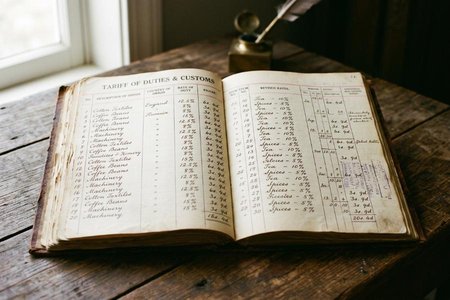
an official list or table showing the duties or customs imposed by a government on imports or exports.
-
the schedule or system of duties so imposed.
-
any duty or rate of duty in such a list or schedule.
-
any table of charges, as of a railroad, bus line, etc.
-
bill; cost; charge.
verb (used with object)
-
tariffs,
present (3rd person singular)
-
tariffed,
past participle, past
-
tariffing
present participle
-
to subject to a tariff.
-
to put a valuation on according to a tariff.
noun
-
-
a tax levied by a government on imports or occasionally exports for purposes of protection, support of the balance of payments, or the raising of revenue
-
a system or list of such taxes
-
-
any schedule of prices, fees, fares, etc
-
-
a method of charging for the supply of services, esp public services, such as gas and electricity
block tariff
-
a schedule of such charges
-
-
a bill of fare with prices listed; menu
-
the level of punishment imposed for a criminal offence
verb
-
to set a tariff on
-
to set a price on according to a schedule of tariffs
Usage
What does tariff mean? A tariff is a tax or duty on products that come into a country (imports) or leave it (exports), imposed by the country’s government. A tariff is also the list of taxes a government imposes on imports and exports. To tariff can mean to subject to a tariff. Example: There is a high tariff on foreign music CDs, so I just stream it instead.
Other Word Forms
Derived Forms
Inflected Forms
Nouns
Participles
Conjugated Forms
Present
-
tariffsimple
-
tariffssimple
-
have tariffedperfect
-
has tariffedperfect
-
am tariffingprogressive
-
are tariffingprogressive
-
is tariffingprogressive
-
have been tariffingperfect progressive
-
has been tariffingperfect progressive
Past
-
tariffedsimple
-
had tariffedperfect
-
was tariffingprogressive
-
were tariffingprogressive
-
had been tariffingperfect progressive
Future
Etymology
Origin of tariff
First recorded in 1585–95; earlier tariffa, from Italian, from Arabic taʿrīfah, derivative of ʿarrafa “to make known,” akin to ʿarafa “to know”
Explanation

A tariff is a kind of tax on goods a country imports or exports. If you want to buy a European-made car in the U.S., the price will include tariffs the government adds to the price of imported vehicles. Usually a government imposes a tariff to encourage its own industries and to discourage buying cheaper imports from other countries. If a government wants to protect its own clothing industry, it may add a tariff to imported clothing, to make sure that the imported clothes aren't cheaper than the locally manufactured items. You can control exports, too, by imposing tariffs. As a verb, you can say "the government tariffs certain imports and exports."
Vocabulary lists containing tariff
American History I
Looking to grow your vocabulary? Check out this interactive, curated word list from our team of English language specialists at Vocabulary.com – one of over 17,000 lists we've built to help learners worldwide!
The American Revolution - Introductory
Interested in learning more words like this one? Our team at Vocabulary.com has got you covered! You can review flashcards, quiz yourself, practice spelling, and more – and it's all completely free to use!
The United States
Want to remember this word for good? Start your learning journey today with our library of interactive, themed word lists built by the experts at Vocabulary.com – we'll help you make the most of your study time!
Example Sentences
Examples are provided to illustrate real-world usage of words in context. Any opinions expressed do not reflect the views of Dictionary.com.
See Examples For:
Michigan’s manufacturing supply chains are deeply integrated with Canada, and small businesses especially have borne the tariff brunt since they have less capacity to absorb the costs than larger companies do.
From The Wall Street Journal ● Oct. 8, 2026

Back then, stocks were setting up for a historic comeback after nearly skidding into bear-market territory following the White House’s initial “liberation day” tariff rollout.
From MarketWatch ● Oct. 6, 2026

India's economy is growing at an enviable rate of over 7% despite global energy shocks, rising interest rates, tariff uncertainties and weather-related disruptions.
From BBC ● Oct. 5, 2026

"Indian products face a variety of tariff and non-tariff hurdles in China that make it difficult to scale exports," says Li.
From BBC ● Oct. 5, 2026
“So six bolts of silk at twice the price, plus the tariff, but minus my bargain to you as a Zoroastrian would be one hundred forty-seven drachms.”
From "The Many Assassinations of Samir, the Seller of Dreams" by Daniel Nayeri

Bailey said the firm was facing tariffs from the US and "huge pressure to go electric".
From BBC ● Oct. 8, 2026
Consumers watched the prices of goods like bananas rise after the onset of reciprocal tariffs, Mahoney noted, and fall only slightly after those tariffs were rescinded.
From The Wall Street Journal ● Oct. 8, 2026
Professor David Bailey said JLR was facing tariffs from the US and "huge pressure to go electric"
From BBC ● Oct. 8, 2026
Despite a steep increase in tariffs, U.S. imports grew by 4.5% last year.
From The Wall Street Journal ● Oct. 8, 2026
It recognized England’s right to retain tariffs on American exports while granting English imports most-favored status in the United States; it implicitly accepted English impressment of American sailors.
From "Founding Brothers: The Revolutionary Generation" by Joseph J. Ellis
According to data by Statistics Canada, the swing state of Ohio will be hardest hit, with C$3.2bn - or 12% - of its exports soon to be tariffed by Canada, followed by Illinois and Pennsylvania.
From BBC ● Aug. 31, 2026
Products that are almost entirely metal will still be tariffed at 50%.
From The Wall Street Journal ● Apr. 23, 2026
Will retailers seek out customers who paid higher prices on products that were tariffed to hand them refunds?
From Los Angeles Times ● Feb. 24, 2026

Importers have been agile in switching their supply chains away from the most highly tariffed countries.
From BBC ● Feb. 20, 2026
For a minute, amid the pleasantness—poetry in tariffed items, but all the more, for guests already convicted, a challenge to consumption—they smiled at each other in confirmed fellowship.
From The Ambassadors by Henry James

This is why the surreal stories about the US tariffing rarely visited islands only inhabited by penguins matter.
From BBC ● Apr. 5, 2025
“You can’t be tariffing people at the same exact time that you’re negotiating a detailed arrangement with them,” Mr. Ross said, while describing them as a cocked pistol.
From New York Times ● May 21, 2018

The exportation of the national specie was still forbidden, and more than once the State found itself obliged to return to the question of the tariffing of its coinage.
From The History of Currency, 1252 to 1896 by William Arthur Shaw
He had something to do with the high cost of tariffing.
From Who Was Who: 5000 BC - 1914 Biographical Dictionary of the Famous and Those Who Wanted to Be by Irwin Leslie Gordon
Definitions and idiom definitions from Dictionary.com Unabridged, based on the Random House Unabridged Dictionary, © Random House, Inc. 2023
Idioms from The American Heritage® Idioms Dictionary copyright © 2002, 2001, 1995 by Houghton Mifflin Harcourt Publishing Company. Published by Houghton Mifflin Harcourt Publishing Company.
