tragedy
Americannoun
-
tragedies
plural
-
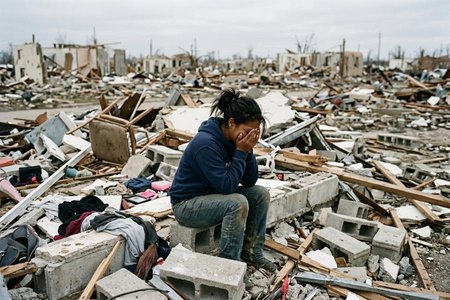
a lamentable, dreadful, or fatal event or affair; calamity; disaster.
stunned by the tragedy of so many deaths.
-
a dramatic composition, often in verse, dealing with a serious or somber theme, typically involving a great person destined to experience downfall or utter destruction, as through a character flaw or conflict with some overpowering force, as fate or an unyielding society.
-
the branch of the drama that is concerned with this form of composition.
-
the art and theory of writing and producing tragedies.
-
any literary composition, as a novel, dealing with a somber theme carried to a tragic or disastrous conclusion.
-
the tragic or mournful or calamitous element of drama, of literature generally, or of life.
noun
-
(esp in classical and Renaissance drama) a play in which the protagonist, usually a man of importance and outstanding personal qualities, falls to disaster through the combination of a personal failing and circumstances with which he cannot deal
-
(in later drama, such as that of Ibsen) a play in which the protagonist is overcome by a combination of social and psychological circumstances
-
any dramatic or literary composition dealing with serious or sombre themes and ending with disaster
-
(in medieval literature) a literary work in which a great person falls from prosperity to disaster, often through no fault of his own
-
the branch of drama dealing with such themes
-
the unfortunate aspect of something
-
a shocking or sad event; disaster
Discover More
In common usage, disasters of many kinds are called tragedies.
Aristotle argued that the proper effect of tragedy is catharsis — the purging of the emotions.
Other Word Forms
Derived Forms
Inflected Forms
Nouns
Etymology
Origin of tragedy
First recorded in 1325–75; Middle English tragedie, from Medieval Latin tragēdia, Latin tragoedia, from Greek tragōidía, from trág(os) “goat” + ōid(ḗ) “song” ( see ode) + -ia -y 3; reason for name variously explained
Explanation

Tragedy is a noun that indicates disaster or bad fortune. It would be a tragedy to lose your job, but an even greater tragedy to fall ill while unemployed and without health care. First recorded in the late 14th century, the noun tragedy originally referred to a play with an unhappy ending. About a century later it also came to mean an unhappy event or a disaster. The playwright George Bernard Shaw wittily observed, "“There are two tragedies in life. One is to lose your heart's desire. The other is to gain it.” The comedian Mel Brooks defined tragedy as follows: "Tragedy is when I cut my finger. Comedy is when you walk into an open sewer and die."
Vocabulary lists containing tragedy
Ancient Greece - Introductory
Looking to grow your vocabulary? Check out this interactive, curated word list from our team of English language specialists at Vocabulary.com – one of over 17,000 lists we've built to help learners worldwide!
Bud, Not Buddy
Interested in learning more words like this one? Our team at Vocabulary.com has got you covered! You can review flashcards, quiz yourself, practice spelling, and more – and it's all completely free to use!
Calamity, Catastrophe, and Crisis: Disaster Words
Want to remember this word for good? Start your learning journey today with our library of interactive, themed word lists built by the experts at Vocabulary.com – we'll help you make the most of your study time!
Example Sentences
Examples are provided to illustrate real-world usage of words in context. Any opinions expressed do not reflect the views of Dictionary.com.
See Examples For:
Sister, the oldest of the Whitby children, is trying to keep this rule in mind as she heads to her mother’s house nine years after the tragedy.
From The Wall Street Journal ● Oct. 16, 2026

Another parent, Asadullah, said he lost a son, nephew, and three other close relatives in the tragedy.
From Barron's ● Oct. 16, 2026

"We are stunned and heartbroken by this senseless tragedy," said Bend-La Pine Schools Superintendent Steven Cook in a statement.
From Barron's ● Oct. 15, 2026
Gareth Jones, now 67, said he had joined Thursday's ceremony in the Senedd to show the King a photograph of his father meeting him and his sister on the day after the tragedy.
From BBC ● Oct. 15, 2026

The difference between Euripides’ Medea and Apollonius’ heroine and also Virgil’s Dido is in its degree a measure of what Greek tragedy was.
From "Mythology: Timeless Tales of Gods and Heroes" by Edith Hamilton

Florence Lustman, head of France Assureurs, pointed to the "human tragedies" behind the figures and expressed the industry's "solidarity".
From Barron's ● Oct. 16, 2026
"With profound grief and sorrow, I urge the authorities to conduct a thorough investigation and take strict action against anyone found responsible so that such tragedies can be prevented in the future," he said.
From Barron's ● Oct. 15, 2026
At the concert, Mastodon also appeared as a band pushing past the tragedies, and was re-energized and refocused with a new lineup.
From Los Angeles Times ● Oct. 12, 2026

"The company still has an opportunity to demonstrate accountability by strengthening safeguards, improving transparency and taking concrete action to help prevent similar tragedies in the future."
From BBC ● Sep. 22, 2026
If we let these tragedies become growth experiences, if we learn from them, then we have in some way triumphed over the fear and anger and sorrow that death brings.
From "Tears of a Tiger" by Sharon M. Draper
Random Word
Spin the wheel and learn a new word!
Get a wordDefinitions and idiom definitions from Dictionary.com Unabridged, based on the Random House Unabridged Dictionary, © Random House, Inc. 2023
Idioms from The American Heritage® Idioms Dictionary copyright © 2002, 2001, 1995 by Houghton Mifflin Harcourt Publishing Company. Published by Houghton Mifflin Harcourt Publishing Company.
