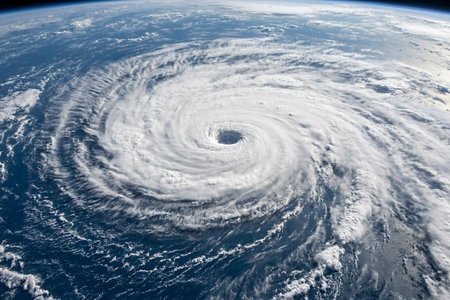
a large-scale, atmospheric wind-and-pressure system characterized by low pressure at its center and by circular wind motion, counterclockwise in the Northern Hemisphere, clockwise in the Southern Hemisphere.
Meteorology.
a large-scale, atmospheric wind-and-pressure system characterized by low pressure at its center and by circular wind motion, counterclockwise in the Northern Hemisphere, clockwise in the Southern Hemisphere.
Also called cyclone collector,
cyclone separator.
Machinery.
a device for removing small or powdered solids from air, water, or other gases or liquids by centrifugal force.
A large-scale system of winds that spiral in toward a region of low atmospheric pressure. A cyclone's rotational direction is opposite to that of an anticyclone. In the Northern hemisphere, a cyclone rotates counterclockwise; in the Southern hemisphere, clockwise. Because low-pressure systems generally produce clouds and precipitation, cyclones are often simply referred to as storms.
◆ An extratropical cyclone is one that forms outside the tropics at middle or high latitudes. Extratropical cyclones usually have an organized front and migrate eastward with the prevailing westerly winds of those latitudes.
◆ A tropical cyclone forms over warm tropical waters and is generally smaller than an extratropical cyclone. Such a system is characterized by a warm, well-defined core and can range in intensity from a tropical depression to a hurricane.
A small-scale, violently rotating windstorm, such as a tornado or waterspout. Not in scientific use.
cyclone
Cultural
Any circular wind motion. A region of low atmospheric pressure. Also, a tropical storm.
Usage
What’s the difference between a cyclone, a hurricane, and a typhoon?
Cyclone, hurricane, and typhoon are all terms for big storms. Although the word cyclone is often used to refer to a big storm, it is, technically speaking, a large-scale, atmospheric wind-and-pressure system characterized by low pressure at its center and by circular wind motion. Because these generally produce clouds and precipitation, cyclones are often simply referred to as storms. When such storms form around the tropics, they are calledtropical cyclones. Tropical cyclones are classified based on their strength. They may start as tropical depressions and progress to tropical storms. The most severe tropical cyclones—those with winds of 74 mph (119 k/mh) or more—are called hurricanes or typhoons. Which term is used depends on where the storm occurs. Generally, storms that form over the Atlantic Ocean or the Gulf of Mexico are called hurricanes, while those that form over the Pacific Ocean are called typhoons. (The word hurricane is sometimes used for storms that form over the eastern or central North Pacific Ocean.)Cyclones rotate counterclockwise in the Northern Hemisphere and clockwise in the Southern Hemisphere. cyclone vs. tornadoIn casual use, the word cyclone is sometimes used to refer to a tornado (but it is not used this way in scientific contexts). Here’s an example of cyclone, hurricane, and typhoon used correctly in a sentence. Example: There have been many devastating cyclones this season, including a hurricane in the Gulf of Mexico and multiple typhoons in the Pacific.Want to learn more? Read the full breakdown of the difference between cyclones, hurricanes, and typhoons.
Closer Look
Technically, a cyclone is nothing more than a region of low pressure around which air flows in an inward spiral. In the Northern Hemisphere the air moves counterclockwise around the low-pressure center, and in the Southern Hemisphere the air travels clockwise. Meteorologists also refer to tropical cyclones, which are cyclonic low-pressure systems that develop over warm water. For a tropical cyclone to originate, a large area of ocean must have a surface temperature greater than 27 degrees Celsius (80.6 degrees Fahrenheit). Tropical cyclones are categorized based on the strength of their sustained surface winds. They may begin as a tropical depression, with winds less than 39 miles (63 kilometers) per hour. Tropical storms are identified and tracked once the winds exceed this speed. Severe tropical cyclones, with winds of 74 miles (119 kilometers) per hour or greater, are better known as hurricanes when they occur in the Atlantic Ocean and Gulf of Mexico, or as typhoons when they happen in the Pacific Ocean. Because the word cyclone broadly defines a kind of air flow, cyclones are not confined to our planet. In 1999 the Hubble Space Telescope photographed a cyclone more than 1,610 kilometers (1,000 miles) across in the northern polar regions of Mars.
Introduced by British meteorologist Henry Piddington (1797–1858) in 1848, perhaps from Greek kyklôn “revolving” (present participle of kykloûn “to revolve,” verbal derivative of kýklos “wheel, ring, circle”; see cycle); apparently confused by Piddington with kýklōma “wheel, snake's coil”
Compare meaning
How does cyclone compare to similar and commonly confused words?
Explore the most common comparisons:
A cyclone is another word for "tornado" or other types of violent, spinning storms. It was a cyclone that uprooted Dorothy in "The Wizard of Oz," and her little dog Toto too. In the midwestern part of the United States, a cyclone is a tornado. But ask a meteorologist and he'll tell you that technically a cyclone is a rapidly rotating storm that forms over a warm ocean, specifically in the South Pacific. Tropical cyclones are actually much bigger than tornadoes: a small cyclone could be 100 miles across, while a monster tornado would only be about a mile across.
Examples are provided to illustrate real-world usage of words in context. Any
opinions expressed do not reflect the views of Dictionary.com.
See Examples For:
If forecasters can recognize earlier when a poorly organized tropical cyclone is becoming more favorable for strengthening, they may be able to provide communities with additional time for evacuation decisions and other preparations.
"El Nino may influence tropical cyclone activity in the Central and East Pacific and could alter the risk of floods, wildfires, and other weather extremes elsewhere," it said.
The research may also provide forecasters with additional clues about which disorganized tropical cyclones are beginning to transition into a structure that is more favorable for intensification.