epidemic
Americanadjective
-
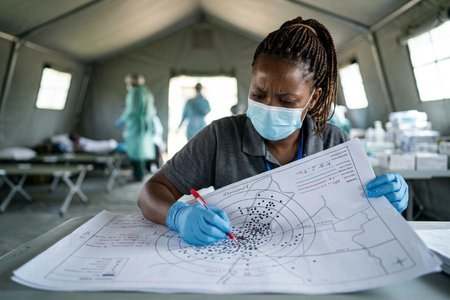
Also epidemical (of a disease) affecting many persons at the same time, and spreading from person to person in a locality where the disease is not permanently prevalent.
-
extremely prevalent; widespread.
noun
-
epidemics
plural
-
a temporary prevalence of a disease.
-
a rapid spread or increase in the occurrence of something.
an epidemic of riots.
adjective
noun
-
a widespread occurrence of a disease
an influenza epidemic
-
a rapid development, spread, or growth of something, esp something unpleasant
an epidemic of strikes
Other Word Forms
Derived Forms
Inflected Forms
Nouns
Etymology
Origin of epidemic
First recorded in 1595–1605; obsolete epidem(y) (from Late Latin epidēmia, from Greek epidēmía “staying in one place, among the people,” equivalent to epi- epi- + dêm(os) “people of a district” + -ia -y 3 ) + -ic
Explanation

An epidemic is a disease that spreads rapidly among many people in a community at the same time. In the 1980s, the fast-spreading AIDS epidemic transformed life on our planet. Epidemic can be used figuratively to refer to something that spreads or grows rapidly: an epidemic of laziness has taken over the tenth grade. This word is from French épidémique, ultimately from Greek epidēmia "staying in one place, among the people." The related word pandemic refers to a disease that spreads throughout an entire country or throughout the world.
Vocabulary lists containing epidemic
Human Geography - Middle School
Looking to grow your vocabulary? Check out this interactive, curated word list from our team of English language specialists at Vocabulary.com – one of over 17,000 lists we've built to help learners worldwide!
Human Geography - High School
Interested in learning more words like this one? Our team at Vocabulary.com has got you covered! You can review flashcards, quiz yourself, practice spelling, and more – and it's all completely free to use!
List 1
Want to remember this word for good? Start your learning journey today with our library of interactive, themed word lists built by the experts at Vocabulary.com – we'll help you make the most of your study time!
Example Sentences
Examples are provided to illustrate real-world usage of words in context. Any opinions expressed do not reflect the views of Dictionary.com.
See Examples For:
The HIV epidemic was raging across the U.S.,
From The Wall Street Journal ● Oct. 11, 2026

In an interview with BBC Scotland News, Farrell described the scale of violence against women and girls in Scotland as an "epidemic", and that police forces were not immune to the problem .
From BBC ● Oct. 8, 2026

The surgeon general declared a loneliness epidemic in 2023, but it was already happening.
From Los Angeles Times ● Oct. 7, 2026

Rospotrebnadzor said Wednesday that there were no "epidemic risks to the populations of Irkutsk and the Irkutsk Region".
From Barron's ● Oct. 7, 2026

Stanton weeded out unfit and incompetent officers; battled dishonest government contractors who sold the army low-quality uniforms, rotting equipment, and defective weapons; and endured an epidemic of officers who would not fight.
From "Chasing Lincoln's Killer" by James L. Swanson

More than half of the deaths were due to the collapse of the health system, along with epidemics and famine.
From Los Angeles Times ● Oct. 13, 2026
Tung's rocky tenure was marked by the Asian Financial Crisis, two major epidemics, and historic protests which attracted criticism of his administration.
From BBC ● Sep. 9, 2026
"Respect for humanitarian personnel and humanitarian activities is essential to ensuring that communities affected by epidemics and other crises continue to receive the assistance and services they urgently need," it said.
From Barron's ● Aug. 24, 2026
For many people, plague brings to mind rats, crowded medieval towns, and the devastating epidemics that spread across Europe during and after the Middle Ages.
From Science Daily ● Jun. 18, 2026

Major yellow fever epidemics had struck Manhattan and the surrounding towns in 1702, 1731, 1742, and 1743, and then every year from 1791 through 1821.
From "An American Plague: The True and Terrifying Story of the Yellow Fever Epidemic of 1793" by Jim Murphy
Random Word
Spin the wheel and learn a new word!
Get a wordDefinitions and idiom definitions from Dictionary.com Unabridged, based on the Random House Unabridged Dictionary, © Random House, Inc. 2023
Idioms from The American Heritage® Idioms Dictionary copyright © 2002, 2001, 1995 by Houghton Mifflin Harcourt Publishing Company. Published by Houghton Mifflin Harcourt Publishing Company.
