
noun
-
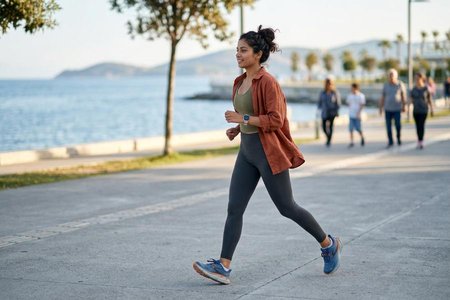
manner of walking or running; bearing
-
(used esp of horses and dogs) the pattern of footsteps at various speeds, as the walk, trot, canter, etc, each pattern being distinguished by a particular rhythm and footfall
verb
Usage
What does gait mean? Gait means the way a person or animal walks or runs. Gait is often used in the context of horses and show dogs when analyzing how they walk, trot, and run. The human gait is studied in medicine and in sports like running. Gait can also be used as a verb meaning to teach a horse a particular gait. Example: You can tell that his gait is affected by a limp.
Other Word Forms
Noun Inflected Forms
Etymology
Origin of gait
1500–10; Scots, Middle English spelling variant of gate 1 in various senses
Explanation

Some people have a very distinct gait, or manner of walking or running, which allows you to recognize them from far away. Walking with two legs is a pretty straightforward task, so most of us (with the exception of runners) don’t think about our own gait very often. However, when four legs are involved, the definition of gait becomes more complex. In horseback riding, gait is used to refer to the particular sequence or pattern of footsteps that the horse is using. Well-known gaits include the trot, the gallop, and the canter.
Vocabulary lists containing gait
Horsin' Around
Looking to grow your vocabulary? Check out this interactive, curated word list from our team of English language specialists at Vocabulary.com – one of over 17,000 lists we've built to help learners worldwide!
List 5
Interested in learning more words like this one? Our team at Vocabulary.com has got you covered! You can review flashcards, quiz yourself, practice spelling, and more – and it's all completely free to use!
Bud, Not Buddy
Want to remember this word for good? Start your learning journey today with our library of interactive, themed word lists built by the experts at Vocabulary.com – we'll help you make the most of your study time!
Example Sentences
Examples are provided to illustrate real-world usage of words in context. Any opinions expressed do not reflect the views of Dictionary.com.
See Examples For:
The findings, published in August 2025, came from the first randomized, placebo-controlled clinical trial to demonstrate the effectiveness of personalized gait retraining for knee osteoarthritis over a full year.
From Science Daily ● Oct. 11, 2026

Importantly, turning the toes inward or outward without professional assessment is not the same as receiving personalized gait retraining.
From Science Daily ● Oct. 11, 2026
“The duration an individual, whether male or female, can maintain balance on one leg,” it concluded, “emerges as the most reliable determinant of aging, surpassing strength, gait, and other balance parameters.”
From Los Angeles Times ● Aug. 18, 2026

The first signs that a dog is crossing over into his senior years are often a graying muzzle, cloudier eyes or a slower gait.
From The Wall Street Journal ● Jul. 30, 2026

I’ve worked hard on my gait; on learning how to adapt.
From "The Running Dream" by Wendelin Van Draanen

“All states, shapes, shades and gaits are welcome.”
From Los Angeles Times ● Apr. 22, 2025
Dressage is the oldest equestrian discipline, and sees rider and horse perform a series of movements to music across the gaits of walk, trot and canter.
From BBC ● Dec. 5, 2024

Both were walking on two feet, although they had different gaits and foot shapes, which the research team in this study used to differentiate the footprints.
From Salon ● Nov. 29, 2024

"We have thus confirmed the hypothesis that efficient gaits can be realized by exploiting natural oscillation patterns," explains Prof.
From Science Daily ● Nov. 18, 2024
No doubt it was the similarity of their gaits that prompted Penelope’s memory, but the two had little else in common: For example, Dr. Westminster was extremely clever and Bertha was not clever at all.
From "The Unseen Guest" by Maryrose Wood
Definitions and idiom definitions from Dictionary.com Unabridged, based on the Random House Unabridged Dictionary, © Random House, Inc. 2023
Idioms from The American Heritage® Idioms Dictionary copyright © 2002, 2001, 1995 by Houghton Mifflin Harcourt Publishing Company. Published by Houghton Mifflin Harcourt Publishing Company.
