pathogen
Americannoun
-
pathogens
plural
noun
-
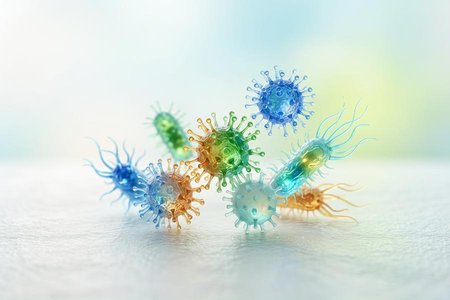
An agent that causes infection or disease, especially a microorganism, such as a bacterium or protozoan, or a virus.
-
See Note at germ
Other Word Forms
Derived Forms
Inflected Forms
Nouns
Etymology
Origin of pathogen
Explanation

A pathogen is a tiny living organism, such as a bacterium or virus, that makes people sick. Washing your hands frequently helps you avoid the pathogens that can make you sick. Pathos is the Greek word for disease and -genes means "born of." So, a pathogen is something that causes disease, like a virus like the rhinovirus, which causes the common cold. At summer picnics, people are cautious about keeping certain foods like potato salad in coolers with ice — the eggs in such dishes spoil quickly out in the heat, introducing pathogens that can make people sick.
Vocabulary lists containing pathogen
Common Senses: Path ("Feeling")
Looking to grow your vocabulary? Check out this interactive, curated word list from our team of English language specialists at Vocabulary.com – one of over 17,000 lists we've built to help learners worldwide!
Fast Food Nation
Interested in learning more words like this one? Our team at Vocabulary.com has got you covered! You can review flashcards, quiz yourself, practice spelling, and more – and it's all completely free to use!
The Martian
Want to remember this word for good? Start your learning journey today with our library of interactive, themed word lists built by the experts at Vocabulary.com – we'll help you make the most of your study time!
Example Sentences
Examples are provided to illustrate real-world usage of words in context. Any opinions expressed do not reflect the views of Dictionary.com.
See Examples For:
Plague is a disease caused by the Yersinia pestis bacterium, the same pathogen that killed millions of people in Europe during the Middle Ages.
From Barron's ● Oct. 7, 2026

“You cannot be able to put a wall between Uganda and D.R. Congo, between Kenya and Uganda, to prevent the entry of a pathogen, so we continue to maintain a heightened state of alert.”
From The Wall Street Journal ● Oct. 6, 2026

Asked if the pathogen might have been studied for potential use as a bio-weapon, the scientist agreed it was possible.
From BBC ● Oct. 5, 2026

“Similar research could certainly be used in the development of better vaccines and therapeutics for the virus — but it could also be used to make the pathogen more dangerous,” Anthropic wrote.
From Salon ● Sep. 11, 2026

In the second stage a former animal pathogen evolves to the point where it does get transmitted directly between people and causes epidemics.
From "Guns, Germs, and Steel: The Fates of Human Societies" by Jared M. Diamond

Kate Herridge, a PhD student working on the project, said the next step was to "concentrate these water samples" and "find if any pathogens have attached themselves to the samplers".
From BBC ● Oct. 4, 2026
But the western blacklegged tick, known as the deer tick in most of the country, is common in the state’s chaparral, grasslands and woods, and can transmit Lyme disease, babesiosis and other pathogens.
From Los Angeles Times ● Oct. 4, 2026

One of its primary jobs is to keep iron away from pathogens.
From Science Daily ● Sep. 28, 2026

Now their AI biosecurity startup, called Red Queen Bio, is rushing to design antibodies that can be manufactured to protect against a range of potential pathogens, including the seemingly sci-fi threat of an AI-designed virus.
From The Wall Street Journal ● Sep. 28, 2026
The only pathogens in this waste are the ones I already have.
From "The Martian" by Andy Weir
Definitions and idiom definitions from Dictionary.com Unabridged, based on the Random House Unabridged Dictionary, © Random House, Inc. 2023
Idioms from The American Heritage® Idioms Dictionary copyright © 2002, 2001, 1995 by Houghton Mifflin Harcourt Publishing Company. Published by Houghton Mifflin Harcourt Publishing Company.
