
government
Americannoun
-
governments
plural
-
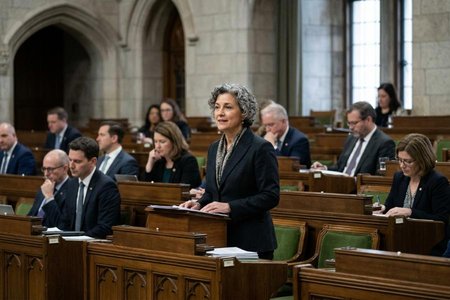
the political direction and control exercised over the actions of the members, citizens, or inhabitants of communities, societies, and states; direction of the affairs of a state, community, etc.; political administration.
Government is necessary to the existence of civilized society.
-
the form or system of rule by which a state, community, etc., is governed.
monarchical government; episcopal government.
-
the governing body of persons in a state, community, etc.; administration.
-
a branch or service of the supreme authority of a state or nation, taken as representing the whole.
a dam built by the government.
-
(in some parliamentary systems, as that of the United Kingdom)
-
the particular group of persons forming the cabinet at any given time.
The prime minister has formed a new government.
-
the parliament along with the cabinet.
The government has fallen.
-
-
direction; control; management; rule.
the government of one's conduct.
-
a district governed; province.
-
Grammar. the extablished usage that requires that one word in a sentence should cause another to be of a particular form.
the government of the verb by its subject.
noun
-
the exercise of political authority over the actions, affairs, etc, of a political unit, people, etc, as well as the performance of certain functions for this unit or body; the action of governing; political rule and administration
-
the system or form by which a community, etc, is ruled
tyrannical government
-
-
the executive policy-making body of a political unit, community, etc; ministry or administration
yesterday we got a new government
-
( capital when of a specific country )
the British Government
-
-
-
the state and its administration
blame it on the government
-
( as modifier )
a government agency
-
-
regulation; direction
-
grammar the determination of the form of one word by another word
Grammar
See collective noun.
Pronunciation
Normal phonological processes are reflected in a variety of pronunciations for government. Most commonly, the first of assimilates to the immediately following , with the resulting identical nasal sounds coalescing to give the pronunciation . This pronunciation is considered standard and occurs throughout the U.S. For speakers in regions where postvocalic is regularly lost, as along the Eastern Seaboard and in the South, the resulting pronunciation is or, with loss of the medial unstressed vowel, . Further assimilation, in which the labiodental , in anticipation of the bilabial quality of the following , becomes the bilabial stop , leads in the South Midland and Southern U.S. to the pronunciation . See isn't.
Other Word Forms
Derived Forms
-
countergovernmentnoun
-
nongovernmentnoun
-
regovernmentnoun
-
subgovernmentnoun
-
undergovernmentnoun
-
governmentaladjective
-
nongovernmentaladjective
-
pro-governmentadjective
-
semigovernmentaladjective
-
ungovernmentaladjective
-
governmentallyadverb
-
semigovernmentallyadverb
-
ungovernmentallyadverb
Inflected Forms
Nouns
Etymology
Origin of government
First recorded in 1350–1400; Middle English word from Old French word governement. See govern, -ment
Explanation

Your government is the system of people, laws, and officials that define and control the country that you live in. The U.S. government, for example, is a representative democracy with three branches. There are many different kinds of government, but they all do essentially the same thing: "govern" or oversee the rules, regulations, and interactions of the people who live under them. For the most part, a government is concerned with public life, though many of the laws that a government like ours establishes and enforces can regulate what happens in private life, too. If you work for the government, you're in public life. If you work for a company, you're in the private sector.
Vocabulary lists containing government
Tax Day Words
Looking to grow your vocabulary? Check out this interactive, curated word list from our team of English language specialists at Vocabulary.com – one of over 17,000 lists we've built to help learners worldwide!
Commonly Misspelled Words, List 2
Interested in learning more words like this one? Our team at Vocabulary.com has got you covered! You can review flashcards, quiz yourself, practice spelling, and more – and it's all completely free to use!
"The Constitution"
Want to remember this word for good? Start your learning journey today with our library of interactive, themed word lists built by the experts at Vocabulary.com – we'll help you make the most of your study time!
Example Sentences
Examples are provided to illustrate real-world usage of words in context. Any opinions expressed do not reflect the views of Dictionary.com.
See Examples For:
The median earnings of Stevens students who received financial aid four years after graduation is $112,538, according to government data, nearly double the national median for four-year colleges of $60,377.
From MarketWatch ● Sep. 22, 2026

The government had already confirmed the new rights will also apply to parents who experience a miscarriage before 24 weeks of pregnancy.
From BBC ● Sep. 22, 2026

The U.S. government is expected to keep Falcon busy, with flights on the rocket and its larger variant potentially extending into the early 2030s.
From The Wall Street Journal ● Sep. 22, 2026

The article views the litigation as a test of whether government institutions can still restrain concentrated private power.
From Los Angeles Times ● Sep. 21, 2026

“There is some sort of secret government project out here on the Virginia peninsula, and they are looking for Colored women who are mathematicians,” Eric told me.
From "Reaching for the Moon" by Katherine Johnson

Ongoing heavy debt issuance volumes from governments and corporates continue to pressure term premia globally and from this point of view, RBC BlueBay is disinclined to extend beyond intermediate maturities.
From The Wall Street Journal ● Sep. 21, 2026
That finding is especially relevant as governments and international organizations place increasing emphasis on forest restoration.
From Science Daily ● Sep. 21, 2026

Some at that time described the Jaffna region as an "open prison" - and the security forces were accused of causing the disappearance of thousands of civilians, something Sri Lankan governments have always denied.
From BBC ● Sep. 20, 2026
Faux explained that, theoretically, yes, there are many ways that Bitcoin could serve the marginalized and oppressed: It could be used in international remittances; it could protect wealth against irresponsible governments.
From Slate ● Sep. 20, 2026

The latter willingness is one so strongly programmed into us citizens of modern states, by our schools and churches and governments, that we forget what a radical break it marks with previous human history.
From "Guns, Germs, and Steel: The Fates of Human Societies" by Jared M. Diamond
Definitions and idiom definitions from Dictionary.com Unabridged, based on the Random House Unabridged Dictionary, © Random House, Inc. 2023
Idioms from The American Heritage® Idioms Dictionary copyright © 2002, 2001, 1995 by Houghton Mifflin Harcourt Publishing Company. Published by Houghton Mifflin Harcourt Publishing Company.
