Bracket Battle: Food Fight!
Vote for the word that makes your mouth water
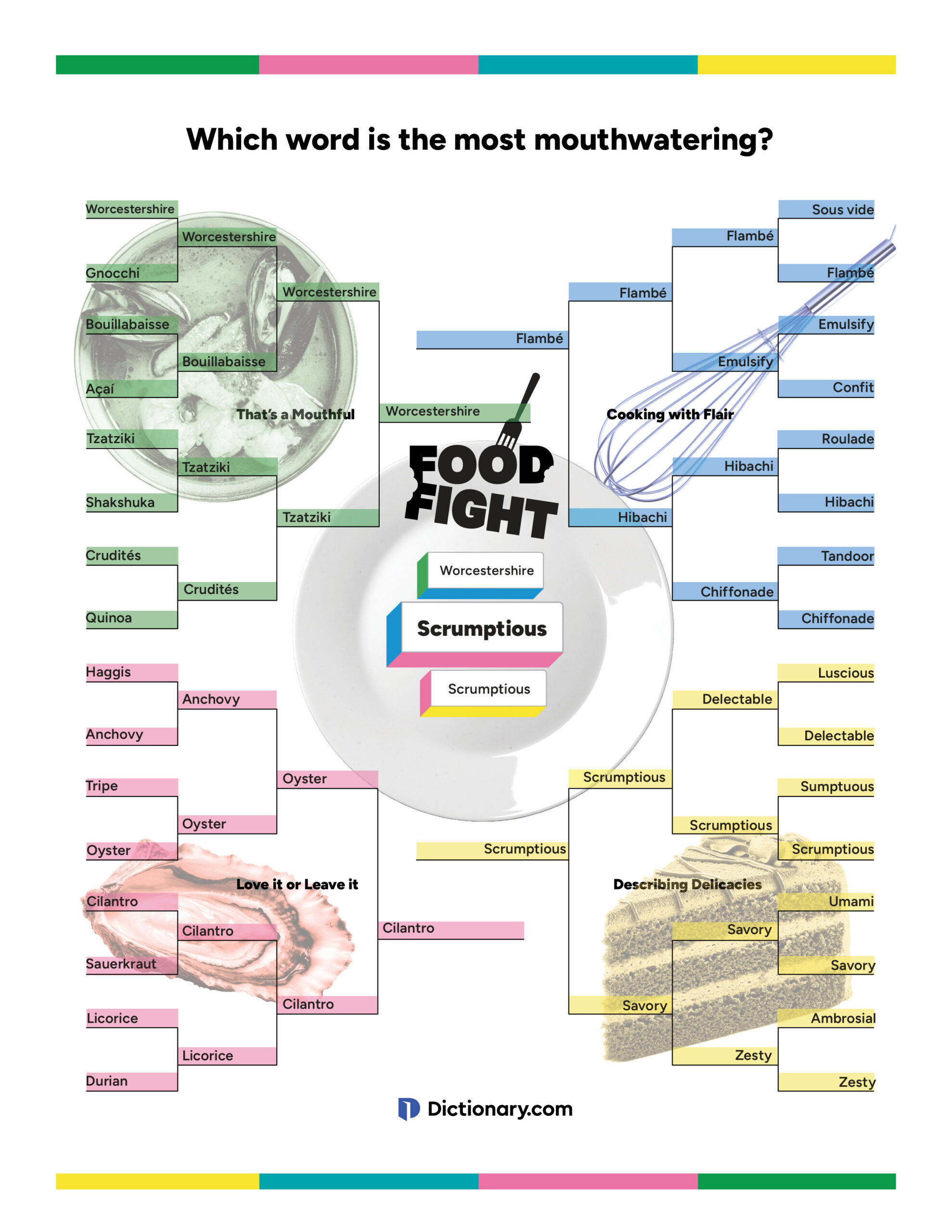
The bracket is set and it’s time for the ultimate Dictionary.com Food Fight! This bracket season, words go head-to-head in a showdown of flavor. Our four divisions include That’s a Mouthful, Cooking with Flair, Love it or Leave It, and Describing Delicacies.
Which word makes your mouth water instantly and which makes your nose wrinkle and call for a timeout? Trust your cravings and vote for the word that wins your appetite. Let the chomping, crunching, and champion-crowning begin!
Winner
Scrumptious
The votes are in, the plates are cleared, and we have our winning word. After a week of sizzling showdowns and mouthwatering matchups, scrumptious has claimed the crown—besting Worcestershire with a decisive 71% of the vote in the final round.
It was a tournament of bold flavors, tricky pronunciations, and delicious debate but in the end voters couldn’t resist a word that simply sounds as good as food tastes. From the opening round to the championship bite, scrumptious proved it had the flavor to go all the way.
Thank you to everyone who followed along, cast their votes, and fueled this year’s Food Fight! Until next time, keep those taste buds (and vocabularies) hungry.
SCOUTING REPORTS
Finals
That’s a Mouthful vs. Describing Delicacies
Worcestershire vs. Scrumptious
The championship plate is set. Worcestershire carved out its spot in the finals after slipping past cilantro with 56% of the vote, proving that a bold, savory staple can hold its own in any matchup. Across the kitchen, scrumptious squeaked by flambé with 55.9%, winning voters over with its irresistible appeal.
Now it’s the ultimate flavor face-off: a tangy condiment versus a word that simply sounds delicious. Will Worcestershire bring the seasoning or will scrumptious steal the spotlight? The final bite belongs to you. Which word makes your mouth water?
Winner: Scrumptious (71.2% of votes)
Round of 4
That’s a Mouthful vs. Cooking with Flair
Worcestershire vs. Flambé
After burning the competition against hibachi, flambé now faces the heavyweight Worcestershire. Flambé is this tournament’s biggest showman, but can its flash overcome the defensive wall in Worcestershire, which just shut down tzatziki’s creamy consistency?
Winner: Worcestershire (56.5% of votes)
Love It or Leave It vs. Describing Delicacies
Cilantro vs. Scrumptious
Fresh off an upset over oyster, cilantro takes on scrumptious, a fan favorite that outlasted savory. Cilantro relies on the sharp, polarizing speed to cut through the noise but we’ll see if that’s enough to score over the pure flavor of scrumptious.
Winner: Scrumptious (55.9% of votes)
Round of 8
That’s a Mouthful
Worcestershire splashed ahead of bouillabaisse by a mere 13 votes to face tzatziki, which dipped past crudites by a whopping 69 votes. Will Worcestershire keep shaking things up or will tzatziki spread its way into the final four?
Winner: Worcestershire (65% of votes)
Love It or Leave It
Oyster shucked its way into the next round with plenty of support but can it take on cilantro, a leafy herb that people either love or really love to argue about?
Winner: Cilantro (55.2% of votes)
Cooking with Flair
Talk about a fiery matchup! Flambé torched emulsify in the last round with a commanding 69% of the votes. But the flames aren’t dying down yet because hibachi is bringing the sizzle after grilling chiffondade.
Winner: Flambé (57.7% of votes)
Describing Delicacies
Scrumptious vs. Savory
When it comes to describing delicious food, things are getting serious. Scrumptious delighted voters over delectable but savory brings serious seasoned flavor to the table. Which s-word sounds more satisfying?
Winner: Scrumptious (54.9% of votes)
Round of 16
That’s a Mouthful
| Worcestershire vs. Bouillabaisse
Worcestershire sauced its way to victory, slipping past gnocchi by just 28 votes. Not bad for a word most people still aren’t sure how to pronounce. Bouillabaisse made waves against açaí, simmering up a decisive win with 62.1% of voters spooning their support into the French seafood stew. Winner: Worcestershire (52.1% of votes) |
Tzatziki vs. Crudités
Tzatziki doused shakshuka’s heat while crudités snapped past quinoa. Now will the creamy cucumber dip overtake a crispy vegetable crunch or will crudités keep munching its way up the bracket? Winner: Tzatziki (61.3% of votes) |
Love It or Leave It
| Anchovy vs. Oyster
The ocean is calling! Anchovy swam past its first-round challenger with salty confidence but now it’s diving headfirst against oyster, the briny mollusk that slurped up plenty of support. Small fish, meet shellfish. Winner: Oyster (57.2% of votes) |
Cilantro vs. Licorice
Two very polarizing flavors, one face-off. Licorice has its fans but can it outlast cilantro’s herby appeal? Winner: Cilantro (59.3% of votes) |
Cooking with Flair
| Flambé vs. Emulsify
Things got flashy in the kitchen when flambé torched sous vide in the first round. But now it meets its match in emulsify, which whisked past confit with a razor-thin 51.6% victory. Can the sheer force of emulsion beat out the pyrotechnics? Winner: Flambé (69.1% of votes) |
Hibachi vs. Chiffonade
Dinner and a show proved hard to beat when hibachi stepped up to the grill, sizzling past roulade with 60.8% of the votes, while chiffonade delicately sliced past tandoor with 52.8%. Sounds like the battle between David and Goliath but can the underdog prevail? Winner: Hibachi (62.5% of votes) |
Describing Delicacies
| Delectable vs. Scrumptious
Delectable made its first-round opponent look…less than appetizing. But now it faces scrumptious, a word that practically begs for another bite. Which word would you rather have a second-helping of? Winner: Scrumptious (56.4% of votes) |
Savory vs. Zesty
Savory powered through its opener with classic comfort appeal, while zesty zipped ahead with bright, citrusy energy. Rich depth vs. lively zing, which flavor word will spice up the next round? Winner: Savory (64% of votes) |
Round of 32
That’s a Mouthful
| Worcestershire vs. Gnocchi
Worcestershire (say it with confidence) is a bold and sharp sauce that adds a depth of flavor to marinades, gravies, and even a Bloody Mary. Gnocchi, on the other hand, are soft, pillowy Italian dumplings made from potatoes. Are you voting for the tongue-twisting drizzle or the forkful of comfort? Winner: Worcestershire (52.4% of votes) |
Bouillabaisse vs. Açaí
Bouillabaisse is a rich French seafood stew, brimming with fish, shellfish, and herbs. Açaí is a deep purple berry from South America, famously used in smoothie bowls piled high with fruit and granola. Are you going for seafood soup or superfruit sweetness? Winner: Bouillabaisse (62.1% of votes) |
| Tzatziki vs. Shakshuka
This matchup brings the Mediterranean heat. Tzatziki is a cool, creamy yogurt sauce mixed with cucumber, garlic, and herbs that pairs well with grilled meats, pita bread, and raw vegetables. Shakshuka is a sizzling skillet of eggs poached in tomato sauce, perfect for crusty bread scooping. Winner: Tzatziki (62.3% of votes) |
Crudités vs. Quinoa
A fancy French term for a platter of raw, sliced vegetables, crudités are perfect for dipping and snacking. Then we have high-fiber protein powerhouse quinoa, an Andean seed often mistaken for a grain, the ultimate utility player for salads and bowls. Winner: Crudités (55.6% of votes) |
Love It or Leave It
| Haggis vs. Anchovy
Haggis, Scotland’s savory powerhouse of minced sheep offal, oatmeal, and spices boiled in a sheep’s stomach, takes on the salty underdog anchovy. Anchovies are tiny fish that’s often tinned or made into a paste and a fundamental ingredient in Caesar salad dressing. Winner: Anchovy (59.8% of votes) |
Tripe vs. Oyster
Tripe, the edible lining of a cow’s stomach known for its distinct honeycomb texture that is beloved in hearty stews around the word, goes head-to-head with oyster, a briny bivalve mollusk. Often slurped raw, oysters bring a chilled, slippery burst of mineral flavor. Both are salty and savory but which will win your stomach? Winner: Oyster (71.5% of votes) |
| Cilantro vs. Sauerkraut
“The Herby Highlight” faces “The Fermented Finisher” in this match-up. Cilantro are the pungent leaves of the coriander plant, to flavor or garnish various dishes. Depending on your genetic traits, people find it either refreshing or soapy. Sauerkraut is finely shredded cabbage that’s been fermented by lactic acid, a sour probiotic powerhouse with a long shelf life. Winner: Cilantro (57.1% of votes) |
Licorice vs. Durian
Licorice is a root-derived confection known for its polarizing, bitter, medicinal anise flavor. It takes on durian, a spiky Southeast Asian fruit famous for its custardy texture and notoriously pungent aroma. Brace yourself for this daring duel! Winner: Licorice (63.5% of votes) |
Cooking with Flair
| Sous Vide vs. Flambé
Here we have fire vs. water, in a battle of the elements. Sous vide is a slow and steady cooking method where food is vacuum-sealed and submerged in a low-temperature bath. Flambé is all drama, igniting alcohol in a pan to create a burst of flames and caramelized flavor. Winner: Flambé (73% of votes) |
Emulsify vs. Confit
To emulsify is to whisk two liquids, like oil and vinegar, into a sauce (hello, may and vinaigrettes)! Confit is a slow method of cooking food in fat or syrup until it’s tender, such as duck legs that practically fall apart. Winner: Emulsify (51.6% of votes) |
| Roulade vs. Hibachi
A roulade is a sophisticated technique of rolling meat or pastry around a savory or sweet filling, think a flank steak packed with mushrooms or a sweet Swiss roll. It faces off hibachi, a Japanese grilling style where chefs chop, flip, and flame your meal right before your eyes. Winner: Hibachi (60.8% of votes) |
Tandoor vs. Chiffonade
A blazing-hot clay oven, a tandoor is used to char meats and blister flatbreads, such as naan. It matches up against chiffonade, the delicate technique of stacking, rolling, and slicing leafy herbs into long ribbon-like stripes. Are you voting for bold heat or elegant detail? Winner: Chiffonade (52.8% of votes) |
Describing Delicacies
| Luscious vs. Delectable
Luscious just oozes indulgence, an adjective describing something richly sweet, juicy, and intensely pleasing to the senses. Ripe peaches and melty chocolate, the kind of bite that makes you close your eyes. Delectable is a little more refined, the polite but confident way to say “wow, that’s really good.” Winner: Delectable (50.7% of votes) |
Sumptuous vs. Scrumptious
Sumptuous sweeps in with velvet curtains and candlelight, an adjective to describe a rich and decadent feast. Scrumptious can be used to describe food that is lick-your-fingers lip-smacking good. Both are fun to say but only one can advance. Winner: Scrumptious (72.7% of votes) |
| Umami vs. Savory
Umami is one of the five basic tastes, a deep meaty, mushroomy flavor that takes broths and stir-fry to the next level. Savory describes food that is salty or spicy, rather than sweet. One sounds very chef-y while the other feels like home cooking. Winner: Savory (58.7% of votes) |
Ambrosial vs. Zesty
Ambrosial floats in on a cloud. It’s a word derived from “ambrosia,” the food of the gods that means exceptionally divine. Zesty is more earthbound, describing a piquant and citrusy flavor, waking up your palate with a lively kick. Are you voting for dreamy and decadent or something bright and bold? Winner: Zesty (56.8% of votes) |
